

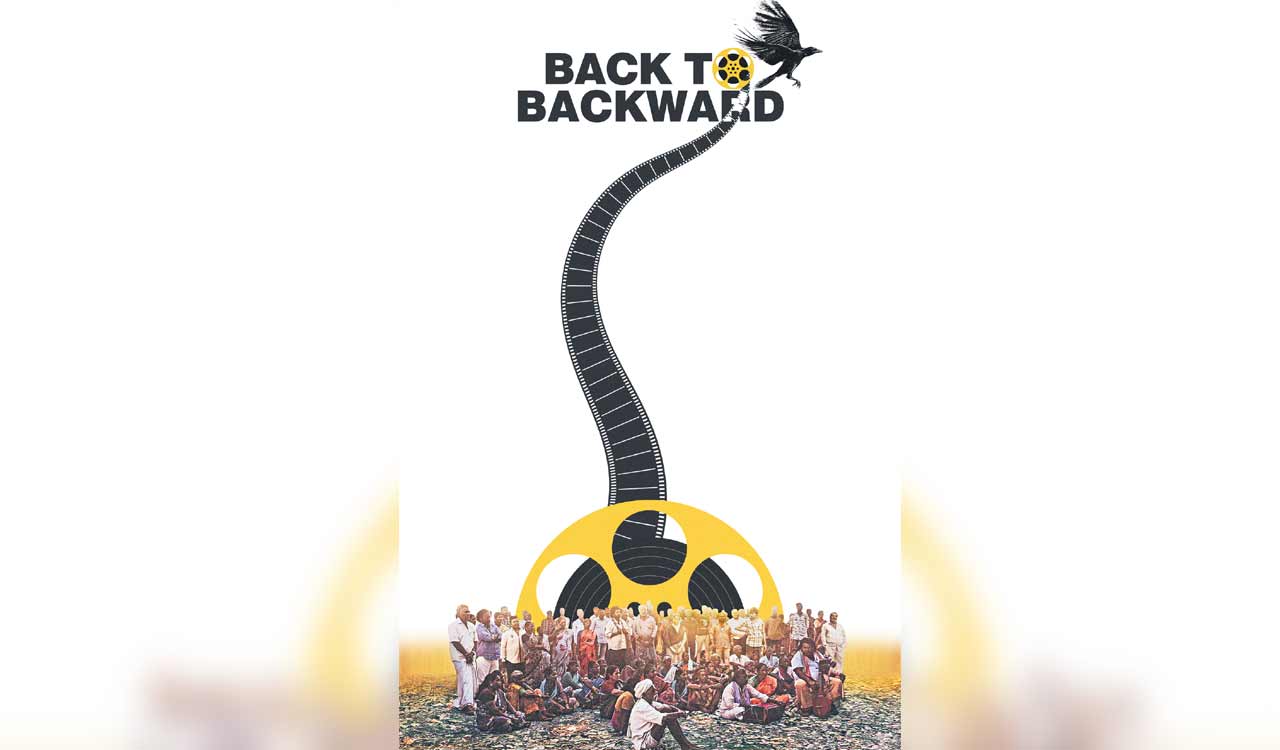
There is a need to challenge popular discourse and redefine notions of good and “tidy” movies
Posted on – Sunday, 04/06/23 at 12:45pm

Illustration: Guru G.
By YL Srinivas
Hyderabad: The media and film are powerful institutions capable of influencing perceptions at the societal and individual levels, affecting attitudes and beliefs, and thus behavior. News, television, movies, and other social media play an important role in providing experiences that go beyond the confines of everyday human interaction. However, when media messages include stereotypes, they become problematic because they perpetuate very dangerous attitudes.
Many times people are swayed by this popular discourse supported by mass media and tend to endorse what is being peddled without any critical scrutiny of the narrative. This has caused certain views and ideas to become hysterical, deeply affecting the perception of the broad masses of the people. Movies in particular are guilty of perpetuating stereotypes and dangerous beliefs, masquerading as entertaining or harrowing narratives, leading them to be called “good” movies. Therefore, counter-discourse needs to be built, whether it is heard or not.
Sensation and Euphoria
The film Happy Days (2007) by renowned filmmaker Shekar Kammula is an example of this phenomenon. The movie was a hit, and reviews thought it was a clean, good movie, but this one had the cheek to romanticize teenage love, giving the impression of young people going off to engineering school to fall in love. On the crucial subject of raghavan, the film should actually be prosecuted for violating the recommendations/norms of the Raghavan committee appointed by the Supreme Court. However, this movie is both a good movie and a clean one.
Sixteen years later, we see a similar pattern of audience perception and euphoria in the film “Balagam”. There were no big stars or power stars; no Oscar-worthy director, and yet the film was a huge success. Shot in the rural interior of Telangana, the theme evokes everyday life in a Telangana village, while the action scenes, reminiscent of a character in an arthouse film, certainly provide viewers with a sense of humor. A whole new experience. Tired of masala movies off the beaten track. However, a critical analysis of this film reveals the dangers of sanctioning such films as “good”.
• Films that promote superstitious beliefs and do not properly reflect changes in rural society cannot be called good films
The point is not whether the film should be didactic and moral. It doesn’t have to be. However, if a film is glorified beyond a good film, then the clear message of the film will have a profound effect in influencing people’s behavior and perpetuating stereotypes and superstitious beliefs, so it is necessary to challenge Popular discussion and problematization of the concepts of good movies and “tidy” movies.
“Balagam” can be a smart movie that entertains the audience, but anything that entertains the audience doesn’t have to be classified as a good movie. The film uses superstition as part of the story, but worryingly, it leaves behind the threat that the family of the deceased face expulsion from the village if the crows do not touch the offerings made as part of the funeral ritual/ceremony The risks, this is a very serious and dire proposition, unimaginable even.
serious contradiction
Let’s start with the title of the movie “Balagam”. Where the title of the song is introduced, “Balagam” is about living in harmony with the village’s ecosystem, people, flora and fauna. By the end of the film, however, the semantics of the title are reduced to a display of mutual care among siblings and other members of the family. A smiling family photo was shown, while family members displayed camaraderie and seemed blind to the hatred they had just buried.
• Narratives that substantially blur the line between reality and fiction can easily lead viewers to believe far-fetched claims
This may seem too academic, but it’s important to position this contradiction as a prelude to highlighting other serious and harmful contradictions. The story is filled with many situations and dialogues that are either romanticized or exaggerated to the absurd. The protagonist, Koaraiah, is a paradox – on the one hand, he is a responsible farmer and head of the family, beloved by the villagers, a role model for those around him, and has a deep connection with nature and the village; Considered a flirt who doesn’t respect boundaries. For example, at the beginning, he wandered around the village, met a little girl, and asked her why she worked so late: “Is your husband not letting you sleep now?”
The woman replied that her husband had been away for the past three days. Komaraiah then asked her why she hadn’t informed him when her husband was away, which was obvious. Consider the woman’s response, which was part persuasion, part condescension. She said, if she told him, would he jump over the fence of the compound like a little boy? Implicit. It gives the impression that crossing the compound for obvious purposes is common in villages. However, all of these plots can be glossed over in order to keep the gray characters real.
But the story itself is woven around family rituals, folk traditions, and ego conflicts within the family. The son-in-law didn’t eat the sheep bones that chewed the marrow, which became the fuse of the family’s 20-year estrangement. Komaraiah scolds husbands for not being able to control their wives, which can be attributed to the dominant patriarchal culture, and the Indian village is no exception.
• The movie “Happy Days” (2007) was a hit, and critics thought it was a good movie, but this one has the audacity to romanticize the rags
Then, due to Komaraiah’s death, Sailu’s engagement to a girl is broken because an older lady believes that the girl’s fate is responsible for the family’s misfortune. The old lady says, “Goddu vochina vela bidda vochinna vela antaru” (the time when the buffalo comes and the time when the girl comes), which directly attributes Komaraiah’s death to the girl’s participation through the offer. Thus, the fate of the stigmatized girl is irrelevant in the story—whether or not she carries the burden of being a star-crossed girl her whole life. While these stereotypes and patriarchal notions are not uncommon, this blatant portrayal is sure to validate and further perpetuate the attitude among viewers.
problematic subject
But a more important point is the theme of the movie. Crows eating sacrificial offerings are at the heart of the story. On the third day of the ceremony, the crow does not touch the offering. The scene is also repeated on the fifth day. Although the son-in-law offered sumptuous meals and foreign drinks to make the sacrifice attractive, the crow did not appear. In the debates that followed these rituals, eating crow sacrifices also absurdly became a test of one’s manhood and a family’s honor.
After the fifth day’s ritual clearly fails, the story takes a pernicious and dangerous turn. While carrying out the set agenda, the protagonist hatches a conspiracy with his friends. A rumor spread like wildfire that disgruntled spirits of Komaraiah were wandering the village and actually caught several people so they were facing problems. There are three different reasons for the three villagers’ ailments, but the real causes are all suppressed to a certain degree, giving reason to believe that their illnesses are caused by the village being haunted by the unfortunate spirit of Komaraiah.
The village committee held a meeting to discuss the matter. The resolution of the village council has been communicated to Komaraiah’s family. If the crow does not touch the offering on the 11th day, the family is expelled from the village or banished from the village – a twist that defies all common sense.
• “Balagam” is not just an attempt to perpetuate superstitions, but an attempt to give one superstition over the others
Eating offerings by crows or any other birds is a widespread belief in much of South India and is not disputed. But villages in Telangana, like towns and villages elsewhere, are moving forward. Offerings are made by family members in areas conducive to bird feeding. Some families leave it in ponds in the hope that aquatic life will eat it. Gone are the days when people waited indefinitely for crows or birds to come and taste their offerings.
But ‘Balagam’ did not allow this reform to continue. There’s an episode in the movie where we have an authority figure assert that only crows, and only crows, should eat sacrifices because only they have the ability to communicate with the spirits of the dead – thus ruling out all other options.
So the movie not only tries to perpetuate superstitions, but tries to make one superstition trump the others. If a family’s sacrifice is not eaten by crows on the appointed day, the fate of the family rests in the hands of the village committee. From caste hierarchies to community polarization, from access to temples to drinking from wells, “Balagam” added ritual offerings of eating crows or not eating crows to control the redemption of the bottom section by the dominant group in the village.
selective perception
While many may argue that the film has its merits – family unity, overcoming family conflicts, emphasis on rural lifestyles, etc., the truth is that the average moviegoer – especially those from rural areas – will watch Yan value rather than being able to discern social right and wrong in movies. Additionally, communities that have adjusted to superstitious beliefs will find the film to ease the cognitive dissonance they experience in keeping up with the changing science and modern thinking of the times.
Selective perception and reservation is another danger – whether people see the good in the film or not, they will selectively keep what is good for them, especially superstitious customs, and the anomalous powers given to “village councils” to interfere The internal affairs of a family determine their fate. The region of Telangana, where the film was filmed and where it was widely screened, has a culture of village development committees, which wield far more power than village-elected representatives.
• It is time we understand that culture and tradition cannot be equated with superstition
Returning to the question of what makes a good movie and its characteristics, it’s important to realize that these are highly subjective propositions that fit into the framework. When everyone starts praising a film, the film’s subtle message has far-reaching consequences. It is high time we understand that culture and tradition cannot be equated with superstition.
While imagination and fantasy are integral to most films, narratives that essentially blur the line between reality and fiction can easily lead audiences to believe far-fetched claims. Sure, a movie that promotes superstition, a movie that tries to take us back to the Middle Ages, a movie that doesn’t properly reflect the changing sociology of the village, a movie that doesn’t document the progress the village has made due to education and modernization, Can’t be called a good movie. This movie might entertain you, but that’s not and never was the parameter of a good movie.
If we’re still calling this movie a good movie, we might be endorsing a new kind of exile and a new tool of family communication.
(The author is Professor of English and Vice-Chancellor at Aurora University, Hyderabad)
