

Published: Post Date – 12:45 AM, Sunday – November 13

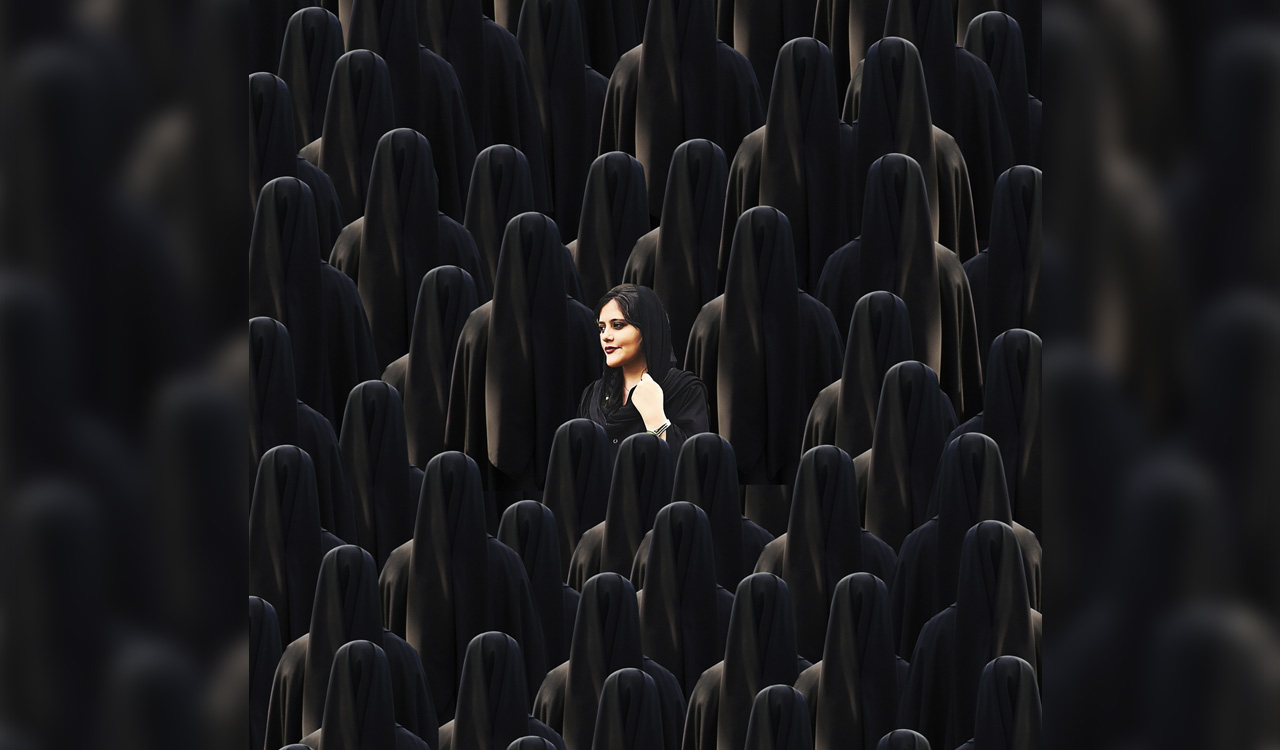
A new wave of protests in Iran, led by Generation Z, is raging at the core of the cleric-led national identity — the mandatory veil — and is unlikely to go away.
The anti-regime protests that rocked Iran for more than a month now mark one of the biggest challenges the country’s civilian rulers have faced since the Islamic Revolution seized power in 1979. The “Women, Life, Freedom” movement showed no signs of tapering off after 22-year-old Kurdish woman Mahsa Amini was detained by Tehran’s “morality police” for wearing a hijab that was too loose on September 16.
The protests first erupted at Amini’s funeral, which was held in her hometown of Sarquez in the Kurdish region. Crowds of young women soon flooded the streets, twirling hijabs and cutting off their hair in midair, chanting “death to the dictator” and targeting Iran’s supreme leader, Ayatollah Ali Khamenei. Human rights groups say more than 300 protesters have been killed and thousands arrested since the unrest began, including numerous journalists and children. Protests have spread to more than 133 Iranian cities and 129 universities and several secondary schools.
Around the world, 80,000 people marched in Berlin on October 22, waving Iranian flags and holding signs reading “Women, Life, Freedom”. Iranians traveled from across the US, Canada and the European Union to attend. The Berlin march was the largest ever demonstration of Iranians abroad against the Islamic Republic. Similar scenes have emerged on the streets of Washington, Australia and Japan, among other places.
rebel against dictators
Zahedan, the capital of impoverished Sistan-Baluchistan province on the border with Pakistan, has become a flashpoint for protests. According to Amnesty International, at least 66 people were killed in what is now known as “Bloody Friday” in Zahedan on September 30, when security forces cracked down on protesters, worshipers and bystanders after Friday prayers outside the city’s main mosque. By.
Young people, including university students in Tehran, Isfahan and other major cities, took part in demonstrations despite warnings from security forces. They are even fighting back against the Basij (Mobilization of the Oppressed), founded by Ayatollah Ruhollah Khomeini shortly after the 1979 Islamic Revolution, to Islamize Iranian society and fight internal enemies.
Restrictions were imposed on the internet, including Instagram, LinkedIn and WhatsApp, to prevent protesters from organizing and sharing videos with the outside world. Only short videos have found their way, including those of security forces shooting protesters and women defiantly cutting off their hair and burning their hijabs.
Major General Mohammad Bagheri, the chief of staff of the Iranian Armed Forces, acknowledged that the traditional methods of the past and repeated and ineffective actions are not the solution. “Indeed, we face a mix of threats today. Military, security and cultural threats are constantly emerging, sometimes unknown at the same time, and in an orchestrated combination by the enemy. We must prepare for such battles and confrontations.”
Unlike past protests that were largely economic and political, this new wave of protests shows anger at a core element of Iran’s cleric-led national identity: the mandatory veil. It has no leader and is led by Generation Z, who even has the support of minorities and workers in Iran’s vital oil industry.
under cover
On March 7, 1979, Khomeini announced that all women must wear the hijab, overturning a ban enacted by army officer-turned-king Reza Shah Pahlavi on January 8, 1936 The decree “kashf-e hejab” of traditional Islamic veil and scarf. The very next day – International Women’s Day – tens of thousands of naked women took to the streets in protest. Since April 1983, all Iranian women have been required to wear the hijab. Legal measures and social restrictions were enforced and criminal penalties were imposed on offenders in the 1990s. It can range from imprisonment to fines.
Many people, especially in big cities and younger generations, violate the dress code. “While the current uprising appears to be new, it follows decades of women’s resistance. The feminist movement in Iran can be traced back to the women who took part in the Constitutional Revolution in 1906. Women played a key role, and through the establishment of women’s associations , taking part in protests and supporting strikes. A month after the 1979 Islamic Revolution, Iranian women staged mass demonstrations after hearing rumors of compulsory wearing of the hijab. Although these protests delayed the mandate, It finally went into effect in 1983,” said Niloofar Hooman, a doctoral student in communication studies and media arts at McMaster University in conversation.
In 2018, the regime became somewhat weak. A new decree does not fine or imprison women in Tehran for not following the dress code. Instead, they must take Islamic education courses. The “morality police” or Gasht-e-Ershad is a unit of the Iranian police force tasked with enforcing laws regarding Islamic dress codes in public. They usually escort women to police cars and then go to class. The new order applies only to the capital, Tehran, but even there, women who repeatedly violate the dress code could still be subject to legal action.
Iranian society has struggled to give women the right to choose their clothes and veils since the mid-19th century, when poet and religious scholar Tahereh dramatically appeared before a group of men in 1848, said Iranian scholar and professor Farzaneh Milani. Department of Gender Studies, University of Virginia. A few years after her unveiling, public authorities executed Tahereh. “Iran’s history and recent events leave us in no doubt. The desire of women to choose freely cannot be stifled or suppressed,” Milani stressed.
Political reforms launched by then-President Mohammad Khatami in 1997 were resisted by hardliners. Later, centrist President Hassan Rouhani pledged under a nuclear deal his government signed with world powers in 2015 for a more functioning economy. The deal, aimed at reducing Tehran’s nuclear ambitions, collapsed in 2018. new low.
International pressure, economic downturn
The Biden administration has imposed sanctions on Iranian officials for deadly crackdowns and the delivery of drones and technical assistance to Russia’s war on Ukraine. The U.S. also ordered military strikes against Iranian-backed militias in Syria in August in response to attacks on U.S. forces in the region.
Canada also announced new sanctions targeting Iranian police and judicial officials, while German Chancellor Olaf Scholz said the European Union was considering reimposing sanctions on Iran because of his concerns over “people who peacefully demonstrate during protests in Iran are dying” Shocked.
Ayatollah Ali Khamenei blamed the unrest on external actors, including the United States, Israel and Saudi Arabia. The hostility toward the US began with the US-backed 1953 coup that consolidated the Shah’s rule. For Washington, the 1979 U.S. embassy hostage crisis stoked hostility toward Iran. This mutual distrust persists to this day.
The public is also frustrated as inflation hits 42.1% and youth unemployment stands at 23%.according to a Financial Times According to the report, the last national census six years ago showed that people aged 10 to 24 accounted for about 22 per cent of the 80 million population. An increasingly educated population (including women accounting for 60 percent of university degrees), fast-paced urban development and wider use of the internet and smartphones have all raised public expectations.
The value of the currency plummeted from 32,000 riyals to 1 dollar in 2015 to 3,15,000 riyals to 1 dollar in 2022. A growing number of Iranian youths are looking abroad for new means of earning a living, no matter the cost. Those who stayed struggled to make ends meet.
leadership battle
At home, the leadership struggle could shift Iran’s attention further inward. Khamenei, 83, has no designated successor, but some analysts believe his son Mojtaba Khamenei may be considered. The Revolutionary Guard, answerable only to the supreme leader, grew stronger.
Hardliners also see Iran’s territorial integrity at risk, including ethnic groups such as Arabs, Kurds, Baluchi, Turks and Sunni Muslims. Both the Theocracy and the Guard have economic and political incentives to maintain the status quo.
But a crack appeared to appear as senior officials called for clemency. Ali Larijani, Speaker of the Iranian Parliament, warned: “The hijab has a cultural solution that does not require a decree and a referendum. … Do not doubt that when a cultural phenomenon becomes common, A strict reaction to it is not the cure. The people and young people who take to the streets are our own children. In a family, if a child commits a crime, they try to guide him to the right path, society needs more Much tolerance,” he stressed.
Perhaps these protests could also fail like previous ones. But for now, with no other avenue, mass protests continue. History may not repeat itself, but it does rhyme a lot.
past protests
1979 Islamic Revolution
• Deaths: estimated at more than 2,000 to 3,000
• Detained: thousands
• Flashpoints: Social Injustice, Political Oppression, Corruption and Religious Motives
• Location and scope: Protests spread to nearly every major city, with millions
The Islamic Revolution of 1979 began with widespread mass protests that eventually forced the ouster of a Western-backed monarchy. But amid the resulting chaos, hardline followers of Ayatollah Ruhollah Khomeini quickly turned to sideline leftist and moderate opposition groups, forcing many Iranians to jail or exile and laying the groundwork for civilian rule. established a solid foundation.
2009 Green Campaign
• Deaths: at least 100
• Detained: at least 4,000
• Flashpoint: Election Fraud and Corruption
• Location and scope: Millions of people participated in protests in at least 10 major cities
The summer of 2009 erupted in the largest and longest-running protests since the Islamic Revolution, when the reformist opposition challenged the re-election of hard-line President Mahmoud Ahmadinejad. The Green Movement takes its name from a green belt given to Iran’s last prime minister, Mir Hussain Mousavi, by Iran’s two-term president, Mohammad Khatami, and the reform movement’s first standard bearer, Mohammad Khatami. Neda Agha Soltan, a 27-year-old woman, has become a symbol of the protest movement after she was shot and bled to death in a video viewed by millions on social media.
2019 Price Increases
• Deaths: at least 304
• Detained: at least 7,000
• Flashpoint: fuel prices
• Location and scope: Protests spread to at least 100 towns and more than 200,000 people
In a surprise overnight announcement on November 15, 2019, Iran raised natural gas prices by 300% and introduced a new rationing system. The government’s goal was to raise funds to help the poor, but it backfired.
resource: iranprimer.usip.org
(according to agency opinion)
