

Scientists find ice grains on Saturn’s moon Enceladus rich in minerals and organic compounds
Posted Date – 12:15 AM, Fri – 16 June 23
Washington: Scientists have discovered that ice grains on Saturn’s moon Enceladus are rich in minerals and organic compounds — including the amino acid components associated with life.
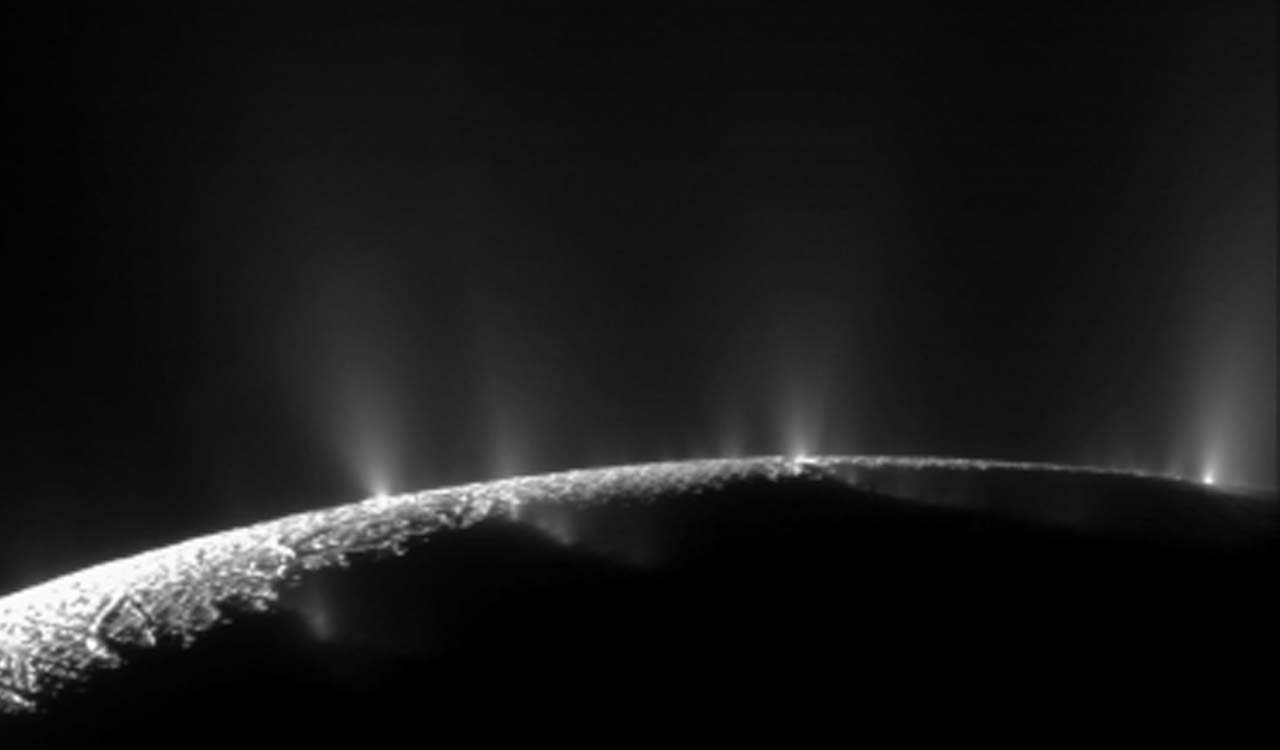
From 2004 to 2017, the Cassini spacecraft explored Saturn, its ring system and moon system for more than 13 years, discovering subsurface liquid water on Enceladus. They analyzed samples from the mass of ice particles and gas ejected into space from cracks in the moon’s icy surface.
Data from Cassini’s cosmic dust analyzer showed the presence of sodium phosphate, suggesting phosphorus readily exists as phosphate in Enceladus’ ocean.
Phosphorus is the least abundant element among the essential elements necessary for biological processes and has not been discovered until now. This element is the building block of DNA, which forms chromosomes and carries genetic information, and is found in mammalian bones, cell membranes, and marine plankton.
Phosphorus is also a fundamental building block of energy-carrying molecules in all life on Earth. Life is impossible without it.
“We found that the phosphate concentrations in the lunar plume-forming seawater are at least 100 times higher than in Earth’s oceans,” said Dr. Christopher Glein, a planetary scientist and geochemist at the Southwest Research Institute (SwRI) in Texas.
Previous analyzes of Enceladus ice grains have revealed concentrations of sodium, potassium, chlorine and carbonate-containing compounds, and computer models suggest that the subsurface ocean has a moderate alkalinity—all factors that favor habitable conditions.
“High phosphate concentrations are the result of the interaction of carbonate-rich liquid water with rocky minerals on the seafloor of Enceladus, and likely occur on many other ocean worlds as well,” Glein said.
“This key component may be abundant enough to support life in Enceladus’ ocean; a surprising discovery for astrobiology,” he added.
While the science team is excited that Enceladus holds the building blocks of life, Glein stresses that no life has been found on the moon or anywhere else in the solar system other than Earth.
“Having these components is necessary, but they may not be sufficient for an alien environment to host life. Whether life originated in Enceladus’ ocean remains an open question.”
The Cassini-Huygens mission is a cooperative project of NASA, ESA (European Space Agency) and the Italian Space Agency. Cassini’s mission ended in 2017, with the spacecraft burning up in Saturn’s atmosphere, but the vast amount of data it collected will continue to be a rich resource for decades to come.
