

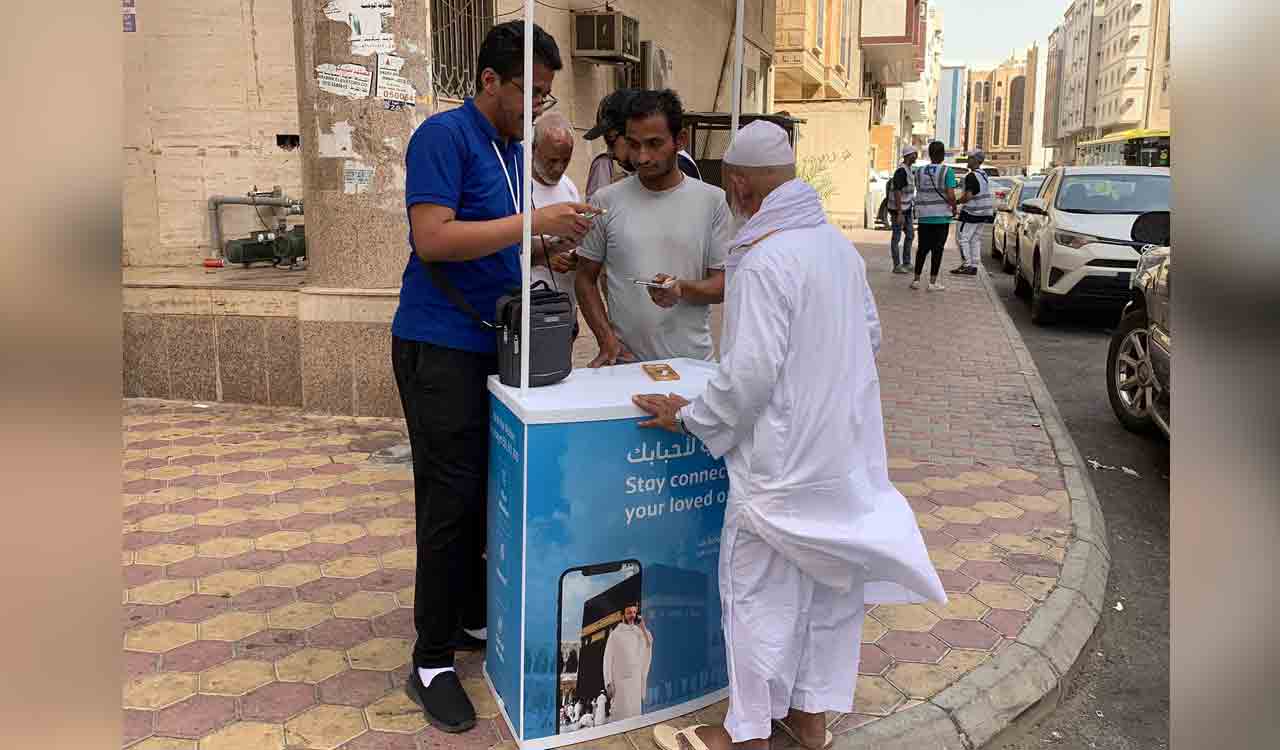
Indian pilgrims face difficulty communicating with family back home due to inactive Saudi SIM cards.
Posted on – Thu 22 Jun 23 at 03:27pm

Jeddah: Some Indian pilgrims are having difficulty communicating with their families back home because their Saudi SIM cards are not activated.
Iqbal, 66, of Karim Nagar was terrified as he raced from a top hospital in the holy city of Mecca to relay the deteriorating health of his wife Shahin Sultana to his family in India. Hometown family. However, he had to communicate alone with his relatives in Saudi Arabia and had to stay home for a long time until an acquaintance helped him open the phone on Wednesday.
His case illustrates the trauma experienced by Pilgrims without a SIM card.
The Hajj Council of India provided pilgrims with prepaid SIM cards issued by various Saudi telecommunications service providers. However, the Indian pilgrimage authorities failed to explain the procedure for activating these SIM cards to pilgrims arriving in Saudi Arabia at the boarding point.
According to CITC rules, any SIM card in Saudi Arabia can be activated after biometric verification of the end user profile. Also, users need to top up their SIM card to use it for voice calls or data according to their needs. Leading telecom service providers offer various plans ranging from SR.35 to SR.173 with varying airtime and data from 5 GB to 40 GB.
Many Indian pilgrims believe that since the SIM cards are provided by the Hajj committee, they can use them for free upon entering the holy site, as they are unaware of the mandatory biometric registration and top-up procedures. At the time, telecom service providers set up hundreds of kiosks near pilgrim buildings in Aziziah and other parts of Mecca to complete biometrics and sell top-up cards.
During last year’s Hajj, pilgrims consumed 36,000 megabytes, the equivalent of streaming 14.83 million hours of 1080p high-definition video clips, through Mecca’s telecommunications network. The average daily consumption per user was 851.13 megabytes, more than three times the world average of approximately 200 megabytes per user.
