

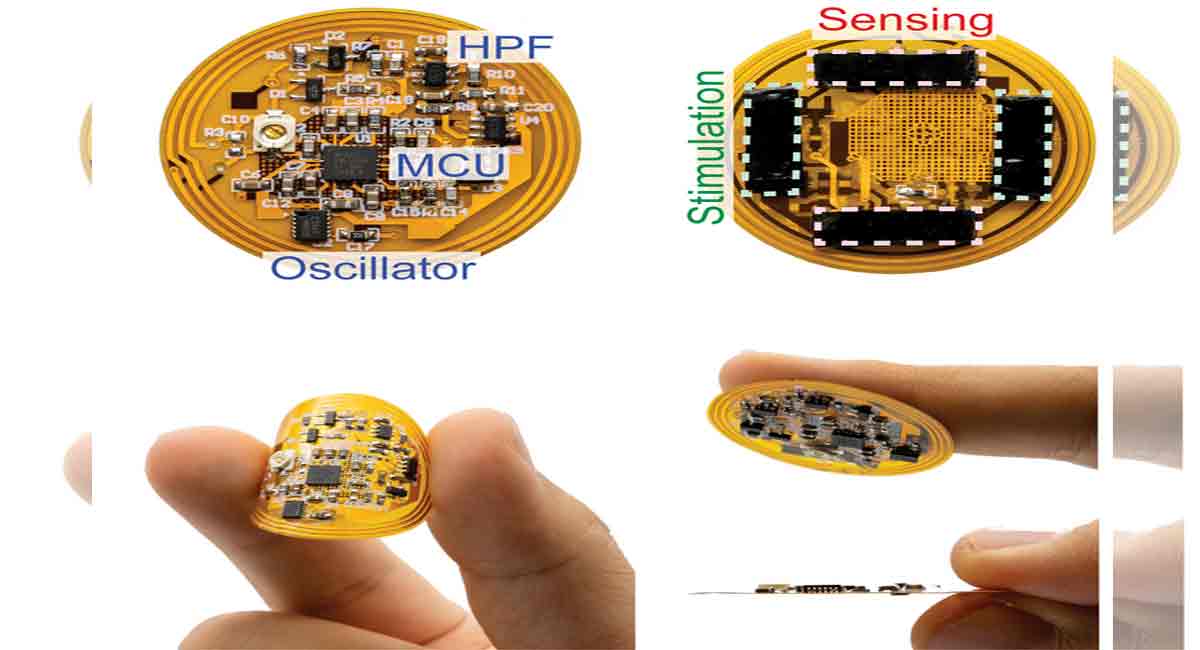
Scientists at Stanford University have developed a new wireless bandage that can speed up the wound healing process through a real-time monitoring system.
Updated: Sat 11/26/22 at 02:39pm

Source: Jian-Cheng Lai, Bao Research Group @Stanford University.
Hyderabad: We speed up the healing process by dressing small cuts and bruises with bandages, but some cuts or injuries, especially chronic wounds, take time to heal. Sometimes, an infected wound can lead to amputation and be life-threatening.
Scientists at Stanford University have developed a new wireless bandage that can speed up the healing process with a real-time monitoring system.
The bandage is an integration of biosensors, high-pass filter (HPF), microcontroller unit (MCU), crystal oscillator, radio antenna, and adhesive sensing electrodes.
The prototype device has two electronic layers. While the top has a rubbery polymer film to which the electronic components are attached, the underside of the polymer has a hydrogel that comes into contact with the wound.
If the wound is not healing as expected or becomes infected, the sensor relays the information to the MCU, which triggers a small electrical current into the wound bed to speed up the tissue closure process and reduce infection.
Co-author Artem Trotsyuk said: “By stimulating and sensing in one device, a smart bandage can accelerate healing, but it also keeps track of the wound as it improves.”
The study, published Nov. 24 in the journal Nature Biotechnology, also showed that electrical stimulation activates the genes Selenop and Apoe, which are required for wound repair and tissue growth.
Compared with ordinary bandages, the prototype device healed 25 percent faster and regenerated the skin about 50 percent faster.
