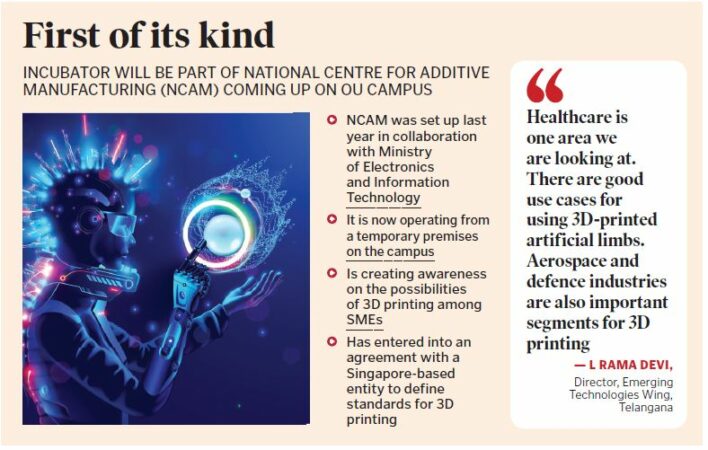
In this way, start-ups in the field of additive manufacturing or 3D printing receive mentoring, mentoring and other support
Post Date – 11:00 PM, Saturday – 1/7/23

Hyderabad: First, Telangana will set up an incubator for additive manufacturing start-ups. In this way, start-ups in the field of additive manufacturing or 3D printing receive mentoring, mentoring and other support.
According to L Rama Devi, Director of Emerging Technologies at Telangana, the incubator will be part of the upcoming National Center for Additive Manufacturing on the campus of Osmania University.
“We plan to create an incubator to support startups working on additive manufacturing. It will be the first of its kind. Accelerators and incubators are for all kinds of technology startups, but not for Being able to call apps from different startups,” she said.
NCAM was established last year in partnership with the Ministry of Electronics and Information Technology. It is now operating from a temporary location on campus.
“Permanent facilities are being prepared. Once ready, we will buy a lot of machines that can be used by MSMEs. The focus is on medical, aerospace and defense and other sectors,” Rama Devi said.
She said NCAM was addressing the lack of awareness of the possibilities of 3D printing among SMEs at large and had been running awareness drives, workshops and design sessions.
Beyond that, the focus is on evolving standards to ensure consistency in production.
“Designs are being finalized, but the hurdle is standards. Once those standards are established, they will also help bag export orders,” she said.
NCAM has entered into an agreement with a Singaporean entity as part of its efforts to define standards for 3D printing.
“Healthcare is one of the areas we are focusing on. In some cases, there are good use cases for using 3D printed prosthetics. The aerospace and defense industry is also an important area for 3D printing. We will acquire the machines and work with various sectors. Proper research by multiple stakeholders is required before starting production, as not all components can be 3D printed. It depends on the need, economics and availability of supporting raw materials,” she says.
“We’ve increased our visibility over the past year. Now, people know a point of approaching and exploring the possibilities of additive manufacturing. Now in some cases, manufacturing cycles are delayed because they depend on the import of raw materials. Some of these Classified as dangerous goods. Therefore, their transportation takes time. People are asking whether additive manufacturing can play a role in this situation,” says Rama Devi.