

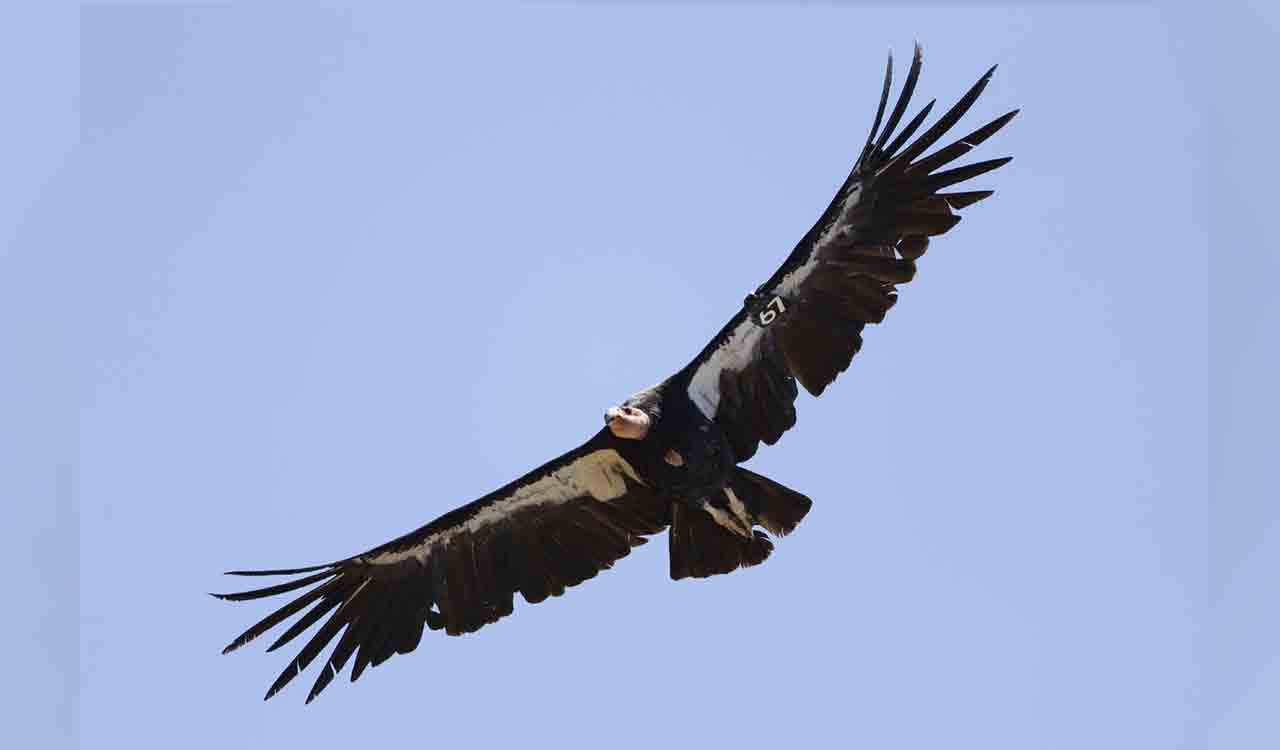
The birds, “California condors,” are part of a population that migrates throughout northern Arizona and southern Utah, including Grand Canyon National Park, the park service said.
Posted Date – Sat 08 Apr 23 09:42 AM

In this file photo, a California condor flies in the Ventana Wilderness, east of Big Sur, California. ((AP Photo/Marcio Jose Sanchez)
Marble Canyon: Three California condors have died from bird flu in northern Arizona, the National Park Service announced Friday, and authorities are trying to determine what killed five others in the flock.
A sick female bald eagle with suspected lead poisoning was found dead on March 20 and tests showed it was infected with highly pathogenic avian influenza (HPAI), the park service said.
Two other birds that were later found dead also tested positive, while test results for five others are pending, the park service said. the park service said.
The Peregrine Foundation, which manages the Arizona-Utah flock, also captured five other birds that appeared to be sick and sent them to a wildlife rescue center in Phoenix. One bird died and four others were quarantined, officials said. Exposure to the virus is expected to increase during the northward spring migration of bald eagles.
HPAI has not been detected in other populations in California or Baja California, Mexico, according to the park service. Avian influenza occurs primarily in birds, including chickens, but in all U.S. states (except Hawaii.
Humans are considered to be at low risk of infection with HPAI, although infections have been reported. The California condor is one of the largest birds in the world, with a wingspan of up to 10 feet (3 meters). These birds once patrolled the skies from Mexico to British Columbia. Condors can live up to 60 years and fly great distances, which is why their range can stretch across several states.
In the 1970s, the population plummeted to the brink of extinction due to hunting, habitat destruction, and lead poisoning from lead-eating animals. In the 1980s, wildlife officials captured the last 22 bald eagles left and brought them to the San Diego and Los Angeles zoos for conservation and captivity. The birds are then released into sanctuaries and national parks, where they can be monitored. These birds have been protected under federal law since 1967 and under California state law since 1971.
California condors have been making a comeback in the wild and now occupy parts of California’s Central Coast, Arizona, Utah and Baja California, Mexico. The total wild population now exceeds 300.
