

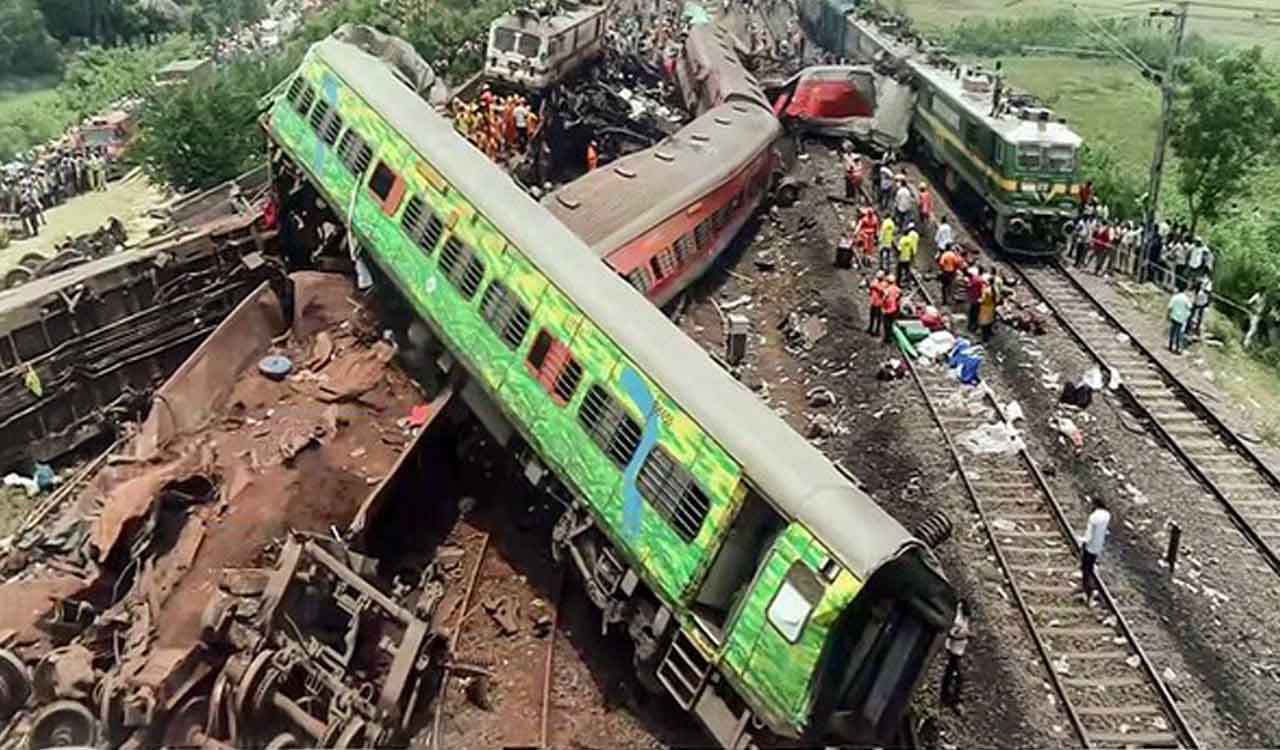
In its report, the CRS, which is investigating the Balasore accident, also highlighted “mistakes in the modification of the signal circuit” on the northern signal “goomty”.
Post Date – 03:27 PM, Tuesday – July 4th

New Delhi: In its report, the Commissioner for Railway Safety (CRS), who is investigating the three train accidents in Balasore, has pinned the blame on failures at multiple levels by the Signaling and Telecommunications (S&T) department of Indian Railways.
The report also highlights past “mistakes in signaling circuit modifications” at the northern signal “goomty” and during the execution of signaling work related to the replacement of the electric lift barrier at Gate 94 at the level crossing. station.
However, senior railway ministry officials have remained tight-lipped about the report.
Apart from CRS, the Central Bureau of Investigation (CBI) is also investigating the Balasore train accident. Under the Ministry of Civil Aviation, CRS is the central government agency responsible for railway safety and investigating railway accidents.
South East Circle CRS AM Chowdhary, which investigated the Balasore train accident in its report, found that failures at multiple levels in the technology sector contributed to the accident, sources said.
The report highlighted that LC94 underwent maintenance work and was signaled to be out of power at 4:20 p.m. on June 2, and was reconnected at 4:50 p.m., the sources said.
The report indicated that after the reconnection, technicians were still working on the signaling circuit, the sources said, adding that no modifications were involved.
“Train 12841 (Coromandel Express) was involved in a rear-end collision with a freight train standing on the station’s upper loop (ordinary loop). The last two cars of the Howrah-SMVT Superfast Express passed the station’s downlink mainline at the same time and were taken by the Coromandel Express,” the report said. The derailed carriage overturned.
“The rear-end collision was caused by past signaling circuit modifications at Goomty (station) at North Signal and errors during the execution of signaling work related to the replacement of the electric lift rail. Crossing gate 94 at the station. These errors resulted in a The Coromandel Express issued an incorrect signal in which the upbound home signal indicated the direction of the green light for through-travel on the station’s uplink mainline, but the crossover linking the uplink mainline with the uplink (crossover 17A/B) was set as an uplink,” The sources cited the report as saying.
“The wrong signal caused the Coromandel Express to travel on the Upper Circular Line and ended up in a rear-end collision with a freight train that was parked there,” the source said. “The accident was the result of mistakes at multiple levels in the technology sector,” he Referring to this report, said.
The report also highlighted that there was a similar incident where the signal set route did not match the actual train route on May 16 this year at Bahanaga Bazar railway station in SER Kragpur area and the reason was wrong, the sources said. . Faulty wiring and cables.
“The accident at the Bahanagarbazar railway station would not have happened if corrective measures had been taken to address the wiring error after the incident,” the source said, citing the report.
In its conclusion, the source said, CRS stated that an action should be initiated to update the completion of the site signal wiring diagrams, other documents (SIP, RCC, SWRD, panel/VDU diagrams, etc.) and signal circuit letters. The report also called for standard practice to be followed when carrying out signal modification work, the sources said.
He said the CRS recommended in the report that before embarking on the modification of existing signaling circuits, the existing circuits under modification should be functionally tested to ensure that the actual circuit is consistent with the as-built drawings.
It also said any alterations to signaling circuits should be made with an approved circuit diagram and in the presence of officials. The source said a separate team should be deployed to inspect and test the modified signaling circuits and functionality before work can be resumed or reconnected.
After strict signal transformation engineering practice training, a certificate of qualification shall be issued.The implementation, inspection and testing of the signal reconstruction project shall be completed by personnel holding the qualification certificate
“If it is detected that both the normal and reverse indication relays are closed at a point, all signal movement at that point shall be prevented. If it is El, it shall be registered as a fault condition and the system shall automatically shut down. Message If the state of the point indicating relay (physical relay) is “normal”, no command should be generated to reverse operate the point to normal and vice versa, the source said.
“The report also says point detection circuits should be carried in separate cables at each point or crosspoint without immediate termination and point switch banks should be eliminated in EI installations,” the source said.
The report also recommends that physical relays should be recorded separately in station data loggers and RTUs should be provided on end equipment for recording digital and analog inputs to ensure end-to-end matching of gear states, sources said.
The report also recommends that station masters be aware of possible failure conditions of the EI system, which can be detected by indications on the panel, and that these failure conditions should also be listed and included in the SWR.
On the evening of June 2, the Balasore train accident killed at least 293 people and injured more than 1,000.
