‘Digital India’ can only be achieved if we unite all communities including marginalized ones
Post Date – 12:30 AM, Wednesday – 5/3/23

‘Digital India’ can only be achieved if we unite all communities including marginalized ones
By Jadhav Chakradhar, Prashant Kumar Choudhary, Jayanti Mala Nayak
Hyderabad: Discrimination is a multifaceted concept that may have economic, political, social and digital dimensions in the technological age. Digital discrimination in India is worrying, with marginalized communities facing digital divide and discrimination in the digital sphere.
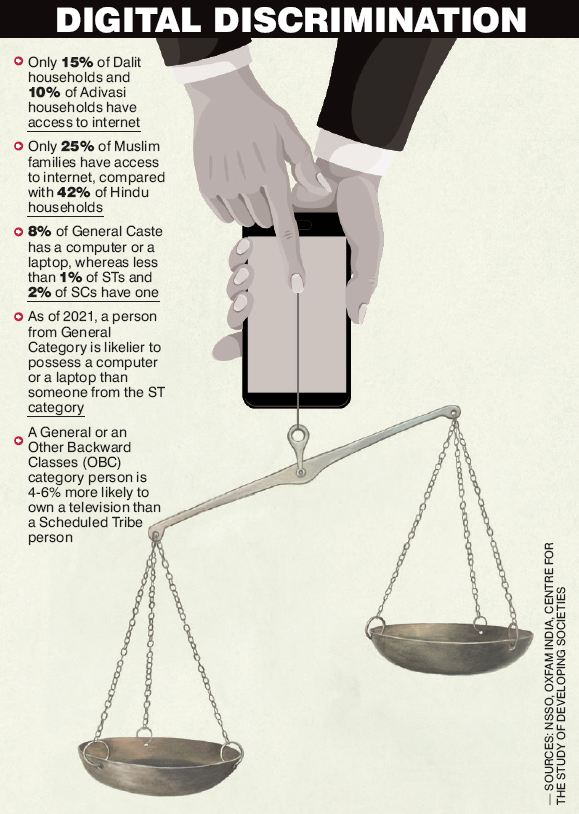
About 70 percent of rural households and 30 percent of urban households in India do not have access to the Internet, according to the National Sample Survey Office. This digital divide is particularly acute in marginalized communities, where only 15% of Dalit households and 10% of Adivasi households have access to the Internet. Likewise, only 25 percent of Muslim households have access to the Internet, compared to 42 percent of Hindu households.
The report also highlighted gender disparities in digital access, with only 22 percent of women in India having access to the internet compared to 33 percent of men. This gender gap is particularly acute in rural areas, where only 15 percent of women have access to the Internet, compared with 33 percent of men.
In addition to the digital divide, marginalized communities also face discrimination online. According to a report by the Center for the Study of Developing Societies (CSDS), 16 percent of Dalits and 14 percent of Muslims face discrimination online. It includes hate speech, cyberbullying, fake news and the spread of misinformation. It also highlights the impact of online discrimination on marginalized communities. It noted that online hate speech can lead to offline violence, while cyberbullying can damage mental health. The spread of fake news and misinformation can also have serious consequences, especially during a public health crisis such as a pandemic.
digital division
The India Inequality Report 2022 by Oxfam India highlights the unequal use of the internet and computers/laptops. According to the report, the sphere of influence of digital technologies is still largely limited to male, urban, upper caste and upper class families and individuals. 8% of Ordinary Castes own a computer or laptop while less than 1% of Scheduled Castes (ST) and 2% of Scheduled Castes (SC) own one.
Across caste groups, only 4% of students from SC and ST communities have access to computers and the Internet. As of 2021, people in the general category are more likely than people in the scheduled tribe (ST) category to own a computer or laptop. The gap has widened from 7 percent since 2018 due to the adverse effects of the pandemic. Oxfam also found that people in the General or Other Backward Class (OBC) categories were 4-6% more likely to own a television than those in Scheduled Tribes. However, from 2018 to 2021, the gap between the average person who owns a cell phone and the ST class who owns a cell phone decreases from 10% to 3%.
unequal access
The reports highlight the growing problem of digital discrimination in India. They identified inequalities and discrimination faced by marginalized communities in India in accessing digital resources. India’s digital divide is widening, with many marginalized communities without access to digital resources such as smartphones, computers and the internet. This has led to a situation where these communities are excluded from the benefits of the digital economy, including access to education, healthcare and employment opportunities. This disproportionately affects marginalized communities, including Dalits, indigenous peoples and Muslims.
These studies and reports call for urgent action to address digital discrimination in India. They recommend that governments bridge the digital divide by providing access to digital resources to marginalized communities. They also recommend stricter enforcement of laws to tackle online hate speech, cyberbullying and the spread of fake news and misinformation. It requires citizens to raise awareness of cyber threats against deliberate government intervention.
Experts also weighed in on the issue, emphasizing the need for a multi-pronged approach to tackling digital discrimination. It includes bridging the digital divide and addressing the social and cultural factors that lead to digital discrimination between registered and non-listed groups.
Sen’s ability method
Amartya Sen’s capability approach is a philosophical framework that emphasizes the importance of focusing on people’s abilities to realize their worth, rather than focusing solely on their income or material possessions. According to Sen, a person’s abilities are influenced by a range of factors, including education, health, social status, and access to resources.
In the context of digital discrimination, competency approaches can be used to identify ways in which discriminatory practices limit people’s access to digital resources and opportunities, such as the Internet, online education, and digital job markets. For example, if a group of people do not have access to the Internet, they may not be able to access important information or participate in online social and economic activities, which may limit their opportunities to realize their value.
The digital divide can adversely affect the economy by exacerbating income inequality and limiting career opportunities. Individuals without access to digital resources and training are disadvantaged in the job market, and their inability to contribute to the economy hinders a country’s competitiveness and economic development, widening the income gap between rich and poor. This could lead companies to outsource jobs requiring advanced digital skills to other regions, depriving the country of potential revenue.
Ultimately, this can lead to higher poverty rates and adversely affect the country’s overall financial health. The dream of a ‘Digital India’ will only come true if we set our priorities in the right direction to bring all communities including the marginalized ones forward.