






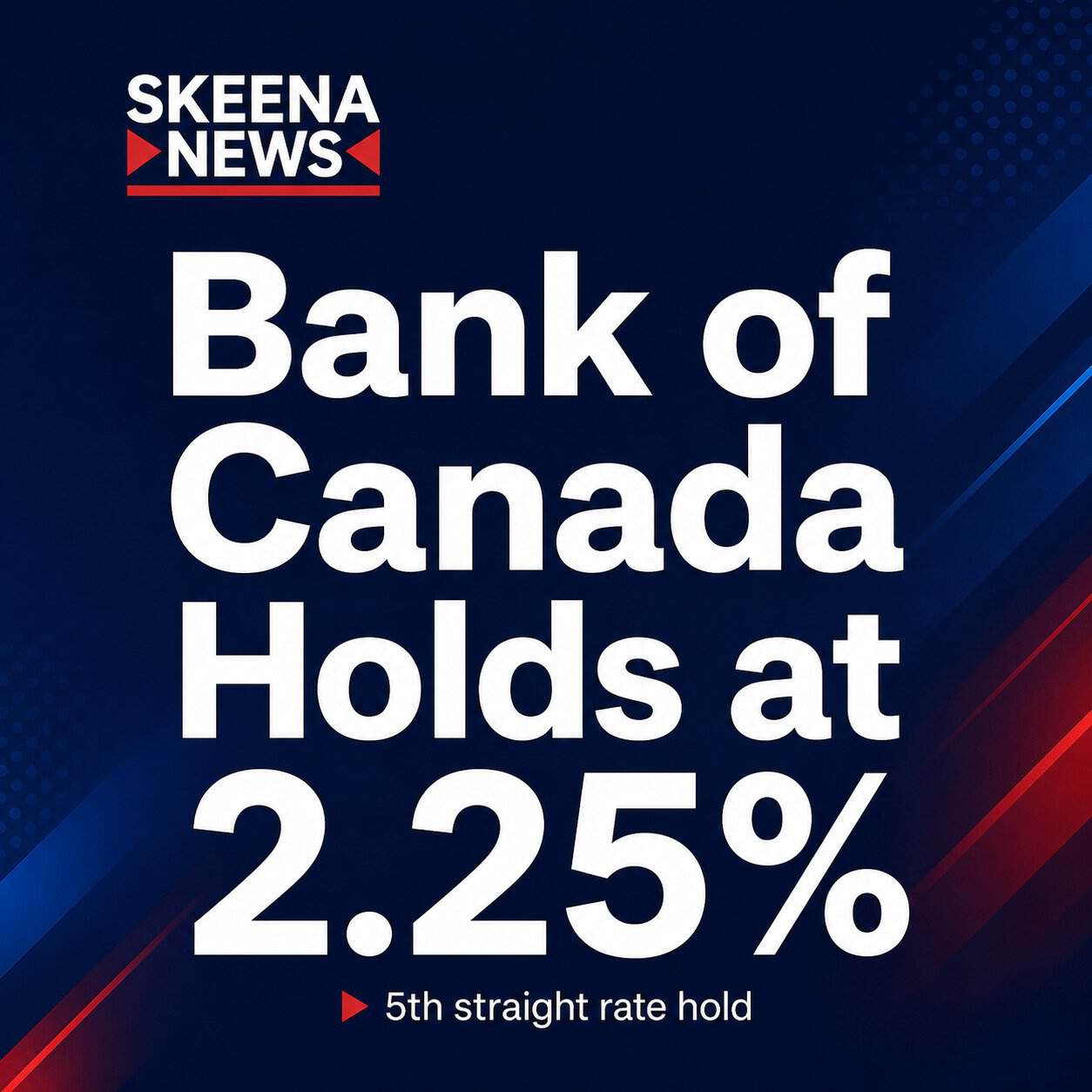
Bank of Canada Holds Interest Rate at 2.25% as Mortgage Renewal Pressure Builds Across Canada
– Jaweed
The Bank of Canada has held its key overnight interest rate at 2.25%, keeping borrowing costs unchanged for the fifth straight decision as the country faces a difficult mix of weak economic growth, high living costs, and renewed inflation pressure from global energy prices.
For Canadian households, the decision means there is no immediate relief on borrowing costs. For homeowners preparing to renew mortgages in 2026 and 2027, the pressure remains especially serious.
The central bank is now in a difficult position. Canada’s economy has shown signs of weakness, with two consecutive quarters of contraction. Normally, that could support lower interest rates. But higher fuel and energy prices, driven by international conflict and global supply risks, are keeping inflation concerns alive.
That leaves the Bank of Canada in a “wait-and-see” position.
For families in northern B.C., the impact is practical. Mortgage payments, rent pressure, vehicle costs, groceries, fuel, and small business borrowing costs are all connected to the same wider economic picture.
Mortgage Renewals Are the Biggest Concern
One of the largest financial issues facing Canadians is the mortgage renewal wave. Many homeowners who secured mortgages during the ultra-low interest rate period of 2020 to 2022 are now renewing at much higher rates.
Across Canada, millions of mortgages are expected to renew by the end of 2027. Many borrowers who once had rates below 2% may now face rates closer to 4% or higher, depending on their lender, mortgage type, and credit profile.
For some households, that can mean hundreds of dollars more each month.
This matters in communities like Terrace, Kitimat, Prince Rupert, Smithers, and surrounding areas, where many families already deal with high transportation costs, limited rental supply, and rising day-to-day expenses.
Variable Rates Are Lower, But Riskier
With the Bank of Canada holding its overnight rate steady, variable-rate mortgages have become more attractive for some borrowers. In some cases, variable rates are currently lower than fixed rates.
But variable rates come with risk.
If inflation rises again, or if global oil prices push costs higher, the Bank of Canada could eventually increase rates. That would quickly affect borrowers with variable-rate mortgages.
Fixed mortgage rates, on the other hand, are more closely tied to Government of Canada bond yields. Those yields have been volatile because of inflation concerns and global uncertainty. That means fixed rates may stay elevated until markets become more confident that inflation is under control.
Housing Market Slows as Buyers Wait
Canada’s housing market has also cooled. National sales forecasts have been revised lower, and many first-time buyers are staying on the sidelines.
Some buyers are waiting for interest rates to fall. Others are waiting for home prices to soften further. But the current situation is uncertain: rates may not fall quickly, and in some regions, housing supply remains tight.
In northern B.C., the housing picture is different from major markets like Vancouver and Toronto. Smaller communities can be affected by local employment, LNG activity, resource projects, infrastructure spending, and limited housing supply. That means national trends do not always tell the full local story.
Small Businesses Also Feel the Pressure
Higher borrowing costs do not only affect homeowners. Small businesses also face higher costs when renewing loans, financing equipment, managing lines of credit, or expanding operations.
For local businesses already dealing with labour shortages, rent, insurance, shipping, fuel, and supplier costs, stable but elevated interest rates can limit growth.
A prolonged pause from the Bank of Canada may provide some predictability, but it does not reduce the cost burden.
What Homeowners Should Consider
Canadians facing mortgage renewal should not wait until the last minute. Financial experts generally recommend speaking with lenders or mortgage brokers several months before renewal.
Homeowners may want to compare fixed and variable options, review prepayment privileges, consider shorter fixed terms, or examine whether extending amortization could temporarily reduce monthly pressure.
The right choice depends on income stability, household budget, risk tolerance, and long-term plans.
No Clear Relief Yet
The Bank of Canada’s latest decision shows how complicated the Canadian economy has become.
If the central bank cuts rates too soon, inflation could become harder to control. If it raises rates, it could put more pressure on households and businesses already feeling squeezed.
For now, Canadians are left with a message of caution: borrowing costs are stable, but they remain high compared with the low-rate years many homeowners remember.
For northern B.C. residents, the key takeaway is simple — anyone renewing a mortgage, planning to buy a home, or running a business should prepare carefully, compare options, and avoid assuming that lower rates are coming quickly.