






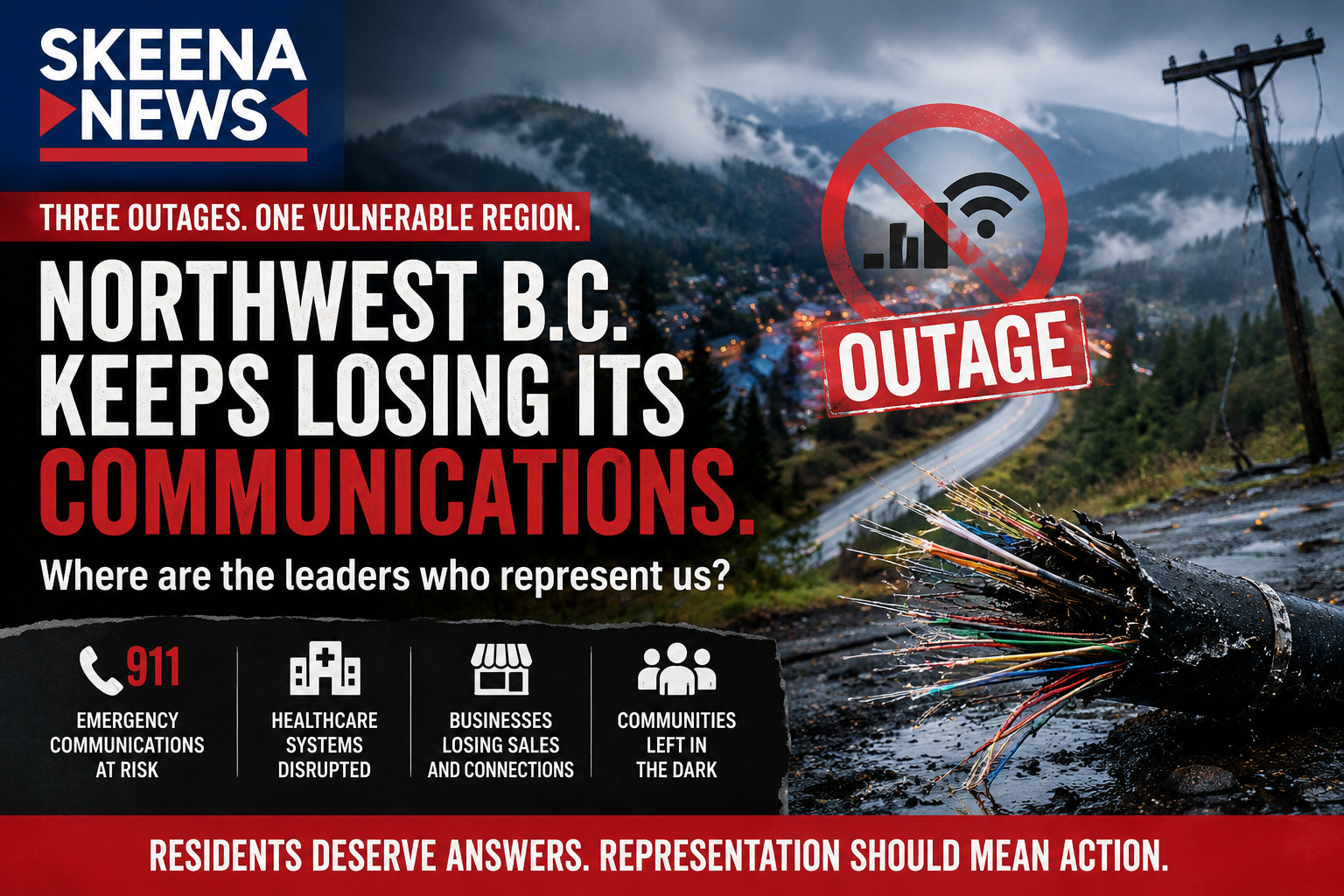
Northwest B.C. Keeps Losing Its Communications. Where Are the Leaders Who Represent Us?
Repeated telecommunications outages have exposed a vulnerability in Northwest B.C. that governments, carriers and elected representatives have known about for years. Residents deserve to know what their leaders are actually doing about it.
SKEENA REGION — When a telecommunications cable is cut in Northwest British Columbia, the consequences can extend far beyond a lost internet connection.
Businesses can lose the ability to process payments. Residents can lose reliable access to communications. Healthcare facilities can be forced onto backup systems. Emergency communications can be disrupted. Communities hundreds of kilometres apart can suddenly find themselves facing the same problem.
And in 2026, this has happened repeatedly.
The question now is not simply who cut the cable?
The bigger question is:
Why does Northwest B.C. remain so vulnerable to a single physical failure?
The region has known for years that telecommunications redundancy is a problem. Yet repeated outages continue to expose the same underlying weakness.
That should concern every resident—and every elected representative who claims to represent them.
This is bigger than one cable and bigger than one political party
The May 4 outage, the August 2 outage and the August 11 disruption were different incidents with different circumstances, but together they have demonstrated the consequences of a telecommunications system vulnerable to physical disruption.
The research reviewed by Skeena News identifies a recurring dependence on linear telecommunications infrastructure along major transportation corridors. The region’s communities are connected across enormous distances, while alternative routes do not necessarily provide the kind of geographically independent redundancy residents might reasonably expect from critical infrastructure.
That distinction matters.
Having a backup system is not necessarily the same as having a truly independent backup route.
If the primary and alternative systems ultimately depend on the same corridor, exchange point or vulnerable section of infrastructure, a second route may not provide the protection people assume it does.
The August 11 outage demonstrated why that matters. The research identifies a situation in which a primary route was disrupted while an alternative route was also unavailable, producing a much larger failure.
This is precisely why telecommunications resilience deserves to be treated as an infrastructure issue rather than merely a crime story.
The region was warned about this vulnerability
The problem did not suddenly appear in 2026.
Connected Coast was developed in part to improve connectivity and create greater redundancy for Northern and coastal communities. Its project documentation describes the historical vulnerability of communities along the Highway 16 corridor and the need for an alternate transport path.
The project represents tens of millions of dollars in public and partner investment.
Yet the experience of 2026 raises an uncomfortable question:
How much redundancy does Northwest B.C. actually have today?
Not how much has been announced.
Not how much has been promised.
Not how much infrastructure exists somewhere along the coast.
How much redundancy can actually protect Terrace, Smithers, Kitimat, Hazelton, Burns Lake, Prince Rupert and other communities when a critical terrestrial route fails?
That is the question residents deserve answered clearly.
A letter is not the same as a solution
Skeena MLA Claire Rattée has raised the issue with B.C.’s Minister of Citizens’ Services.
Her letter identifies the repeated outages and argues that Northwest B.C. cannot continue relying on a telecommunications corridor vulnerable to cable theft, wildfire, severe weather and other disruptions. She specifically asks the provincial government about redundancy, additional fibre routes, alternative technologies and a long-term strategy for the region.
Those are reasonable concerns.
But residents are entitled to distinguish between raising a concern and achieving something concrete.
A letter can ask a minister what the government intends to do.
It cannot, by itself, build a second fibre route.
It cannot appropriate funding.
It cannot create geographic redundancy.
It cannot guarantee 911 continuity.
It cannot change the architecture of private telecommunications networks.
And that is why the public should look beyond the letter.
What happened next?
What commitment was obtained?
What changed?
What will actually be different before the next major outage?
Those are legitimate questions for the MLA and for every other elected official representing the region.
Where is the federal representative?
Telecommunications are not solely a provincial matter.
Federal institutions have major responsibilities for telecommunications regulation and policy.
That means the region’s federal representative cannot simply watch from Ottawa while communities repeatedly experience large-scale communications failures.
Residents should reasonably expect their MP to understand the problem, engage with the relevant federal agencies and push for solutions within federal jurisdiction.
If the answer is that the problem belongs to the Province, then residents deserve to know why.
If the answer is that it belongs to the CRTC or telecommunications companies, then residents deserve to know what the MP is doing to bring those parties to the table.
And if federal funding is part of the solution, residents deserve to know whether that funding is being pursued.
Representation should not stop at issuing a statement after an outage.
And where is the provincial government?
The same standard applies to the government in Victoria.
The NDP government has responsibility for areas that intersect with telecommunications resilience, infrastructure corridors, emergency management and provincial funding programs.
The question is not whether the government is aware that outages are happening.
It clearly is.
The question is whether the government believes the existing system provides an acceptable level of resilience for Northern communities.
If it does, residents deserve to understand why.
If it does not, residents deserve a serious plan.
Not another temporary workaround.
Not another emergency repair.
Not another promise to study the problem.
A resilience plan means identifying the vulnerability, identifying the required infrastructure, identifying the cost, identifying who pays and establishing a realistic path toward completion.
Mayors cannot be spectators either
The issue also belongs at the municipal level.
Terrace, Kitimat, Smithers, Prince Rupert and other affected communities do not exist as isolated islands when telecommunications infrastructure fails.
A failure in one part of Northern B.C. can affect businesses, healthcare, emergency communications and residents in another municipality.
Mayors and councils therefore have a legitimate role in advocating collectively for regional infrastructure.
Residents should know whether their local leaders are treating telecommunications resilience as a regional priority or simply responding to each outage as it happens.
There is nothing unreasonable about residents asking their mayor:
What have you actually done about this?
Not what did you post.
Not what did you say.
What did you do?
Political leadership should not be measured only during election season
This is where the issue becomes larger than telecommunications.
Every election, politicians ask residents for their trust.
They tell voters that they will fight for their communities.
They promise to bring investment, protect services, create jobs, improve infrastructure and make their communities stronger.
Those promises should mean something after the election.
When a problem repeatedly affects the people a politician represents, residents should expect that politician to be able to explain:
What did I do?
Who did I contact?
What did I demand?
What did I achieve?
What remains unresolved?
And if nothing changed, voters have every right to ask why.
That applies equally to an MLA, an MP, a mayor, a cabinet minister, an opposition politician or any other person presenting themselves as a leader.
This isn’t about Conservative versus NDP
It would be easy to turn this into another political fight.
That would miss the point.
The telecommunications network does not care which party represents Terrace.
A fibre cable does not care whether the government in Victoria is NDP or Conservative.
A business unable to process payments does not care which party controls Ottawa.
And someone trying to reach emergency services does not care which politician won the last election.
The problem is fundamentally about representation and infrastructure.
If politicians from different parties genuinely believe Northwest B.C. needs better telecommunications resilience, they should be capable of working together to pursue it.
If they disagree about the solution, they should explain their alternatives.
What residents should not receive is silence, political theatre or competing claims of who is to blame while the underlying vulnerability remains.
Residents should start asking harder questions
Skeena News believes residents have every right to question the people who represent them.
Not only when an election is approaching.
Now.
When a politician comes to your community asking for your vote, ask what they did about the telecommunications vulnerability.
When an MLA holds a public meeting, ask what concrete action has resulted.
When an MP visits the region, ask what has been raised in Ottawa.
When a mayor asks for another term, ask what the municipality has done collectively with neighbouring communities.
When a government announces another broadband investment, ask whether it improves speed or actually improves resilience.
And when a politician says the problem belongs to somebody else, ask:
What have you done to make the people you represent heard by that other level of government?
That is what representation means.
Northwest B.C. deserves more than emergency repairs
Emergency roaming, satellite connections and rapid repair crews are valuable.
They can prevent an outage from becoming an even greater crisis.
But they should not become an excuse to accept the underlying vulnerability as permanent.
The investigative material reviewed by Skeena News identifies several existing forms of contingency infrastructure—including subsea connectivity, emergency wireless roaming and satellite backup for critical facilities—but also identifies continued vulnerabilities for inland communities dependent on terrestrial routes.
The goal should therefore not simply be to become better at responding after the next cable is cut.
The goal should be to make sure the next cable cut doesn’t take the region down with it.
That requires infrastructure.
It requires planning.
It requires cooperation between governments and telecommunications companies.
And it requires political representatives willing to make the issue a priority when there is no election immediately in front of them.
The question now belongs to the people who represent us
Three major disruptions in 2026 should be enough to make telecommunications resilience a serious regional political issue.
Residents should not have to wait for another outage before politicians start talking about it.
They should not have to accept a letter as the end of the process.
They should not have to choose between parties simply because one blames the other.
And they should not have to remember promises made during an election campaign without ever seeing the results.
MLAs, MPs, mayors, cabinet ministers and opposition leaders all have different powers and responsibilities. But they share one thing: they ask the public to trust them with leadership.
That trust comes with a responsibility to act.
Northwest B.C. has already demonstrated what happens when its communications infrastructure fails.
Now its political leadership needs to demonstrate what happens when they decide that repeated failures are no longer acceptable.
The next outage should not be the event that finally forces action.
The time to build a resilient Northwest B.C. telecommunications network is before the next cable is cut—not after.