





$21 Billion Kanata LNG Proposal Could Transform Northwest B.C. — But Major Questions Remain
A proposed US$15.7 billion floating liquefied natural gas project near Prince Rupert has suddenly placed Northwest B.C. at the centre of another major energy story.
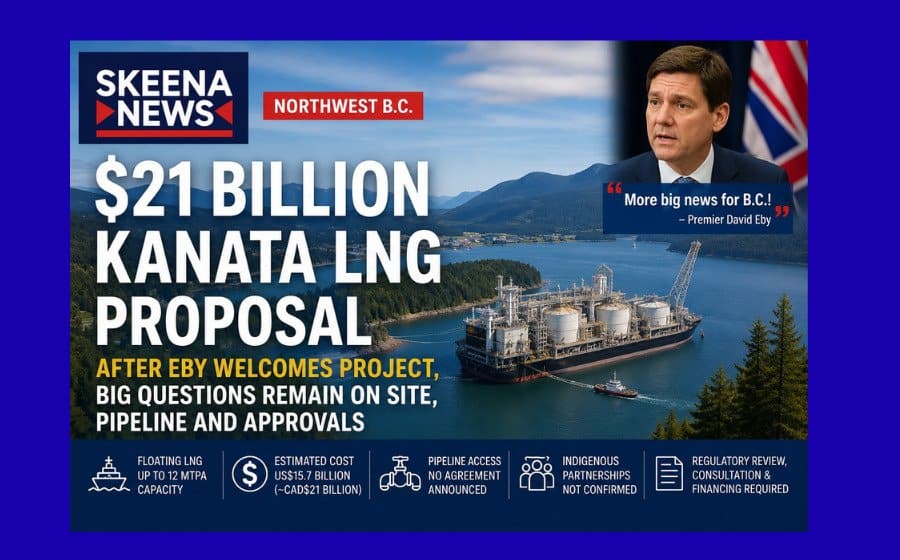
On June 16, South Korean shipbuilding giant Hanwha Ocean and Vancouver-based Kanata Clean Power & Climate Technologies Corp. announced they had signed a non-binding memorandum of understanding to explore the development of Kanata LNG, a floating LNG export facility with a planned capacity of up to 12 million tonnes per year.
The companies say the project would leverage floating LNG technology and target Asian markets from British Columbia’s North Coast, one of North America’s closest Pacific gateways to Northeast Asia.
Premier David Eby publicly welcomed the announcement, calling it “more big news for B.C.” as interest in Canadian LNG exports continues to grow.
Hanwha Ocean Brings Global Experience
Hanwha Ocean is one of South Korea’s largest shipbuilders and offshore engineering companies, with decades of experience constructing LNG carriers and offshore energy infrastructure.
Under the memorandum, Hanwha and Kanata intend to explore cooperation involving:
- Engineering and construction of floating LNG facilities;
- Operations and maintenance;
- Potential investment participation;
- Long-term LNG purchase arrangements;
- Marine transportation solutions.
However, the companies emphasized that the agreement is non-binding and that no final investment decision has been made.
What Is Kanata LNG?
Unlike traditional onshore LNG terminals, Kanata LNG is envisioned as a floating LNG project.
Floating LNG technology allows gas to be liquefied offshore using specially designed vessels rather than massive land-based facilities.
The concept is already being used or proposed elsewhere, including Cedar LNG near Kitimat and Ksi Lisims LNG north of Prince Rupert.
Kanata estimates total project costs at approximately US$15.7 billion.
A Crowded LNG Landscape
Kanata LNG would enter an increasingly competitive B.C. LNG sector.
Major projects include:
- LNG Canada in Kitimat, which is already operating;
- Cedar LNG, currently under construction;
- Woodfibre LNG near Squamish;
- Ksi Lisims LNG, a proposed Indigenous-led project on the North Coast.
Competition for skilled labour, infrastructure, electricity and gas transportation capacity is expected to intensify if multiple projects proceed simultaneously.
Important Questions Still Need Answers
Despite the announcement, many important details remain unknown.
Exact Location
The companies have stated only that the project is planned near Prince Rupert.
No final site has been publicly identified.
Gas Supply
No publicly announced pipeline transportation agreements have been disclosed.
Questions remain regarding how natural gas would reach the proposed facility.
Indigenous Partnerships
Kanata has said participating First Nations could acquire up to a 50 per cent ownership interest, but no formal partnership has been announced publicly.
Indigenous participation has become a defining feature of major LNG developments across British Columbia.
Environmental Review
The project remains subject to numerous approvals, including:
- Environmental assessments;
- Indigenous consultation;
- Regulatory approvals;
- Commercial agreements;
- Financing arrangements.
No construction has begun.
Growing Canada–South Korea Relationship
The announcement comes amid growing economic ties between Canada and South Korea.
Hanwha Group has been expanding partnerships across Canada in energy, manufacturing and technology sectors.
Hanwha Ocean is also participating in discussions surrounding Canada’s future submarine requirements.
The company has previously stated that its broader Canadian investment strategy could support Canada’s industrial and technological objectives.
However, neither Hanwha Ocean nor Kanata has indicated that the Kanata LNG project depends on any defence procurement decisions.
What Could It Mean For Northwest B.C.?
If ultimately approved and constructed, a project of this size could have significant implications for communities across Northwest B.C., including:
- Prince Rupert;
- Port Edward;
- Terrace;
- Kitimat;
- Smithers;
- Hazelton;
- Northeast B.C. gas-producing regions.
Potential benefits could include construction jobs, long-term operations employment, Indigenous business opportunities, and economic activity for contractors and suppliers.
At the same time, questions surrounding housing, infrastructure capacity, electricity demand and environmental impacts would likely become major topics of discussion.
Still Early Days
For now, Kanata LNG remains an idea supported by a memorandum of understanding rather than a fully approved project.
No final investment decision has been announced.
No construction schedule has been released.
No environmental certificates have been issued.
And many of the biggest questions — location, pipeline access, Indigenous partnerships and financing — remain unanswered.
Still, the proposal represents another sign that global investors increasingly view British Columbia’s North Coast as a strategic gateway for supplying LNG to Asia, potentially making Northwest B.C. one of the world’s most important energy regions over the coming decades.