




Skeena steelhead fishing restrictions could have major economic consequences
New report says restrictions on recreational steelhead fishing could put more than 200 jobs and about $23 million in annual economic activity at risk in Northwest B.C.
SKEENA REGION, B.C. — Potential restrictions on recreational steelhead fishing in the Skeena watershed could have significant economic consequences for communities across Northwest B.C., according to a new economic assessment that estimates the fishery supports more than 200 local jobs and approximately $23 million in annual regional economic activity.
The report, Renewable Value, Minimal Impact: The Economic Value of Skeena River Steelhead, was prepared by Big River Analytics and examines the economic contribution of recreational steelhead angling as well as factors affecting wild steelhead survival.
The assessment was commissioned by the Babine River Foundation, Native Fish Society, The Conservation Angler, the Upper Skeena Angling Guides Association and Tourism Smithers.
According to the report, the Skeena steelhead recreational fishery generates approximately $33 million in annual economic output across British Columbia, contributes $16 million to provincial GDP, generates $11 million in labour income and supports approximately 291 full-time-equivalent jobs.
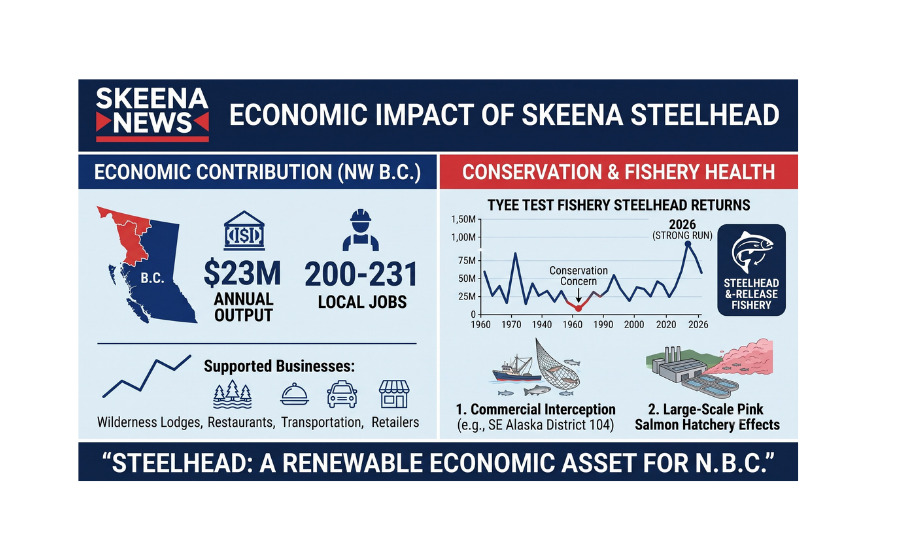
Up to 80 per cent of that economic activity remains within the North Coast–Nechako region, according to the assessment, generating approximately $23 million in annual regional economic output and supporting between 200 and 231 local jobs.
The economic activity reaches well beyond fishing guides.
Wilderness lodges, accommodations, restaurants, transportation providers, retailers and other tourism-related businesses all benefit from visitors travelling to the Skeena watershed to fish for steelhead.
Guided angling in the Upper Skeena, including rivers such as the Babine, Bulkley and Kispiox, accounts for more than 60 per cent of the region’s steelhead-related economic activity, the report states.
Economic value of a catch-and-release fishery
The report’s authors argue that the economic value of the recreational fishery is particularly significant because wild steelhead angling is conducted under catch-and-release regulations.
Rather than generating economic activity through the removal and sale of fish, the recreational fishery generates spending through guiding, accommodation, transportation, food, equipment and other services while the fish can remain in the ecosystem.
The assessment estimates that each steelhead mortality associated with guided recreational angling corresponds to approximately $100,000 in regional economic output and one full-time local job.
In the Upper Skeena, the report estimates the figure rises to approximately $118,000 in economic output and 1.3 full-time local jobs per mortality.
The report also estimates that approximately 27 wild steelhead can be caught and released for every full-time job supported by the fishery.
Tourism Smithers spokesperson Gladys Atrill said the findings demonstrate that healthy steelhead populations have an economic value for communities throughout Northern B.C.
“This study demonstrates that healthy steelhead populations are more than a conservation success — they are a renewable economic asset that supports communities across Northern British Columbia,” Atrill said.
Report points to marine pressures
The assessment argues that restrictions on recreational angling would not address what it identifies as major pressures affecting Skeena steelhead during their ocean migration.
Among those concerns are commercial fisheries and large-scale pink salmon hatchery production.
The report identifies commercial interception in Southeast Alaska and Canadian waters as a significant concern, stating that thousands of Skeena steelhead can be caught incidentally in commercial fisheries.
District 104 in Southeast Alaska is highlighted because commercial fisheries operate in an area used by salmon returning to Canadian rivers.
The report says the lack of comprehensive steelhead bycatch reporting makes it difficult to establish the precise number of Skeena steelhead lost in those fisheries.
It argues that improving management of commercial interception could provide greater conservation benefits than placing additional restrictions on the recreational fishery.
Carrie Collingwood of the Babine River Foundation said the economic consequences of losing steelhead extend beyond the individual fish.
“Activities that remove steelhead — such as commercial fishing and ocean ranching — represent an opportunity cost exceeding $100,000 in provincial economic output per steelhead,” Collingwood said.
Pink salmon ranching also under scrutiny
The report also raises concerns about the effects of large-scale hatchery production of pink salmon in the North Pacific.
According to the assessment, odd-year pink salmon abundance has exceeded even-year abundance by an average of 136 million fish since 1990.
Over the same period, the report says average Skeena steelhead returns in odd-numbered years were approximately 14,500 fish lower than even-year returns.
The report argues that large concentrations of hatchery-produced pink salmon may increase competition for marine food resources used by wild steelhead.
The assessment acknowledges that the relationship requires further scientific examination but argues that the scale of hatchery production warrants greater attention from fisheries managers.
DFO cuts and stakeholder meetings add to concerns
The report comes amid concerns from local stakeholders about changes to fisheries management and enforcement.
DFO has reduced fisheries patrol contracts and temporarily suspended meetings of the North Coast Integrated Fisheries Harvest Planning Committee, a multi-stakeholder forum involving fisheries participants and other stakeholders.
Carrie Collingwood said the timing raises concerns about how conservation decisions will affect local businesses.
The Department of Fisheries and Oceans said the meetings were temporarily suspended because of low participation by fishery participants and stakeholder representatives and that it intends to engage with members after the season about how the committee process should proceed.
The province is responsible for administering and managing steelhead in B.C., while DFO remains responsible for federal fisheries management, including commercial marine fisheries.
That division of responsibility means management of Skeena steelhead involves both provincial freshwater decisions and federal and international fisheries management.
2026 steelhead returns provide a different picture
The economic debate comes as the Skeena’s 2026 steelhead run is showing stronger numbers than some recent low-return years.
The Tyee Test Fishery near the mouth of the Skeena is used to monitor steelhead abundance and inform management decisions.
Under the province’s steelhead management framework, the fishery can face significant restrictions when returns fall to levels of serious conservation concern.
The stronger 2026 run has so far reduced the likelihood of broad recreational restrictions compared with years when steelhead returns fell below conservation thresholds.
The situation demonstrates the central challenge facing managers: balancing conservation requirements during weak returns with the economic importance of the fishery during years when populations are sufficiently strong to support recreational angling.
A regional economic issue as well as a fisheries issue
For communities across the Upper Skeena and North Coast–Nechako region, the debate is therefore not simply about whether recreational fishing should be restricted.
It is also about the economic consequences of those decisions.
The Big River Analytics assessment estimates that the recreational steelhead fishery contributes $23 million in regional economic activity and supports more than 200 jobs, making it a significant component of the tourism economy in communities that serve visiting anglers.
The report argues that conservation policy should focus on the sources of mortality that pose the greatest risk to wild steelhead while maintaining a sustainable recreational fishery where stocks allow.
It calls for greater attention to commercial marine interception, improved bycatch reporting, further examination of large-scale pink salmon hatchery production and continued investment in freshwater monitoring and enforcement.
As fisheries managers consider future steelhead regulations, the economic assessment adds another dimension to the debate: restrictions intended to protect the Skeena’s wild steelhead could also carry substantial consequences for the businesses, workers and communities whose livelihoods depend on the fishery.