





Terrace emergency calls rise 23% as suspicious fires and staffing pressures challenge fire department
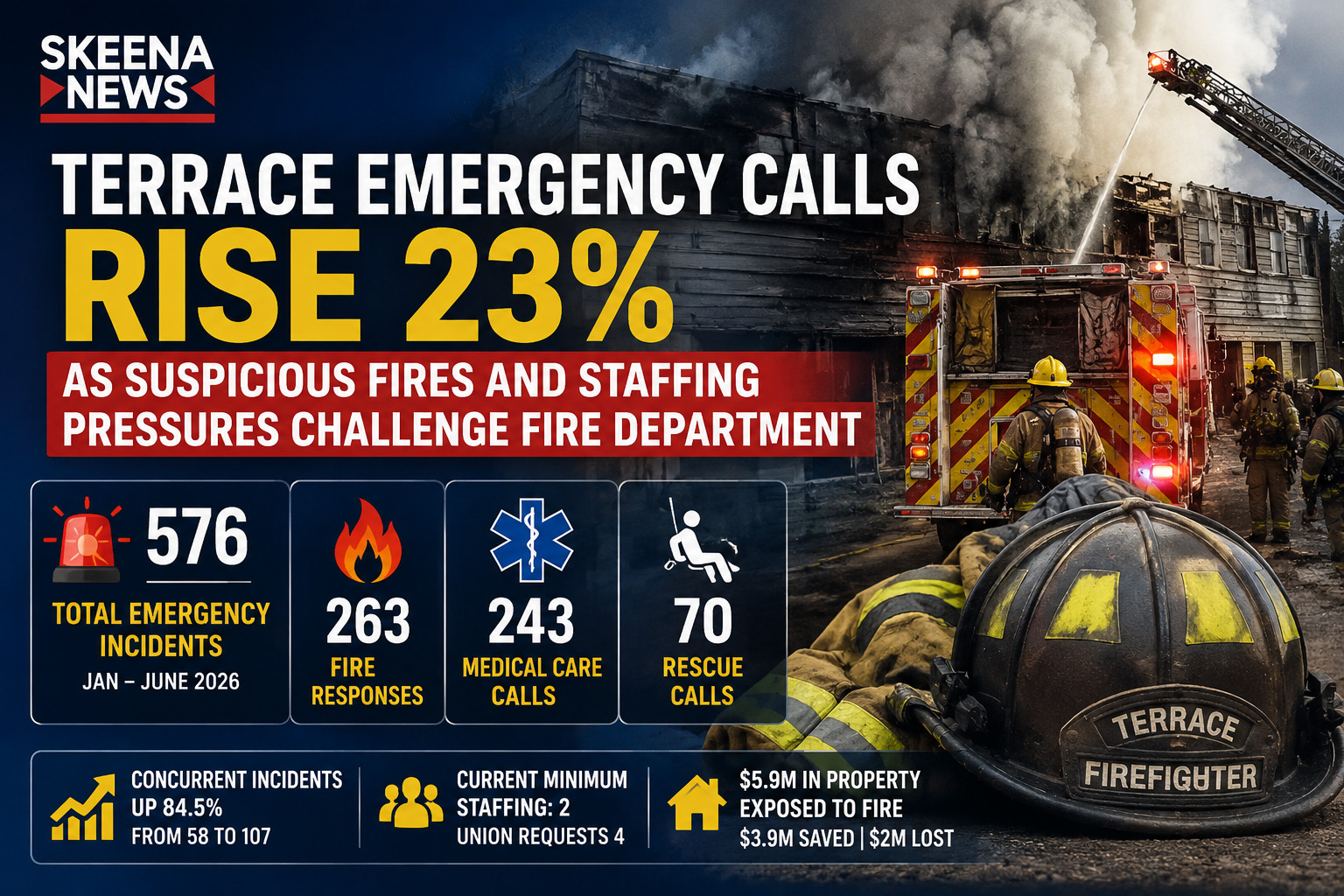
TERRACE, B.C. — The Terrace Fire Department responded to 576 emergency incidents during the first six months of 2026, as rising call volumes, a sharp increase in overlapping emergencies and a series of suspicious fires put additional pressure on the city’s emergency-response system.
Fire department figures for January 1 through June 30 show that the 576 incidents included 263 fire responses, 243 immediate medical-care calls and 70 rescue calls.
The total represents a significant increase from the same period in 2025. Primary emergency incidents rose from 350 to 432, while the number of occasions when multiple emergencies were occurring simultaneously increased from 58 to 107 — an 84.5 per cent increase.
The increase in concurrent incidents is particularly significant because it can require the department to divide its available crews between emergencies or call in additional personnel and mutual-aid resources.
Suspicious fires add another challenge
The increased emergency workload comes as Terrace has also experienced a series of suspicious fires.
Fire Chief Joel Brousson confirmed that the department documented 12 suspicious fires between January and August 2026.
The incidents have involved a range of targets, including building exteriors, dumpsters, vehicles and brush areas. According to Brousson, handheld lighters and liquid accelerants, primarily gasoline, have been identified as common ignition methods.
One of the most serious incidents was the May 21 fire that destroyed the historic Terrace Bowling Alley.
The fire originated at the building’s front north exterior corner and spread into the roof and attic areas. The structure was ultimately declared a total loss.
The incident required an immediate response from Terrace’s career firefighters, the recall of off-duty personnel and assistance from the Thornhill Volunteer Fire Department. A subsequent investigation by the Terrace Fire Department and Terrace RCMP determined that the fire was suspicious, and the RCMP General Investigation Section identified two persons of interest.
A second recent case occurred on August 4, when firefighters responded to a residence in the 4400 block of Greig Avenue after an exterior fire was reported at approximately 10:30 a.m.
Crews found flames climbing the outside wall toward the roof. The fire was contained before it could spread throughout the residence, with an early 911 call by a passing member of the public playing an important role in the response. Investigators determined the fire had been deliberately set.
Union calls for more firefighters
The increase in emergency activity has also brought renewed attention to the department’s staffing levels.
Terrace currently has 12 full-time career firefighters, organized into four crews of three.
However, because of vacation, lieu time and sick leave, the department operates with three firefighters on duty only about 40 per cent of the time. For approximately 60 per cent of operational periods, the minimum guaranteed staffing level is two firefighters.
During a presentation to Terrace City Council on July 13, Captain Jeff Minhinnick, president of the Terrace Firefighters Union, asked council to increase the guaranteed minimum staffing level from two firefighters to four firefighters on duty at all times.
The union’s position is that the current minimum staffing level can create operational challenges when crews arrive at a working structure fire.
Minhinnick cited fire-growth rates and occupational safety requirements, including the principle commonly referred to as “Two-In, Two-Out,” which requires firefighters entering a dangerous structure-fire environment to have a dedicated backup team available.
With only two firefighters initially available, crews may have to wait for additional personnel or mutual aid before undertaking certain interior operations.
The issue becomes even more significant when another emergency is occurring elsewhere in the city.
Cost of additional staffing remains a question
Increasing staffing would come with a significant financial cost.
City administration has estimated that adding one full-time career firefighter costs approximately $200,000 annually, including compensation, benefits and equipment.
That figure is roughly equivalent to the approximately $218,000 in municipal revenue generated by a one-per-cent property-tax increase.
However, city officials have not yet determined the exact number of additional firefighters or the total cost that would be required to guarantee four firefighters on duty during every shift.
The staffing debate comes after property-tax increases of 7.64 per cent in 2025 and 4.8 per cent in 2026, with further budget pressures expected in 2027.
Nearly $6 million in property exposed to fire
The department’s first-half figures also show the financial stakes involved in fire response.
Between January and June, Terrace firefighters responded to residential and commercial structure fires involving an estimated $5.9 million in assessed property value.
Approximately $3.9 million of that property value was preserved, while roughly $2 million was destroyed.
That means firefighters preserved approximately 66 per cent of the assessed property value exposed to fire, while approximately 34 per cent was lost.
The figures highlight the importance of rapid response, particularly when crews are already dealing with another emergency.
City reviewing staffing and operational capacity
The staffing question is now the subject of a formal operational review.
Chief Brousson announced the review during his presentation to Terrace City Council on July 27.
The review is examining staffing levels, deployment practices, shift scheduling and the department’s overall operational capacity, with the goal of determining how the department can meet response objectives as call volumes and overlapping emergencies increase.
Brousson indicated that the completed review is expected to be presented to council by the end of 2026.
Until then, Terrace will continue relying on its existing career crews, off-duty call-backs and regional mutual-aid agreements when emergencies overwhelm available resources.
The Thornhill Volunteer Fire Department has already played an important role in major incidents, including the Bowling Alley fire. Terrace firefighters have also provided assistance outside the city when requested, demonstrating the reciprocal nature of the region’s emergency-response arrangements.
For Terrace, the numbers point to a growing public-safety challenge: more emergency calls, substantially more simultaneous incidents and a series of suspicious fires are placing additional demands on a department operating with a relatively small career workforce.
The results of Brousson’s operational review, along with the city’s eventual decision on staffing, could determine whether Terrace’s current model is sufficient for the level of emergency demand the community is now experiencing.