



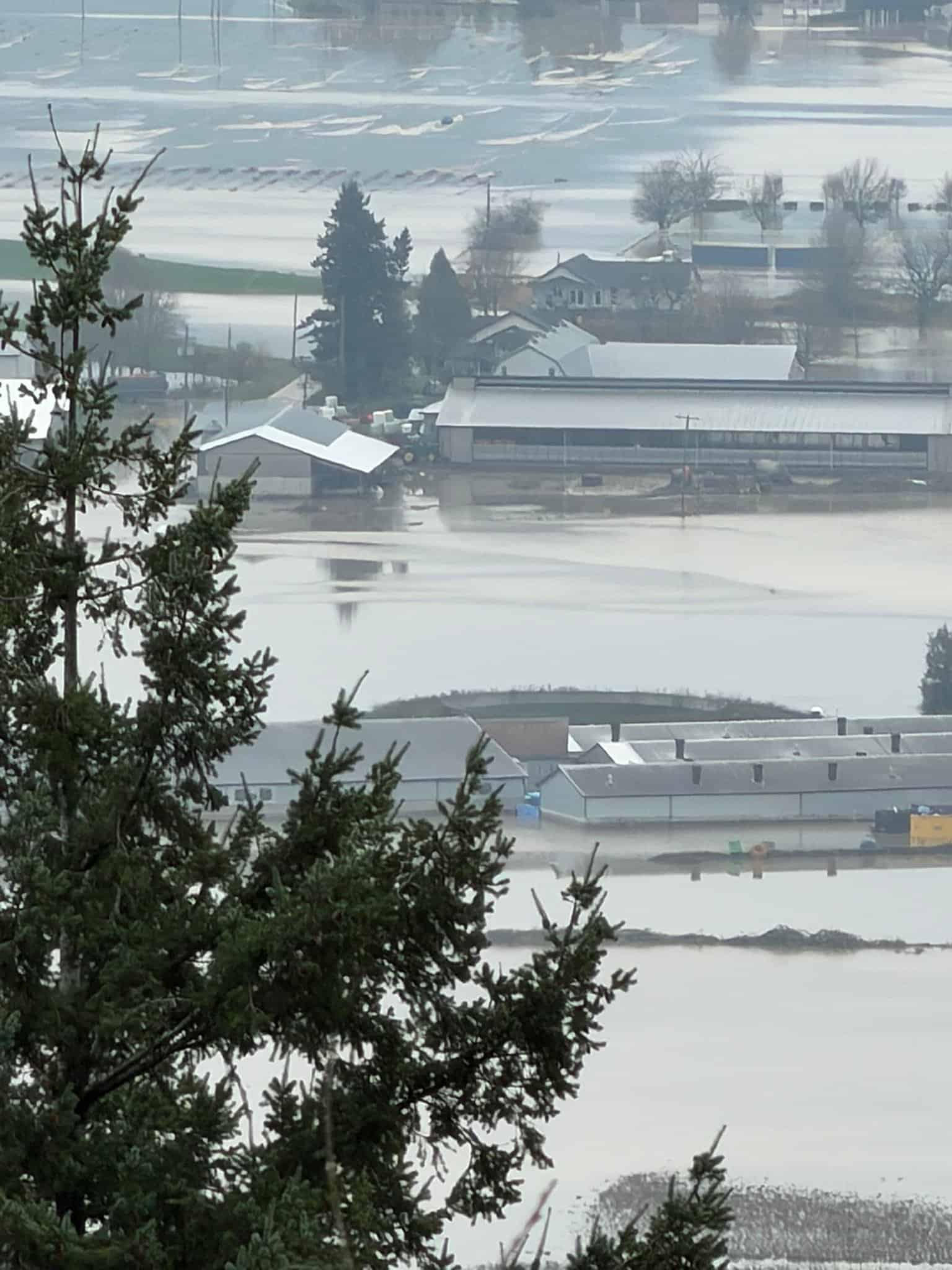
ABBOTSFORD — The financial toll of December’s severe weather is coming into sharp focus, with the Insurance Bureau of Canada (IBC) reporting that last month’s atmospheric river caused nearly $90 million in insured damage across Western Canada—with the Fraser Valley bearing the brunt of the destruction.
According to new estimates released Friday, roughly $74 million of that total is tied to homes and businesses in the Fraser Valley. The region was submerged in mid-December when the Nooksack River in Washington State once again breached its banks, sending cross-border floodwaters into Abbotsford’s Sumas Prairie—a haunting echo of the catastrophic 2021 floods.
A Strategy Without ‘Sinews’
The report has reignited a fierce debate over B.C.’s disaster preparedness. While the provincial government released a formal flood strategy following the 2021 disaster, the IBC claims the plan “remains underfunded” and lacks the teeth to protect residents from the “new weather reality.”
“Investing in community resilience and damage prevention is always more cost-effective than paying to rebuild year after year,” said Aaron Sutherland, Vice-President of IBC’s Pacific and Western regions.
Sutherland noted that while insurers cover 93% of B.C. homeowners, coverage remains unavailable for those in the highest-risk zones—the very people who are being hit repeatedly. He is calling for immediate provincial funding for:
- Flood risk mapping to identify vulnerable zones.
- Protective infrastructure like dikes and pump stations.
- Property incentives to help residents “flood-proof” their homes.
Victoria Blames Ottawa for Funding Gap
Minister of Emergency Management Kelly Greene defended the province’s record, stating that officials have been working closely with hard-hit communities like Abbotsford, Merritt, and Princeton. However, she pointed the finger at the federal government for the lack of progress.
“Our government has been working closely with these communities so people will be better protected… but we can’t do this work alone,” Greene said. She argued that while B.C. has committed to recovery, Ottawa “has not joined B.C. in supporting these communities in their recovery efforts.”
The December deluge forced the evacuation of over 450 properties and inundated several poultry barns, though early reports suggest livestock losses were significantly lower than in 2021.
The North Coast Context
While the Fraser Valley remains the epicenter of flood damage, the “atmospheric river” weather systems are a growing concern for the Skeena and North Coast. Northern B.C. saw an additional $16 million in insured damages from the same December system, primarily due to localized flooding and wind damage.
As climate patterns shift, northern municipal leaders are watching the Fraser Valley’s struggle with interest, fearing that without a fully funded provincial strategy, rural and northern infrastructure could be left behind in the next major storm cycle.