





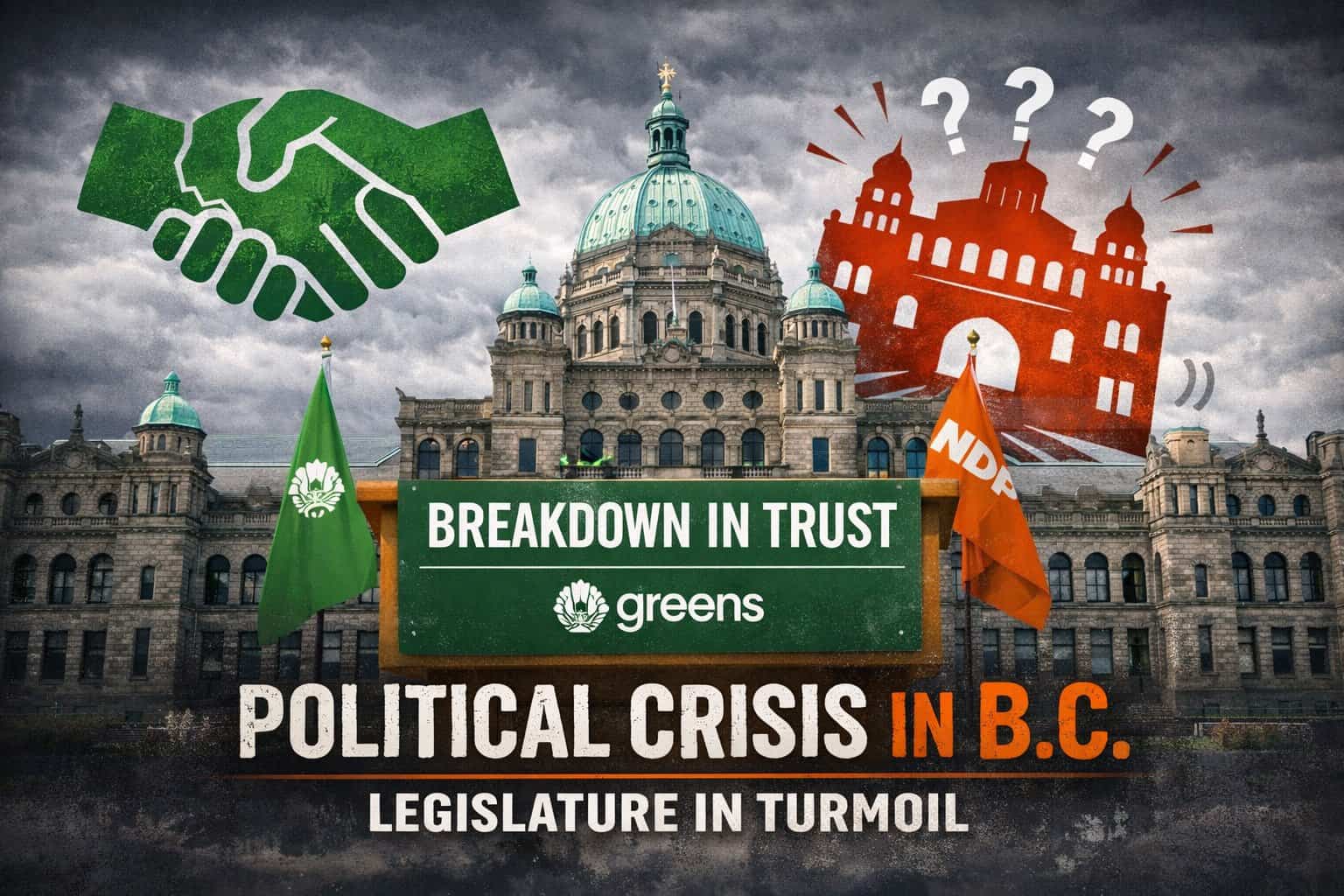
VICTORIA – The landscape of British Columbia’s provincial politics shifted significantly on Monday as the B.C. Green Party officially terminated the Confidence and Reform Government Agreement (CARGA) with the governing NDP.
In a press conference held in Victoria on the morning of February 9, B.C. Green Party Leader Emily Lowan, alongside MLAs Rob Botterell and Jeremy Valeriote, announced that the party would no longer provide guaranteed support for the government. The leadership cited a “breakdown in trust” and a failure by the NDP to meet specific commitments outlined for 2025.
Breakdown in Trust
Rob Botterell, MLA for Saanich North and the Islands, stated that the decision followed a period of increasing friction regarding the execution of shared priorities.
“The Greens entered this agreement in good faith to provide stability for British Columbians,” Botterell said. “However, the government’s inability to execute on agreed-upon priorities has raised serious questions about its administrative competence.”
The Government’s Response
The dissolution of the accord moves the B.C. Legislature into a “vote-by-vote” environment. This means the NDP must now negotiate support for every piece of legislation, including the upcoming spring budget and critical confidence motions.
Premier David Eby maintained that the government remains functional, though it faces a tighter margin in the house. The NDP is currently relying on remote voting from members facing health challenges, including Joan Phillip and Grace Lore, to maintain its legislative edge.
Attorney General Niki Sharma offered a different perspective on the collapsed negotiations. Sharma indicated that the NDP could not reach a middle ground because the Greens refused to rule out a potential alliance with the Conservative Party to trigger an early election—a move Sharma characterized as contrary to the interests of the public.
What Happens Next?
The immediate focus now turns to the spring budget. Without a formal agreement in place, the provincial government faces a high degree of uncertainty. If a budget or a confidence motion fails to pass, British Columbians could be headed to the polls sooner than anticipated.
For residents in the Skeena region and across the North, this legislative shift may impact the speed and delivery of provincial programs as the government navigates a more volatile assembly.