






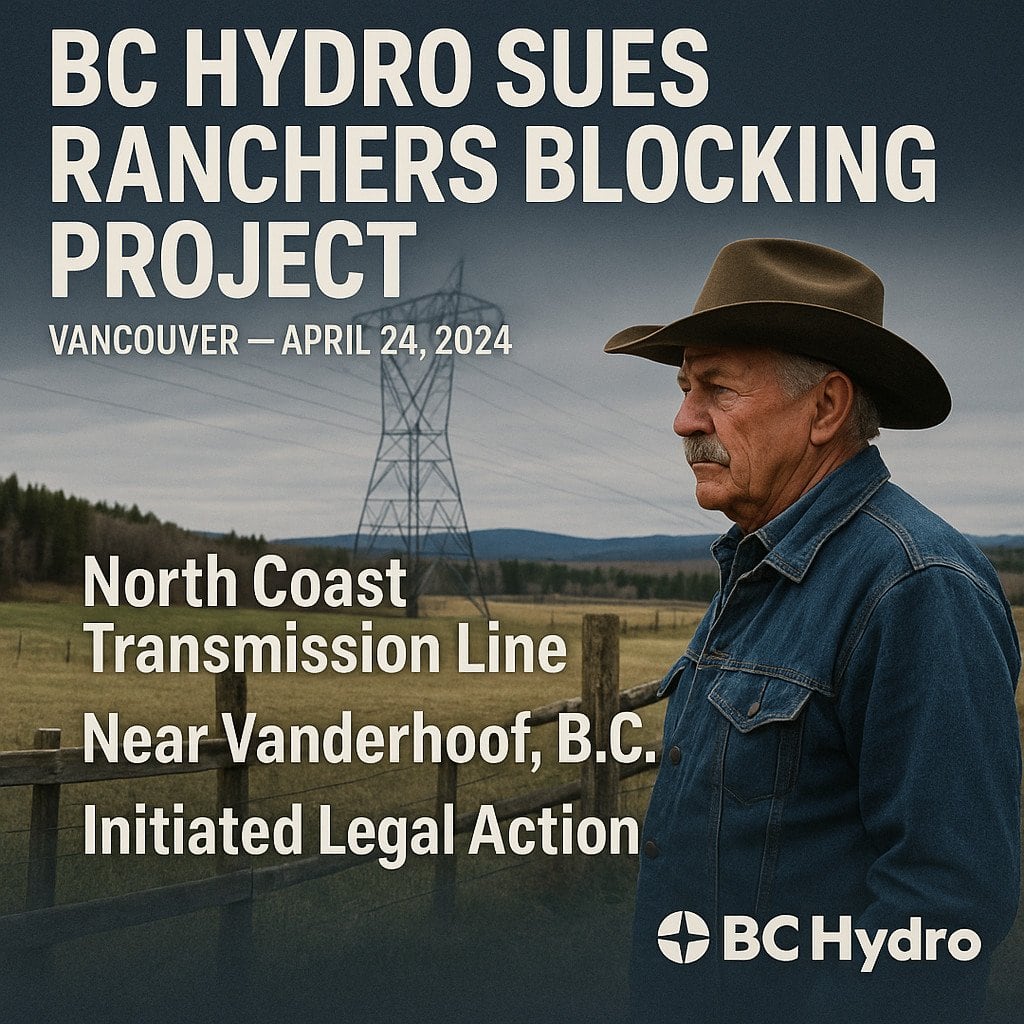
VANCOUVER — British Columbia’s Crown utility, BC Hydro, has initiated legal action against a family of ranchers near Vanderhoof, B.C., for allegedly blocking access to land crucial for the $6-billion North Coast Transmission Line (NCTL).
The NCTL, which Prime Minister Mark Carney designated a “nation-building” project last month, is essential to expanding the province’s electricity grid to power major industrial developments in the Skeena region, including new mines, LNG facilities, and port expansions.
BC Hydro filed a petition in B.C. Supreme Court last week alleging that Kenneth Fawcett, Carolyn Fawcett, and their daughters, who own the multi-generational Little Valley Farms, have wrongfully prevented the utility and its contractors from accessing properties covered by existing right-of-ways.
The Rancher’s Grievances and Conflict
Court documents detail months of conflict between the utility and the family, who assert they were protecting their multi-generational beef operation. The family’s correspondence shows frustration over property damage, including:
- Crop and field damage.
- Gates being left open and fences being cut.
- Tragically, four horses “being killed on the road”.
The family, led by Kenneth Fawcett, who is also the president of the BC Breeder and Feeder Association, sought more financial compensation than the utility offered, along with required infrastructure upgrades like cattle guards and a bridge replacement. An email from the farm stated that an agreement with BC Hydro “will impact future generations to come. We do not take it lightly”.
Tensions escalated in September 2025 when a property contractor reported that Mr. Fawcett had told him BC Hydro was “squatting on his land.” When informed crews had a “legal right” to enter, Fawcett allegedly responded: “bring it on“.
High Stakes and Broader Implications
The utility claims it had “no choice” but to seek a court order after being repeatedly denied access since 2023. The crews require access for essential pre-construction work, including forestry, archeological, environmental, and surveying.
BC Hydro’s petition warns that delaying the first phase of construction could have “broader implications,” including rate hikes for customers, negative economic impacts, and an increase in greenhouse gas emissions.
The Fawcett family, who only learned of the court filing through a reporter, issued a brief statement: “Our intention has been and will always be to find a workable solution for all involved”.
The petition has not been tested in court, and the outcome will be closely watched as it sets a precedent for how large-scale energy projects balance national interests with private property rights in B.C..