






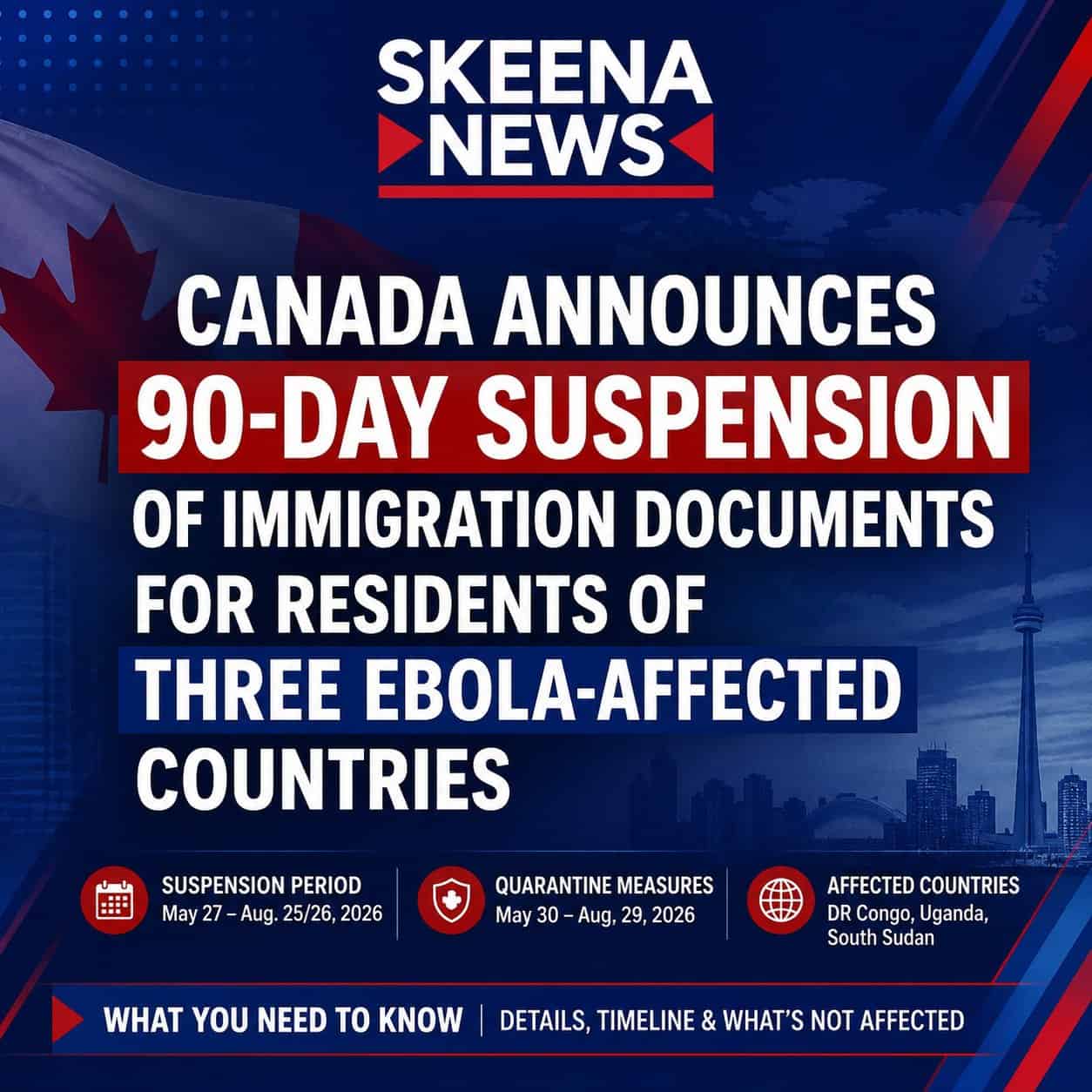
OTTAWA, CANADA — The Government of Canada has announced temporary emergency border and immigration measures in response to the growing Ebola outbreak in parts of Central and East Africa, affecting residents of the Democratic Republic of the Congo (DRC), Uganda, and South Sudan.
The federal government confirmed that beginning May 27, 2026, at 11:59 p.m. EDT, immigration documents issued to residents of these three countries will be temporarily suspended for a period of 90 days. The measures are currently expected to remain in effect until approximately August 25–26, 2026, unless extended or modified by Canadian authorities.
The suspension applies to:
- Temporary Resident Visas (TRVs)
- Electronic Travel Authorizations (eTAs)
- Permanent Resident Visas
- Certain immigration-related travel documents issued to residents of the affected countries
This means that even individuals who already received approval to travel or immigrate to Canada will not be permitted to enter the country using those documents while the suspension remains active.
In addition, Immigration, Refugees and Citizenship Canada (IRCC) will temporarily pause final decisions on many new applications submitted by residents of the Democratic Republic of the Congo, Uganda, and South Sudan. Government officials stated that applications may continue to be processed internally, but final approvals and document issuance will be delayed during the suspension period.
Separate Quarantine Measures Begin May 30
The federal government also announced a second public-health measure that will take effect on May 30, 2026, at 11:59 p.m. EDT and remain in place until August 29, 2026.
Under this measure, Canadian citizens, permanent residents, individuals registered under the Indian Act, and foreign nationals who have recently been in affected Ebola regions within the previous 21 days will be required to complete a 21-day quarantine period upon arrival in Canada if they do not have symptoms. Those showing symptoms will be transported for medical assessment and isolation under Canada’s Quarantine Act.
Government officials emphasized that Canadian citizens and permanent residents will still be allowed to return to Canada but will undergo enhanced health screening at ports of entry.
Why Canada Is Taking Action
The Public Health Agency of Canada stated that the measures are precautionary and intended to reduce the risk of Ebola entering Canada during a period of heightened international travel. Officials also referenced the upcoming FIFA World Cup 2026, which will see matches hosted in Toronto and Vancouver and is expected to bring hundreds of thousands of international visitors into the country.
The World Health Organization recently raised concerns over the outbreak and warned that the risk of wider international spread has increased. Several countries, including the United States, Bahamas, Mexico, and others, have also introduced travel restrictions, screening requirements, or quarantine measures related to the Ebola outbreak.
What Is Not Affected
Canadian officials stressed that the measures are temporary and targeted. They do not represent a general shutdown of Canada’s immigration system and do not affect residents of other countries. Individuals already inside Canada are not impacted by the suspension and may continue to remain in Canada for the duration of their authorized stay.
At present, Canada has reported no Ebola cases, and federal authorities say the overall risk to Canadians remains low. However, officials stated that border measures may be extended, shortened, or amended depending on how the outbreak develops in the coming weeks.
Timeline Summary
- May 26, 2026: Canada announces emergency border measures.
- May 27, 2026 (11:59 p.m. EDT): 90-day suspension of immigration documents begins.
- May 30, 2026 (11:59 p.m. EDT): Mandatory quarantine measures begin.
- August 25–26, 2026: Expected end of the 90-day immigration document suspension.
- August 29, 2026: Scheduled end of quarantine measures, unless extended.
Sources: Public Health Agency of Canada, Immigration, Refugees and Citizenship Canada (IRCC)