





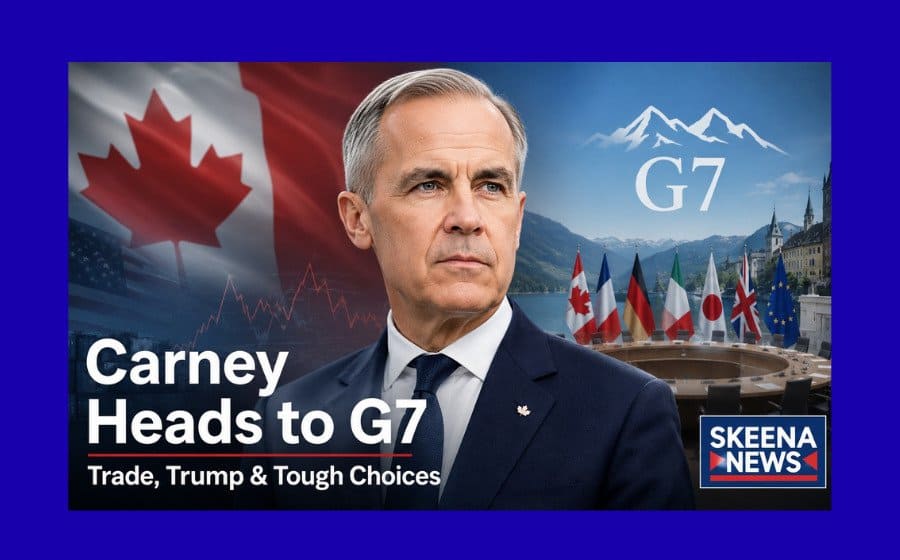
Carney Heads to G7 as Canada Tries to Balance Trump Tensions and Trade Reality
Prime Minister Mark Carney is heading into the G7 summit in France at one of the most sensitive moments in Canada’s relationship with the United States.
Carney met French President Emmanuel Macron in Paris ahead of the G7 Leaders’ Summit in Évian-les-Bains, France, where trade, global security, technology, and the future of international cooperation are expected to dominate discussions.
But for Canada, one issue sits above almost everything else: the future of trade with the United States.
The timing is important. The G7 summit comes just weeks before a key review of the United States-Mexico-Canada Agreement, widely known as USMCA or CUSMA in Canada. That agreement is central to Canada’s economy, linking Canadian industries, workers, exporters, manufacturers, farmers, and resource sectors to the American market.
For many Canadians, the political language around sovereignty and independence from the United States is emotionally powerful. But the economic reality is much harder. Canada remains deeply dependent on U.S. trade, with a major share of Canadian exports still going south of the border.
That is why Carney’s tone toward U.S. President Donald Trump is being closely watched.
Earlier this year, Carney presented himself as a strong defender of middle powers and warned against larger countries using economic pressure against smaller allies. That message resonated with many Canadians, especially after Trump repeatedly made aggressive comments about Canada and launched trade measures that damaged relations.
But now, with trade talks approaching, Carney appears to be taking a more careful approach.
This does not mean Canada is backing down. It means Ottawa is trying to avoid worsening the relationship at a time when the stakes are very high.
For British Columbia and northern communities, these national trade decisions are not abstract. Forestry, energy, mining, ports, transportation, construction materials, seafood, and small businesses are all affected by cross-border stability. When Canada-U.S. trade becomes uncertain, investment decisions slow down. Companies wait. Projects become more expensive. Jobs become less secure.
That is why Carney’s European trip matters beyond Ottawa.
The Prime Minister’s Office says Carney’s visit to France and Ireland is aimed at deepening partnerships in trade, defence, technology, artificial intelligence, quantum industries, critical minerals, agri-food, pharmaceuticals, and climate-related sectors. In Paris, Canada is looking to strengthen ties with France. In Ireland, Carney is expected to focus on cultural, economic, digital, and agri-food connections.
The larger strategy is clear: Canada wants more options.
For years, Canadian governments have talked about diversifying trade beyond the United States. Carney is now trying to turn that idea into a serious policy direction. But diversification is easier to promise than deliver. The United States remains Canada’s closest, largest, and most practical trading partner. Geography, infrastructure, business networks, and decades of integrated supply chains cannot be replaced quickly.
That leaves Carney with a difficult balancing act.
At home, he must show Canadians that Canada will not be pushed around. Abroad, he must convince allies that Canada is a serious and reliable partner. With Trump, he must protect Canada’s interests without turning the upcoming trade review into a political fight that could damage Canadian workers and businesses.
The G7 summit will test that balance.
The summit also comes at a time when global politics are becoming more unstable. Wars, tariffs, energy insecurity, food costs, artificial intelligence, and competition with China are forcing countries to rethink old alliances and supply chains. Canada’s message is that it wants to build strength at home while expanding partnerships abroad.
For northern B.C., that message should be watched carefully.
If Canada succeeds in expanding trade with Europe and other partners, regions like northern British Columbia could benefit from new demand for natural resources, clean energy, critical minerals, port capacity, and transportation links. But if Canada-U.S. trade relations deteriorate, northern industries could feel the pressure quickly.
Carney’s challenge is not simply to sound strong. His challenge is to protect Canada’s economy while building a future where Canada has more than one major customer.
That is the real story behind this G7 trip.
Canada wants independence. But first, it must manage dependence.