






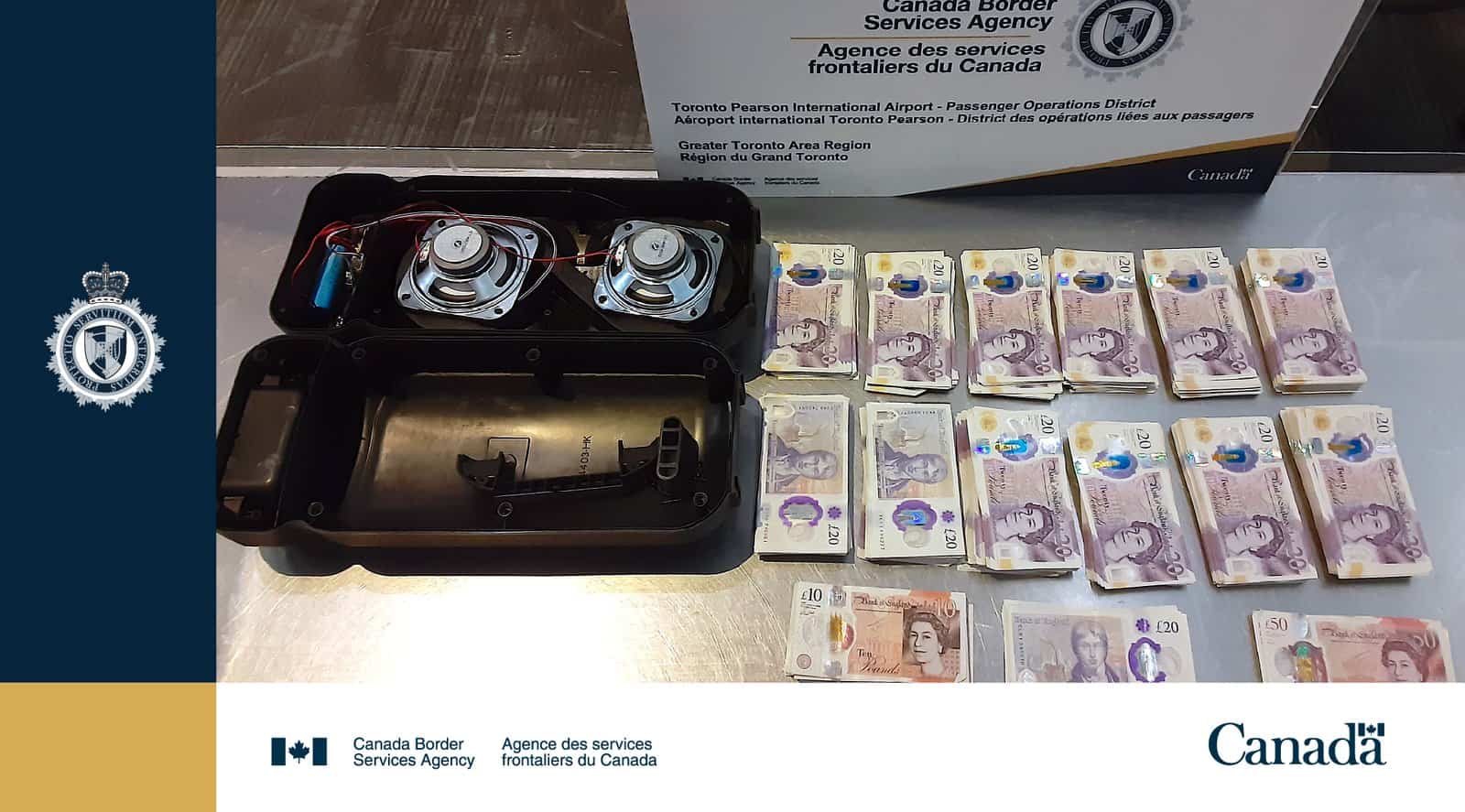
TORONTO, ON — Canada Border Services Agency (CBSA) officers at Toronto Pearson International Airport recently intercepted a traveler attempting to smuggle a large sum of undeclared currency into the country. The individual, arriving from the United Kingdom, was denied entry into Canada after officers discovered British currency equivalent to $38,700 CAD concealed inside a portable speaker.
The seizure was conducted as part of the CBSA’s mandate to disrupt the flow of suspected proceeds of crime. Under Canadian law, travelers are required to declare any currency or monetary instruments valued at $10,000 CAD or morewhen entering or leaving the country.
What Happens to the Seized Money?
When currency is seized by the CBSA as “suspected proceeds of crime,” it follows a strict legal protocol:
- Forfeiture: Unlike cases where a traveler simply forgets to declare legitimate savings (which can often be returned after paying a fine), currency suspected of being tied to criminal activity is typically seized with no terms of release.
- Government Revenue: Once the forfeiture is finalized, the funds are generally transferred to the Receiver General for Canada. These assets may then be reallocated to the Seized Property Management Directorate (SPMD) or used to fund government programs, including law enforcement and victim services.
- Appeals: The individual has the right to appeal the seizure within 90 days by filing a Ministerial Review to prove the funds were obtained legally and were not intended for criminal use.
What Happens to the Individual Denied Entry?
Being denied entry at a Canadian port of entry carries immediate and long-term consequences for a foreign national:
- Immediate Removal: In most cases, a traveler deemed inadmissible is placed on the next available flight back to their point of departure. They remain in CBSA custody or a designated holding area until their flight departs.
- Permanent Record: The denial of entry is recorded in Canada’s global immigration database. This often results in a “red flag” that makes obtaining future Electronic Travel Authorizations (eTAs) or visas significantly more difficult.
- Potential Criminal Charges: While being denied entry is an administrative action, the traveler may also face criminal charges under the Proceeds of Crime (Money Laundering) and Terrorist Financing Act or the Customs Act. If charged and convicted, they could face significant fines or imprisonment in Canada before being deported.
- Future Inadmissibility: Depending on the severity of the concealment and the suspected origin of the money, the individual may be issued an Enforcement Order, such as an Exclusion Order (banning them from Canada for 1–5 years) or a Deportation Order (a permanent ban unless they receive special permission to return).