






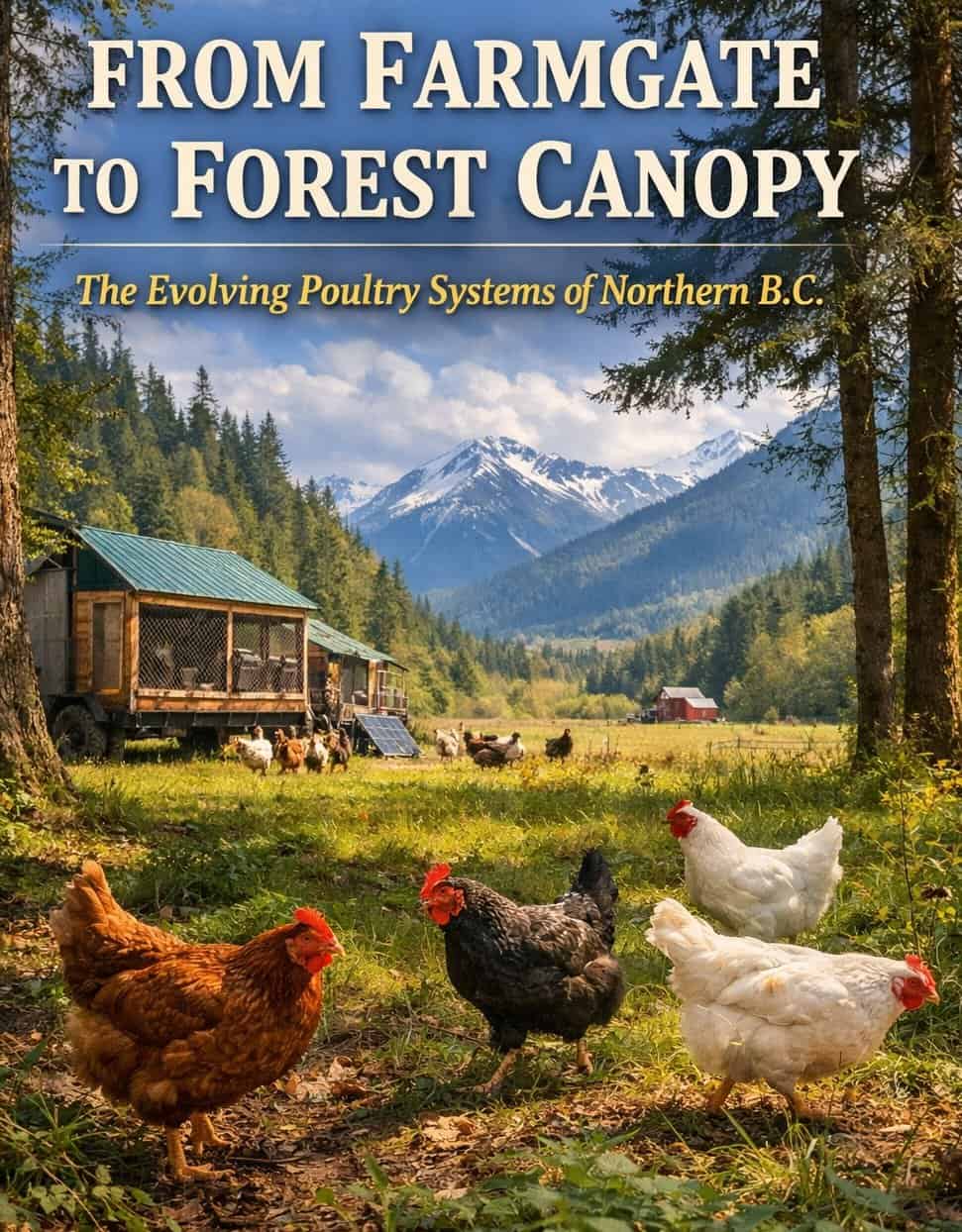
SKEENA NEWS ANALYSIS – In the remote corridors of Northern British Columbia, the sourcing of poultry has evolved from a simple retail logistic into a critical pillar of regional protein security. As traditional food sources like sockeye salmon and moose face ecological pressures, chicken—both industrially produced and locally raised—has become a foundational element of the northern diet.
A new report provides a comprehensive look at the interplay between centralized industrial supply chains and a growing decentralized movement toward food sovereignty across the Skeena and Kitimat-Stikine districts.
The Logistical Gap: 1,000 Kilometers to the Shelf
The poultry industry in British Columbia is highly centralized. Approximately 80.6% of BC chicken farmers are located in the Lower Mainland, while Northern B.C. accounts for less than 0.1% of regulated mainstream production.
This geographic concentration means that most “fresh” chicken in northern supermarkets has traveled over 1,000 kilometers from processing plants in Abbotsford or Chilliwack. This reliance creates significant vulnerabilities; disruptions in the south, such as the major flooding and weather alerts seen in the Fraser Valley, can lead to immediate regional shortages.
Industrial Sourcing: National Brands and Local Partnerships
For residents in Terrace and Kitimat, major retailers like Save-On-Foods and No Frills are the primary sources of poultry.
- Save-On-Foods: Emphasizes Western Canadian sourcing, with 95% of its chicken meeting or exceeding National Farm Animal Care Council (NFACC) stocking density standards.
- No Frills: While carrying national labels, local franchises often integrate regional products. For instance, Kyle’s No Frills in Kitimat sources its eggs from Terrace’s Daybreak Farms, supporting the local economy and reducing the carbon footprint of its supply.
The Regenerative Revolution: “Tree-Range” Poultry
The most innovative development in the region is the “Tree-Range” model, spearheaded by the Skeena Watershed Conservation Coalition (SWCC). Moving away from massive barns, this system utilizes the biological heritage of chickens as a jungle species.
| Feature | Industrial Broiler System | Skeena Tree-Range Model |
| Environment | Enclosed barns, high-density | Forest paddocks, 50% canopy cover |
| Diet | Standardized soy/corn pellets | Local grains + forest forage (bugs, slugs) |
| Growth Cycle | ~35 Days | ~84 Days (12 Weeks) |
| Fat Color | White fat | Yellow fat, complex flavor profile |
Spearheaded by local farmers like Nathan Coombs of Skeena Valley Farm, the project aims for food sovereignty for Indigenous communities. Supported by a $31,115 grant from Northern Health, the initiative is working to develop a mobile processing facility that can be shared among different Nations and farmers.
The Processing Bottleneck
Despite the demand for local birds, the lack of large-scale processing infrastructure remains a major obstacle.
- Graduated Licensing: B.C. uses a tiered system, where “Farmgate” licenses allow for the slaughter of up to 5 “Animal Units” (roughly 5,000 lbs) for local sale.
- Regional Hubs: Local producers currently rely on specialized facilities like Bulkley Valley Custom Slaughter in Telkwa (BC 23) and Newsat Farm in Vanderhoof.
Culinary Integration – A Regional Snapshot
The region’s restaurants showcase the diverse ways poultry is integrated into Northern B.C. culture:
- Terrace: Waldo’s Chicken and Beer specializes in Southern Fried and rotisserie styles, while Arabisk offers Mediterranean-influenced Lebanese chicken dishes.
- Smithers: The Roadhouse is renowned for its Southern Fried Chicken Skillet, utilizing locally sourced organic greens.
- Coastal Hubs: In Prince Rupert, Pavilion Restaurant serves traditional tandoori-style chicken curries, while Pedro’s Grill in Kitimat is a staple for fried chicken.
The Path Ahead
The future of northern poultry lies in scaling the regenerative model while navigating high feed costs and the persistent threat of Avian Influenza. From the forest-raised birds of the Upper Skeena to the farm-to-table menus of the Bulkley Valley, the region is proving that resilience and local food security go hand-in-hand.