





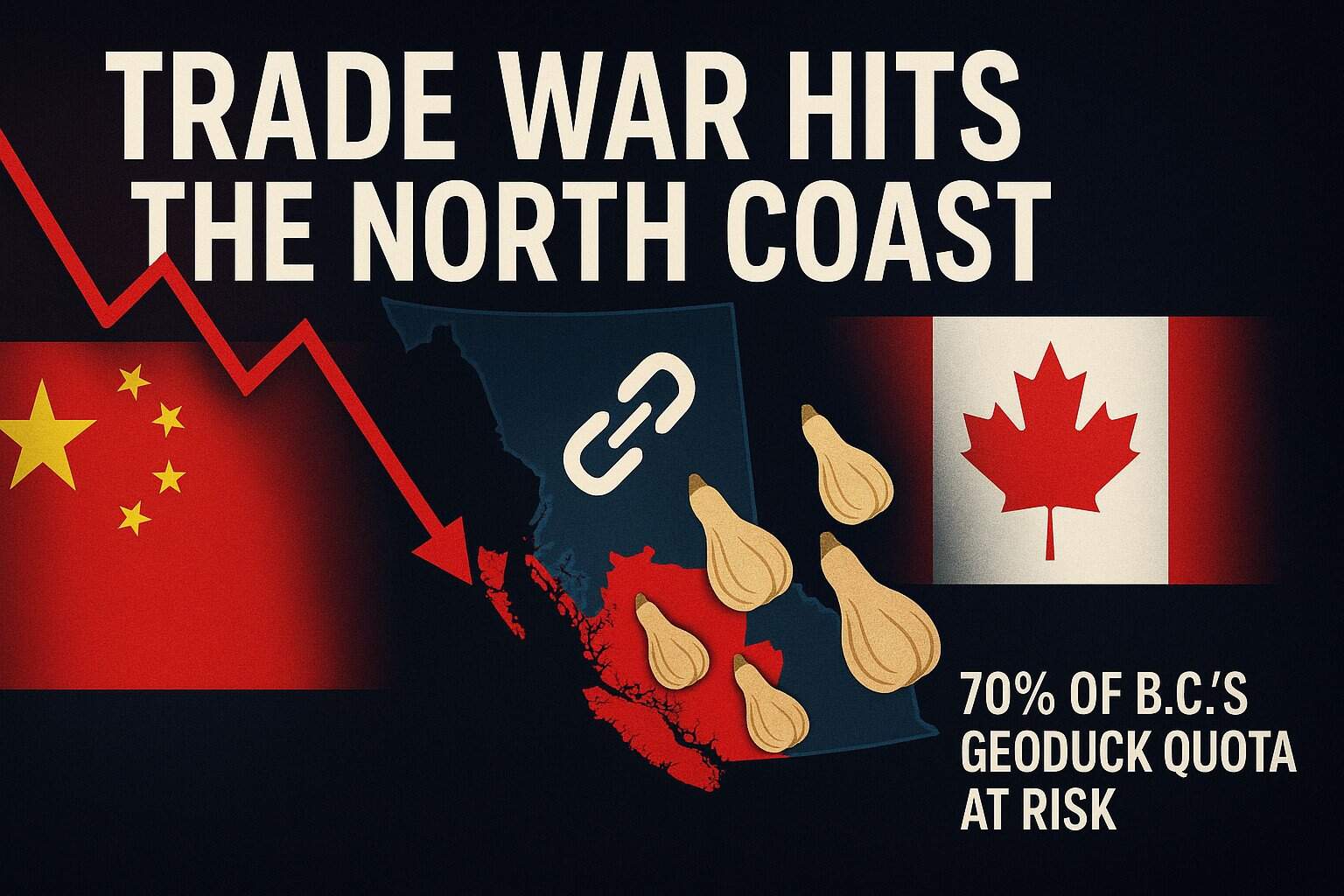
SKEENA REGION – The high-value commercial dive fisheries of British Columbia—including geoduck, sea cucumber, and sea urchin—are navigating a crisis precipitated by geopolitical volatility, with the economic shock disproportionately affecting harvesters in the North Coast region.
The crisis began when China imposed retaliatory tariffs, including a 25 per cent levy on Canadian aquatic products, in response to Canada’s tariffs on Chinese goods. This action exposed a critical structural flaw in the B.C. geoduck sector: its extreme reliance on the Chinese market, which historically bought 90 to 95 per cent of the product.
Quantifying the Shock: Harvesters Take a 50% Pay Cut
The immediate economic consequences far exceeded the nominal tariff rate. When the tariffs were announced, the price paid to harvesters for geoduck dropped overnight by 50 per cent.
This severe price collapse forced fishing families, many operating out of Prince Rupert and other Skeena-adjacent communities, to accept immediate salary cuts of up to 50 per cent. While the price has recovered slightly, it remains approximately 25 per cent lower than pre-tariff levels, placing severe financial strain and increasing solvency risks for highly indebted operators.
“When harvesters put all their clams in one basket, the geopolitical tide can recede swiftly, leaving the sector exposed,” stated one industry analysis.
The North Coast Bears the Heaviest Burden
A detailed analysis of quota allocation confirms that this economic instability is profoundly concentrated geographically in Northern B.C. The North Coast manages and lands the vast majority of the Total Allowable Catch (TAC) for geoduck.
DFO data confirms that the North Coast contributes over 70.4% of the entire B.C. commercial geoduck volume. This overwhelming concentration means that more than two-thirds of the economic instability, including sustained income loss and solvency risks, is geographically situated in Northern B.C.
Furthermore, the substantial Indigenous participation in the dive fisheries means this trade instability directly undermines ongoing efforts toward reconciliation and Indigenous economic development.
The Imperative for Diversification
Faced with a politically motivated crisis, the industry is accelerating efforts toward diversification:
- Domestic Market: The industry recently held the Divers’ Catch Gala, attempting to replicate the success of the B.C. Spot Prawn Festival by educating Canadian consumers on delicacies like geoduck sashimi. However, experts note the domestic market is currently insufficient to absorb the required volume.
- International Re-alignment: Associations are actively promoting dive fisheries at trade shows in global markets like Singapore, Boston, and Barcelona, leveraging B.C.’s strong sustainability credentials (low 1.2% exploitation rate and zero bycatch) to secure a premium price in new, stable jurisdictions.
The crisis has exposed the inherent vulnerability in the supply chain, which relies on centralized processing and air freight out of the Vancouver/Richmond hub. Policy efforts must now focus on immediate mitigation and strategic investment in infrastructure to decentralize live-seafood logistics and build long-term sector resilience in the North.