






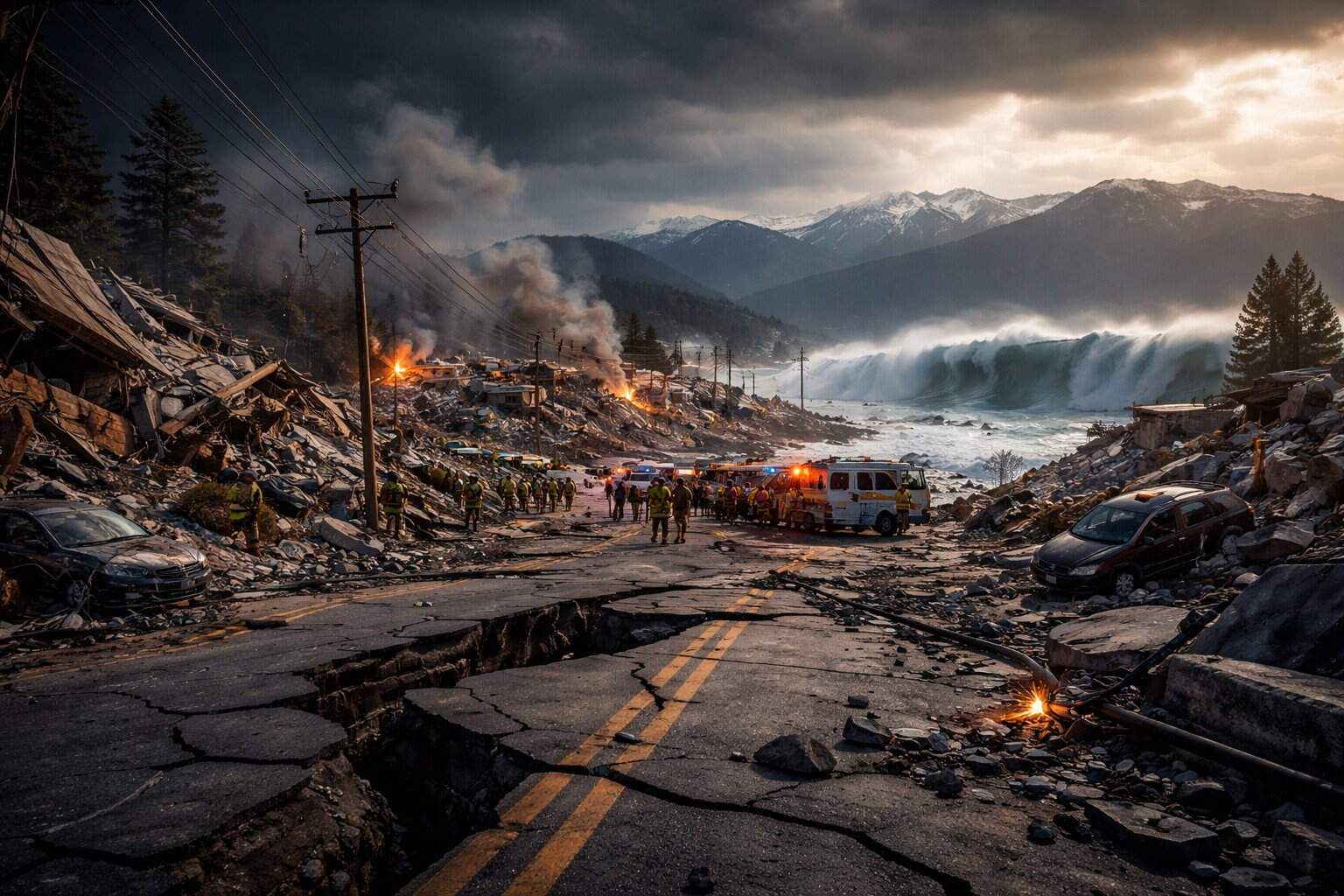
Northwest BC earthquake risk
SKEENA NEWS — A sobering new provincial report has confirmed what geologists have warned of for decades: a catastrophic earthquake is not just a possibility for British Columbia, but an inevitability. According to the British Columbia Disaster and Climate Risk and Resilience Assessment (DCRRA), released in October 2025, the risk is no longer a distant “what if” but a measurable threat to nearly every citizen in the province.
The assessment outlines a “most likely” scenario with severe consequences: a magnitude 9.0 megathrust earthquakerupturing off the Cascadia Subduction Zone. In that scenario, more than 3,400 people could die and 18,000 buildings could be destroyed, with a subsequent tsunami hitting coastal communities within 20 minutes.
The Science of the ‘Big One’
The Cascadia Subduction Zone experiences a colossal earthquake roughly every 400 to 500 years. As of 2026, it has been 326 years since the last major rupture.
- The Probability: According to Natural Resources Canada and U.S. Geological Survey modeling, there is roughly a 37% chance of a magnitude 7.1 or greater earthquake occurring within the next 50 years.
- The Population at Risk: According to the province’s Hazard Insights Tool, 92% of B.C.’s population and 78% of critical facilities—such as hospitals, fire halls, and power stations—are located in areas of high seismic risk.
Infrastructure: A Race Against Time
British Columbia is currently a patchwork of seismic readiness. While new construction must adhere to the BC Building Code 2024 (which came into effect on March 10, 2025), a massive inventory of “pre-code” and “low-code” buildings remain highly vulnerable.
In Victoria, studies by the University of Victoria and provincial seismic assessments suggest nearly 40% of structures could be severely damaged in a major quake. In the Skeena and North Coast regions, the focus is on critical infrastructure:
- Seismic Retrofits: The Ministry of Transportation says it has allocated $7 million in the current fiscal year for retrofitting bridges and key road links to ensure supply lines remain open during a disaster.
- School Safety: Through the Seismic Mitigation Program, the province is upgrading 71 schools; 58 are already complete.
- Hospitals: New or recently upgraded hospital facilities in the Northwest are being designed to modern seismic standards so they can remain operational after a major quake.
The Insurance Crisis
One of the most alarming findings in the DCRRA is the potential for a single major earthquake to destabilize Canada’s entire insurance industry.
- Federal Action: The B.C. government is calling on Ottawa to expand its proposed national flood insurance program to include earthquake coverage.
- The Risk: With 40% of Canadians living in moderate-to-high risk zones, the financial fallout of a “Big One” could bankrupt standard private insurers without federal backing.
Preparing for the Unexpected
While the province provides funding streams like the Community Emergency Preparedness Fund (CEPF), critics argue that plans often fail during the chaos of a real event. B.C. Conservative public safety critic Sheldon Clare said that during a mass disaster, “all the best-laid plans tend to go out the window. You end up relying on the initiative of the people who survive and help coming from areas that are less affected.”
How to Prepare Locally:
- Check the Map: Use the B.C. Hazard Insights Tool to see the specific risk level for your neighborhood in Terrace, Kitimat, or Prince Rupert.
- Seismic Upgrades: Homeowners can explore tax incentives for seismic retrofitting, particularly for older heritage or red-brick structures.
- Potable Water: Communities like Sidney are already using grants (such as the $176,000 for disaster-safe water) to ensure access to drinking water if main lines rupture.
Skeena News Strategy Note: In a major quake, the Northwest may be cut off from southern supply hubs. Experts recommend every household maintains an emergency kit with enough food, water, and medicine for at least 72 hours—though 7 to 14 days is increasingly recommended for remote northern regions.