




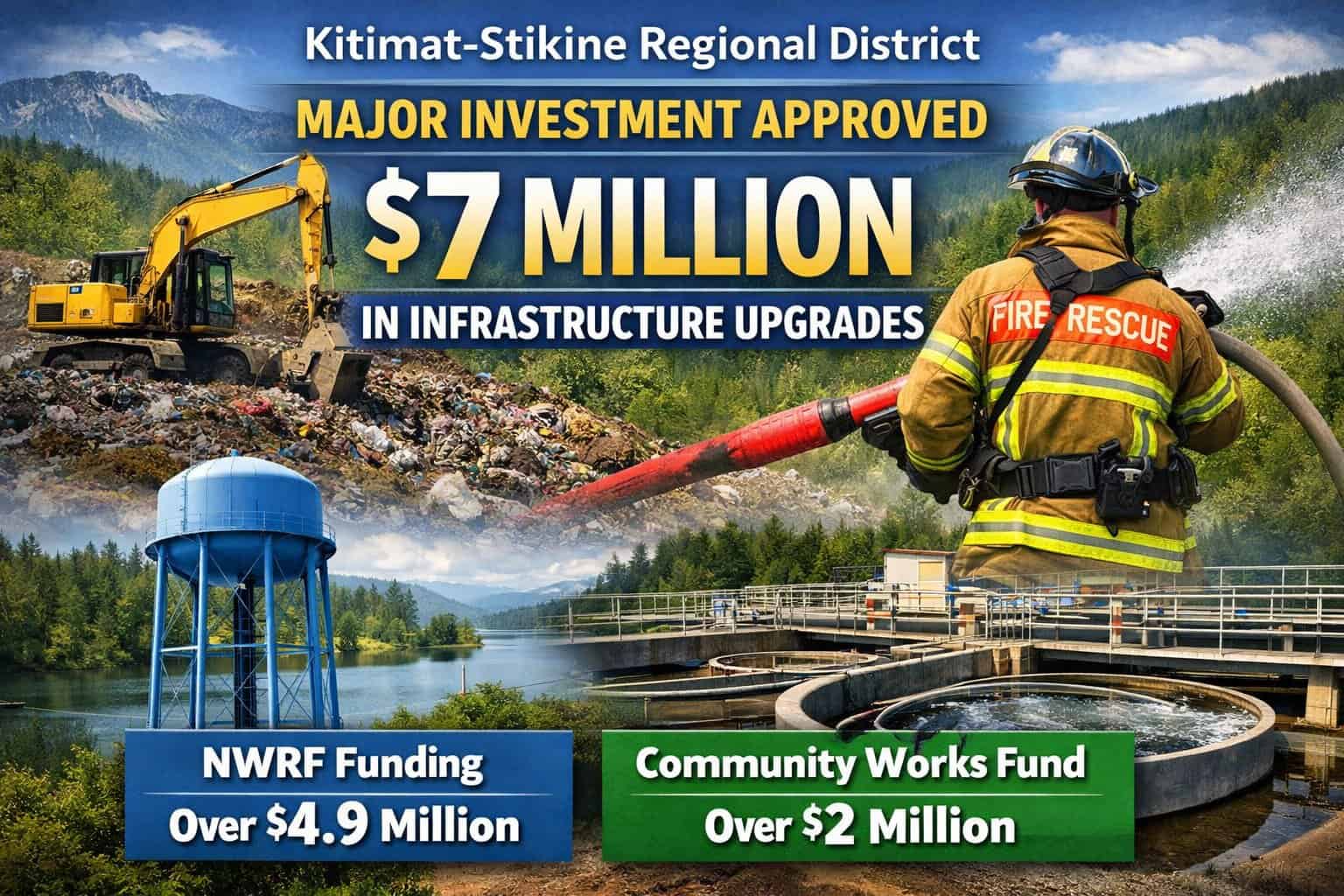
TERRACE, B.C. – The Regional District of Kitimat-Stikine (RDKS) Board of Directors has approved the allocation of more than $7 million in essential capital funding to upgrade infrastructure across its six electoral areas. This major fiscal maneuver, decided at the December 2025 meeting, is aimed not just at maintaining service delivery, but at maximizing future funding leverage with the provincial government.
The total commitment is derived from two critical streams:
- Northwest Regional Funding Agreement (NWRF): Over $4.9 million from this provincial resource mitigation fund.
- Community Works Fund (CWF): Just over $2.0 million from the federal grant program (formerly the Gas Tax Fund).
Compliance Urgency Drives Swift Action
The paramount goal of the December approval was to demonstrate proactive financial management and clear capital backlogs well ahead of mandated deadlines. The RDKS must allocate all NWRF funds by April 1, 2028, and fully spendall CWF funds by March 2029.
Administrative staff stressed that failing to commit the current funding could significantly weaken the District’s position in future negotiations for renewed resource benefit funding. By approving this round, the RDKS has successfully committed approximately 80% of its total $11.9 million NWRF entitlement.
Key Investments – Where the NWRF Money is Going
The NWRF funds, which are specialized “mitigation capital” designed to offset the strain large-scale resource projects place on local infrastructure, were strategically deployed for foundational, long-term programs.
1. Solid Waste Management (Over 67% of NWRF)
The single largest investment is $3.3 million designated for the Hazeltons’ & Stewart Area Solid Waste service (Electoral Areas A, B, and D).
- This substantial capital injection will support essential facility upgrades, new landfill development, and design work related to the Kitwanga Closure.
- The strategy uses provincial resource funds to de-risk these costly, non-revenue-generating services, shielding local taxpayers from the full financial burden.
2. Water and Fire Protection Upgrades
Significant NWRF investments were also directed toward essential utility and emergency capacity improvements across the District:
- Dease Lake Fire Service: A major allocation of $520,000 was approved to support critical infrastructure needs in this northernmost community.
- Thornhill Water Service (Area E): $690,000 was allocated for system upgrades.
- Queensway Sewer Utility (Area E): $150,000 was allocated for environmental treatment enhancements, including the potential addition of a third high-capacity blower.
CWF Focus – Urgent Maintenance and Technical Planning
The Community Works Fund allocations, which have a stringent March 2029 spending deadline, focus on high-priority rehabilitation and technical preparations:
- South Hazelton Weir Rehabilitation: The largest CWF commitment is $900,000 for the comprehensive rehabilitation of the water intake system, which is essential for public health and service reliability.
- Terrace Rural Water: $800,000 was allocated to improve monitoring, quality control, and metering at custody transfer stations.
- Copperside Estates Water: $80,000 was allocated explicitly for design work to establish a secondary well and redundancy within the water system.
Risk Assessment – Administrative Capacity is Key
The analysis points to project delivery as the primary risk moving forward. The substantial remaining balance of $6.2 million in unallocated CWF funding signals a potential future bottleneck. The District now faces the simultaneous pressure of managing multiple large, diverse, and technically complex projects, which will place immense strain on internal administrative capacity for tendering, procurement, and project supervision.
The success of the entire infrastructure strategy depends on the rapid and verifiable completion of these projects, which will be the strongest evidence the RDKS can present to secure the renewal or expansion of the Resource Benefits Agreement when its five-year term concludes.