




A Year of National Reconfiguration and Northern Transformation
SKEENA NEWS ANALYSIS — The year 2025 has proved to be a definitive inflection point in Canadian history, marked by a seismic shift in federal leadership and a strategic pivot that placed Northern British Columbia at the epicenter of national economic security.
As the country navigated a transition from social-policy-focused governance to a technocratic, productivity-driven mandate, the communities of the North experienced a year of profound contradictions: the systemic collapse of traditional forestry set against a historic industrial renaissance in critical minerals and energy.
The Carney Mandate – “Elbows Up” in a New Era
The political landscape underwent a radical reset following the resignation of Justin Trudeau on January 6, 2025. Mark Carney’s rise to the Prime Ministership, leading a minority government after a snap election on April 28, signaled a transition necessitated by the return of Donald Trump to the American presidency.
Carney’s “Elbows Up” campaign resonated with an electorate anxious over 35% U.S. tariffs and threats to Canadian sovereignty. One of the first legislative acts of the new administration was the establishment of the Major Projects Office (MPO), a federal mechanism designed to fast-track infrastructure projects deemed of “national significance,” effectively bypassing long-standing regulatory inertia in the North.
Trade War and Economic Performance
The re-election of Donald Trump fundamentally altered Canada’s economic trajectory. Increased duties on softwood lumber, steel, and aluminum forced a massive reallocation of capital toward “de-Americanized” trade routes.
- Macroeconomic Strain: While B.C.’s economy expanded by 1.4% due to massive capital projects, real GDP growth nationally struggled to stay above 1%.
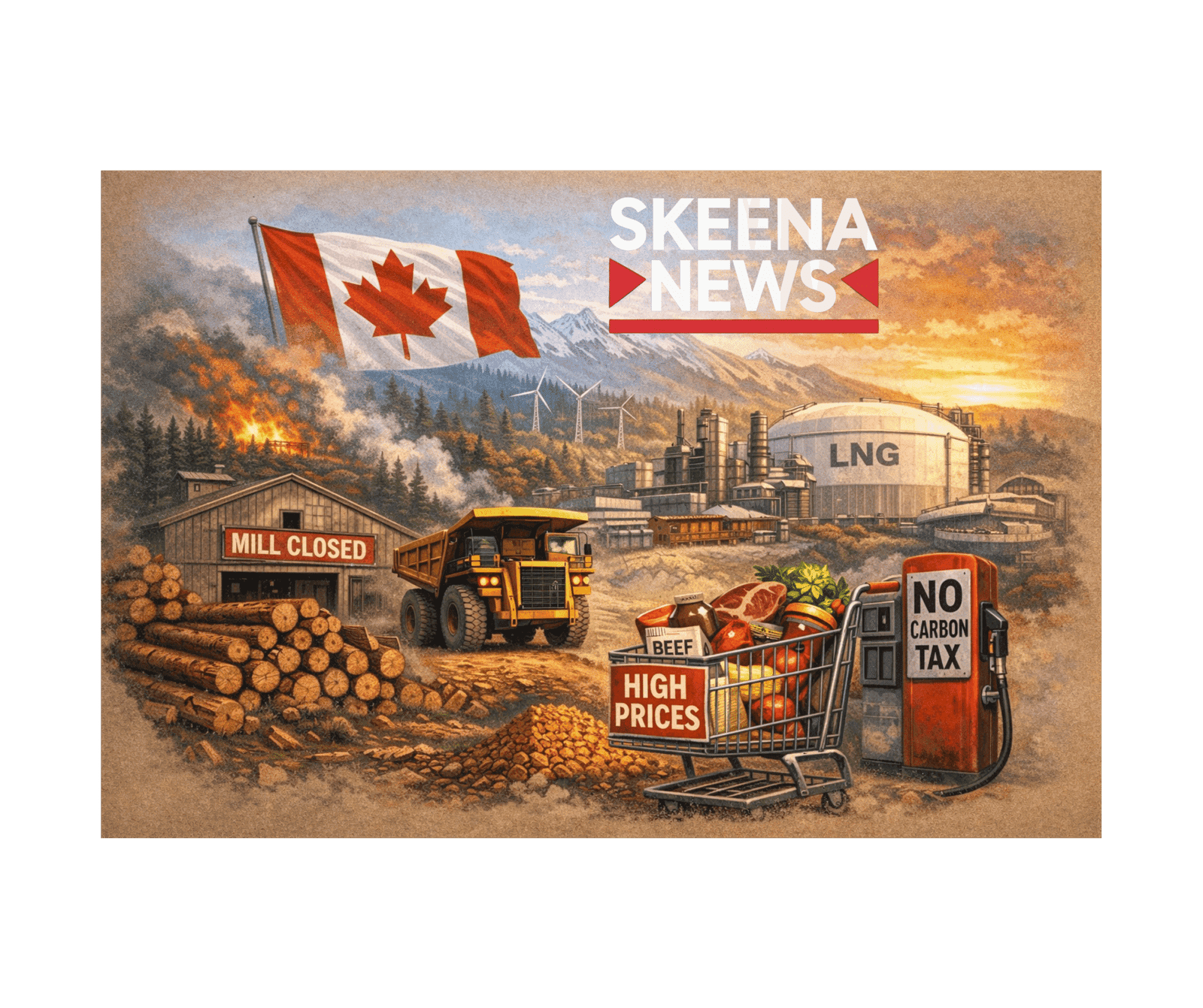
- The Cost of Living: Inflation remained a concern, with grocery prices in B.C. surging by 4.7%. Essentials like beef (+17.7%) and coffee (+27.8%) strained northern household budgets, though the elimination of the federal consumer carbon tax provided some relief on fuel and heating costs.
| B.C. Economic Indicators (Nov 2025) | Percentage Change (Y-o-Y) | Critical Drivers |
| Overall CPI | +2.0% | Moderate compared to national average. |
| Food (Groceries) | +4.7% | Driven by beef, coffee, and fresh fruit. |
| Energy (Fuel/Heating) | -5.8% | Removal of carbon tax. |
| Rent | +4.7% | Elevated despite slower population growth. |
Industrial Renaissance – The Northern Surge
Northern B.C. emerged as Canada’s primary gateway to non-U.S. markets. During a visit to Terrace in November, Prime Minister Carney launched a new wave of “nation-building” projects.
- North Coast Transmission Line (NCTL): This $6 billion project will double electrical capacity between Prince George and Terrace. In a landmark move for economic reconciliation, seven First Nations (K’uul Power) signed for co-ownership, projected to return $1.4 billion in financial benefits over the project’s lifespan.
- LNG and Mining: Federal budget measures extended LNG export licenses to 50 years to support projects like LNG Canada Phase 2 and Ksi Lisims LNG. Meanwhile, the Red Chris Mine expansion is expected to increase national copper production by 15%, a key component in the global battery supply chain.
Crisis in the Woods – Forestry’s Decline and Salvage
The traditional backbone of the North faced a “state of terminal decline” in 2025. Softwood lumber duties of 35% made many operations unviable, leading to permanent closures like the West Fraser mill in 100 Mile House and the Crofton pulp mill.
The Ministry of Forests attempted to “turn devastation into opportunity” by prioritizing wildfire timber salvage. Since 2022, 22 salvage agreements have been issued to First Nations, with pulp mills processing over 1 million cubic meters of “wildfire chips” in the 2024-25 period.
Socio-Economic Challenges: Healthcare and Safety
Despite industrial growth, social infrastructure remained under immense pressure.
- Healthcare Emergency: ER closures and staffing shortages persisted across the North. To combat this, Premier David Eby moved to fast-track American healthcare workers, resulting in 1,400 applications in four months.
- Public Safety Success: The Terrace RCMP reported significant success with the Community Safety and Targeted Enforcement Program (C-STEP). Over four months, the program achieved 231 additional arrests and removed dangerous weapons, including katanas and brass knuckles, from the streets.
Cultural and Scientific Milestones
Amidst the reconfiguration, northern culture and research reached new heights.
- UNBC Excellence: The University of Northern British Columbia recorded its best-ever research performance, including studies on climate impacts in the Nechako Watershed.
- Arts and Reconciliation: The Snotty Nose Rez Kids became the first Indigenous group to win a Juno for Rap Album of the Year, while the Nisga’a Nation celebrated the powerful homecoming of the house pole of Sim’oogit Laay’.
Conclusion – The Road to 2026
The legacy of 2025 is a complex narrative of historic First Nations co-ownership and industrial hope tempered by the decimation of forestry and a hollowing out of rural services. As Canada moves into 2026, the success of the Carney and Eby administrations will be judged not by the speed of their permits, but by their ability to repair the social fabric of the North—ensuring “nation-building” wealth translates into family doctors, affordable homes, and safe communities for those on the front lines of the new frontier.