




Vancouver’s 150 MW AI Data Centre Plan Is Already Facing Protest — What Happens If a 300–400 MW AI Campus Comes to the Skeena Region?
British Columbia is now entering a new industrial debate — not only about LNG, mining, forestry, or ports, but about artificial intelligence.
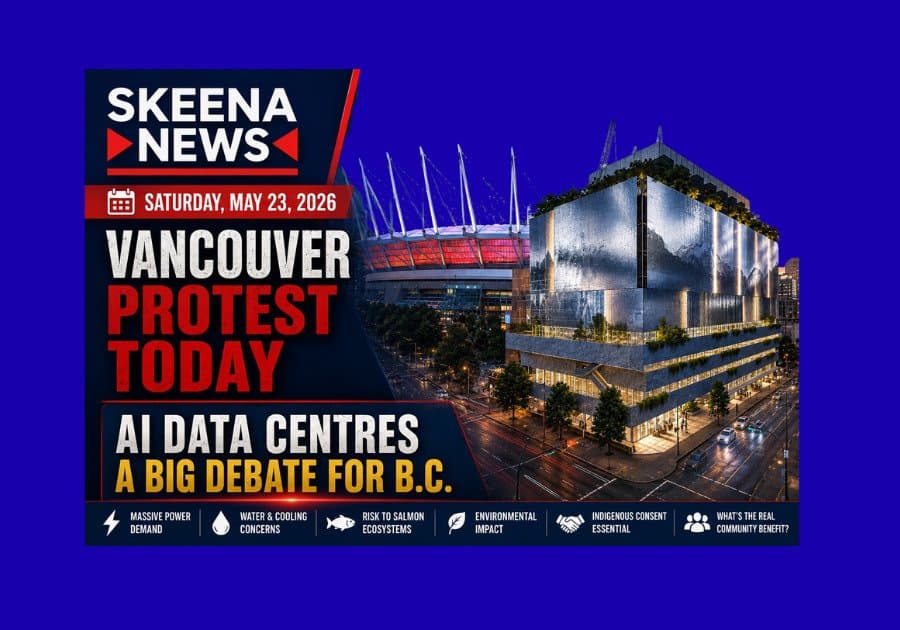
On Saturday, May 23, 2026, a protest is scheduled in downtown Vancouver against proposed AI data centre developments. The protest is being organized by NO AI DATA CENTRES IN VAN, a student-led group identified in the research as being founded by Torin LaRocque. The group is opposing the rapid expansion of large-scale AI computing facilities in Vancouver because of concerns over electricity use, water demand, land use, diesel backup emissions, noise, climate impacts, and the lack of deeper public consultation.
The Vancouver protest matters far beyond the Lower Mainland.
The AI infrastructure currently drawing opposition in Vancouver is connected to a network expected to scale to about 150 MW by 2032. TELUS says the project is designed to scale to more than 60,000 GPUs and 150 MW by 2032.
By comparison, the proposed Skeena Data Centers concept tied to Terrace has discussed a possible long-term build-out of approximately 300 MW to 400 MW. That means the Skeena-region concept could be roughly two to nearly three times larger than the Vancouver-linked AI network already triggering organized public opposition.
For Northwest B.C., the issue is not only artificial intelligence. It is electricity, water, salmon, Indigenous consultation, industrial land, and the future direction of the Skeena region.
What Is Being Proposed in Vancouver?
The Vancouver controversy is connected mainly to the TELUS Sovereign AI Factory expansion, announced with the Government of Canada on May 11, 2026.
The federal objective is to support Canadian-controlled AI infrastructure so that Canadian researchers, businesses, public institutions, and government systems can access high-performance computing without relying entirely on foreign cloud infrastructure. The Government of Canada described the project as part of the effort to bring large-scale sovereign AI data centre capacity online in Canada.
TELUS is the primary private operator. The TELUS network includes three B.C. facilities:
1. Mount Pleasant M3 Facility — Vancouver
This project involves the former Hootsuite headquarters in Vancouver’s Mount Pleasant area.
The research identifies this as a roughly 77,000-square-foot, six-storey building being converted from office use into AI compute infrastructure. Critics argue this is prime urban land near transit that could have supported housing, offices, hotels, or street-level economic activity instead of a low-public-access server facility.
2. 150 West Georgia Street — Downtown Vancouver
This is one of the most controversial sites.
The proposed facility is described as a roughly 400,000-square-foot, 10-storey AI infrastructure tower at 150 West Georgia Street, built above or alongside Creative Energy’s district steam plant. The project includes closed-loop liquid cooling and a waste-heat recovery concept that could redirect server heat into district heating infrastructure.
Supporters say this could reduce waste and help heat buildings. Critics argue the project replaced earlier concepts for more public-facing downtown development and that the zoning change allowing bulk data storage received limited public attention.
3. Kamloops AI Factory Expansion
TELUS is also expanding its existing Kamloops AI data infrastructure. The three-site network is expected to reach over 60,000 GPUs and 150 MW by 2032.
Bell Is Also Expanding – The AI Fabric Race
TELUS is not alone.
Bell Canada is expanding its own AI infrastructure through Bell AI Fabric, including partnerships with BUZZ HPC and TrueNorth Sustainable Infrastructure. Bell announced a partnership with BUZZ HPC for a sovereign accelerated GPU facility in Merritt, B.C.
The Merritt facility has been described as delivering about 6.5 MW of accelerated GPU infrastructure, while other reporting and project descriptions identify Bell’s broader B.C. AI Fabric footprint as including Kamloops and Merritt facilities.
Bell’s AI Fabric expansion is important because it shows that B.C. is not dealing with one isolated data centre. The province is becoming a battleground for corporate AI infrastructure expansion by major telecom companies.
What Benefits Are Being Promised?
Supporters of these AI data centre projects argue that British Columbia and Canada need domestic computing infrastructure for national security and economic competitiveness.
The claimed benefits include:
Canadian data sovereignty, meaning more Canadian data can be processed and stored inside Canada.
Support for universities, researchers, startups, hospitals, government systems, and private companies needing advanced AI computing.
High-paying technical jobs in engineering, operations, cybersecurity, cooling systems, electrical systems, and facility management.
Construction jobs during the build-out phase.
Major private investment into B.C.’s digital infrastructure.
Waste-heat reuse, especially in downtown Vancouver and Kamloops, where server heat could potentially support district heating.
Reduced reliance on American cloud and AI infrastructure.
TELUS has promoted the B.C. network as sustainable and sovereign, with the company saying the system will scale to 150 MW and 60,000 GPUs by 2032.
Supporters argue that if Canada does not build this infrastructure domestically, Canadian businesses and public institutions may become increasingly dependent on U.S.-controlled cloud companies and foreign AI systems.
Who Is Opposing the Projects?
Opposition is coming from multiple levels.
NO AI DATA CENTRES IN VAN
The Vancouver protest is being organized by NO AI DATA CENTRES IN VAN, identified in the research as a student-led advocacy group founded by Torin LaRocque. Their concerns include water consumption, electricity demand, urban land use, wildfire risk, and the environmental impacts of high-density AI infrastructure.
Avi Lewis, Federal NDP Leader
Avi Lewis, the federal NDP leader, has publicly criticized the TELUS-government AI data centre announcement. The NDP statement argued that public resources should be directed toward affordable homes, public transit, public grocery systems, and clean energy infrastructure instead of massive corporate AI data centres without democratic debate.
Lewis also challenged the “data sovereignty” argument, saying Canadian ownership alone does not solve dependence on U.S. tech giants and foreign-controlled AI ecosystems.
Emily Lowan, B.C. Green Party Leader
Emily Lowan, leader of the B.C. Green Party, has called for a moratorium on AI data centres until the risks are better understood and proper regulations are in place. The B.C. Greens said Lowan raised concerns around water use and energy capacity, especially during a water and energy crisis.
The B.C. Greens have also supported opposition to the Nanaimo data centre project and called for stronger provincial rules before more facilities are approved.
Nanaimo Councillors Paul Manly and Hilary Eastmure
In Nanaimo, local councillors Paul Manly and Hilary Eastmure have been identified in the research as opposing the local data centre project because of concerns over water use, planning rules, and municipal oversight. Their opposition matters because Nanaimo has become a warning case for how quickly data centre proposals can become local political battles.
Vancouver Island Water Watch
The research also identifies Vancouver Island Water Watch as part of the opposition ecosystem around the Nanaimo project, where concerns focused on municipal aquifers, agricultural land, and water consumption during drought conditions.
Vancouver City Councillor Sean Orr
The research identifies Vancouver City Councillor Sean Orr as raising concerns about whether these highly specialized AI facilities could become “stranded assets” if the current AI boom slows or shifts. That concern is important because data centres are not ordinary office buildings. If the market changes, communities may be left with highly specialized, power-hungry structures that are difficult to repurpose.
Why Water Is a Major Concern
AI data centres produce enormous heat.
Advanced GPUs used for AI training and inference operate continuously and require industrial cooling systems. Even when companies use closed-loop cooling or recycled water, critics argue that the total scale of these projects still creates a major resource question.
In Vancouver, opponents are raising concerns because the region has faced water restrictions, low reservoir levels, wildfire risks, and drought conditions. The issue is politically sensitive because residents may be asked to conserve water while private AI infrastructure receives access to large-scale cooling resources.
The Nanaimo example adds to this concern. The research notes that a proposed data centre there drew opposition over projected water use and local aquifer impacts.
Why Electricity Is an Even Bigger Concern
The TELUS B.C. network is expected to scale toward 150 MW.
That is already a major industrial load. But the electricity issue becomes much more serious when compared with the proposed Skeena Data Centers concept.
The Skeena proposal has discussed a possible build-out of 300 MW to 400 MW. A continuous 400 MW load would consume approximately 3,504 GWh per year, roughly equivalent to the annual electricity use of more than 340,000 homes.
Northwest B.C. already faces major power demand from LNG, mining, port growth, industrial electrification, and transmission expansion.
The existing regional transmission system cannot immediately support hundreds of megawatts of new AI demand. The North Coast Transmission Line upgrades are still years away.
That raises the central Skeena question:
If Vancouver is already seeing protest around a 150 MW AI network, how would Northwest B.C. respond to a proposed AI campus that could require 300 MW to 400 MW?
The Skeena Salmon Issue
The Skeena comparison is not just about electricity.
It is about salmon.
The Skeena River is one of British Columbia’s most important wild salmon watersheds. A large industrial AI campus near the region raises potential concerns involving water withdrawals, groundwater impacts, stormwater runoff, thermal discharge, land clearing, cooling systems, diesel or gas backup generation, and changes to watershed temperature conditions.
Even small changes in water temperature can affect salmon survival, migration, and spawning success.
That is why the Skeena version of this debate may become far more sensitive than the Vancouver debate. In Vancouver, the opposition is focused heavily on urban land, water, electricity, and climate. In the Skeena region, those same issues would be joined by salmon protection, First Nations rights, industrial corridor pressures, and regional infrastructure limitations.
The Proposed Skeena Data Centers Concept
The Skeena Data Centers concept is tied to the Terrace region and the Skeena Industrial Development Park area.
The proposal has discussed a long-term AI and high-performance computing campus with a potential capacity of 300 MW to 400 MW. It is being promoted around digital sovereignty, high-performance computing, AI workloads, enterprise cloud, and industrial-scale technology infrastructure.
The concept could bring benefits, including construction jobs, property tax revenue, industrial diversification, fiber infrastructure, and new technology investment. It could also help position Northwest B.C. as part of Canada’s domestic AI infrastructure network.
But the unresolved issues are significant:
Where would the electricity come from?
Would BC Hydro have capacity?
Would natural gas generation be used behind the fence?
Would that trigger environmental assessment?
How much water would be needed?
Could cooling or runoff affect salmon-bearing systems?
What role would Kitselas and Kitsumkalum consent frameworks play?
Would the permanent jobs justify the energy demand?
Would local communities receive enforceable benefits?
The Real Comparison – Vancouver vs. Skeena
The Vancouver debate gives Northwest B.C. a preview of what could happen.
Vancouver-linked TELUS AI network: approximately 150 MW by 2032.
Proposed Skeena Data Centers concept: approximately 300 MW to 400 MW.
Vancouver has urban land-use concerns.
Skeena has salmon watershed concerns.
Vancouver has municipal water and cooling concerns.
Skeena has river, groundwater, stormwater, and fish habitat concerns.
Vancouver has BC Hydro demand concerns.
Skeena has regional transmission constraints and competing LNG, mining, and industrial power demands.
Vancouver has protest from student organizers, political leaders, and environmental critics.
Skeena may eventually face scrutiny from residents, First Nations, environmental groups, salmon advocates, industrial users, and local governments.
Conclusion
The Vancouver protest scheduled for May 23, 2026, is not only a local Vancouver story.
It is a warning signal for all of British Columbia.
If a 150 MW AI network in Vancouver and Kamloops can generate organized protest over water, electricity, land use, and public consultation, then a proposed 300 MW to 400 MW AI campus in the Skeena region deserves serious public scrutiny before any major commitments are made.
The question is not whether artificial intelligence is important.
The question is whether B.C. can build massive AI infrastructure without sacrificing water security, electricity reliability, salmon ecosystems, and public trust.
For the Skeena region, the debate should begin now — before the decisions are already made.