




Behind the Terrace Data Centre Pitch – Christopher Chong, His Companies, and the Public-Record Reality Check
Skeena News Investigative Report
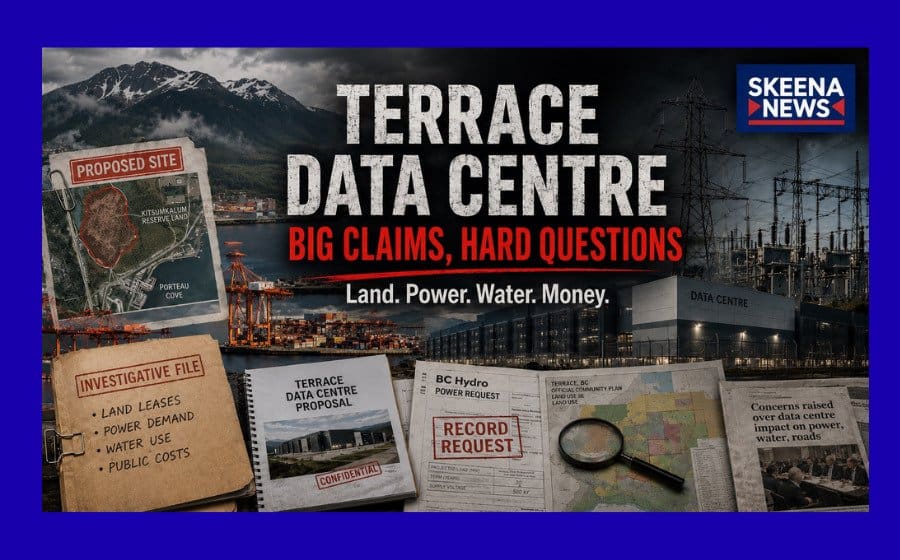
A proposed data centre in Terrace arrived with the language of the future: sovereign compute, artificial intelligence, trans-Pacific connectivity, international partnerships and a multi-billion-dollar digital infrastructure campus.
The proposal, promoted by Vancouver-based technology entrepreneur Christopher Chong through Skeena Data Centers Corporation, has been described in company materials and media coverage as a large-scale data centre and innovation park planned for the Terrace area.
Public materials connected to the project have referred to 430 acres or 173 hectares, scalable power, closed-loop cooling, fibre connectivity, strategic Korea-Canada cooperation and a platform that could support enterprise, cloud, colocation, hyperscale and AI workloads.
But a Skeena News review of public information shows a much more complicated picture.
Christopher Chong is not a person with no business history. Public records and company materials connect him to SST Wireless Inc., a B.C. industrial sensor company with a real technology background, and INDSENTEC Corporation, an advisory and investment-style platform. SST Wireless appears to have developed actual industrial monitoring technology, including wireless sensors and tire pressure monitoring systems for heavy-duty applications.
The question is not whether Chong has any technology background. He does.
The question is whether the public record supports the much larger claim now attached to his name: a massive Terrace data centre project requiring land, electricity, water infrastructure, financing, municipal approvals, fibre connectivity and binding partners.
So far, the answer is far from clear.
Who is Christopher Chong?
Christopher Chong, also appearing publicly as Chris Chong or Christopher C.S. Chong, is a B.C.-based technology entrepreneur and corporate advisor. Public profiles and business materials connect him primarily to three corporate names: SST Wireless Inc., INDSENTEC Corporation and Skeena Data Centers Corporation.
His longest and most concrete operating background appears to be with SST Wireless Inc., a B.C. company involved in industrial wireless sensor systems, tire pressure monitoring, heat detection and other technologies for difficult industrial environments.
That background matters because it gives Chong a real technology record. SST Wireless is not simply a paper concept. It has been connected publicly to industrial products, patents, partners and innovation-sector activity.
But there is also a scale issue.
The publicly documented work of SST Wireless sits in the world of industrial sensors and early-stage technology commercialization. The Skeena Data Centers proposal sits in a very different world: utility-scale energy, land development, water systems, telecom redundancy, major capital financing and municipal approvals.
That leap is at the centre of this story.
SST Wireless – the strongest part of the record
SST Wireless appears to be the strongest verified business record connected to Chong.
The company has been described as an industrial technology firm focused on wireless sensors and monitoring systems. Its products and related technology have been connected to heavy-duty tire pressure monitoring, heat sensors, condition monitoring and industrial applications in sectors such as mining, transit, forestry and manufacturing.
Public records and business materials reviewed for this story connect SST Wireless to several positive indicators.
The company has been associated with industrial sensor products. It has been connected to technology involving heavy-duty tire pressure monitoring and wireless condition monitoring. Public materials also show ties to partners or customers such as Kal Tire, New Flyer, enCompass Solutions, Precision Machinery, Soracom and Momenta Ventures.
SST Wireless also appears in federal public funding records. Research reviewed by Skeena News identified a $250,000 contribution from the National Research Council of Canada’s Industrial Research Assistance Program for work connected to a wireless tire pressure monitoring system project. That is a legitimate public R&D funding record.
This means any fair article about Chong must acknowledge a basic fact: he has a real technology-company background.
But SST Wireless also appears to be a small technology company, not a major infrastructure developer. The public record reviewed by Skeena News does not show SST Wireless as a firm with the financial capacity, construction capacity or utility-development experience to build a multi-billion-dollar data centre campus.
That distinction matters.
INDSENTEC – advisory platform, not an infrastructure giant
INDSENTEC Corporation appears in the public record as Chong’s advisory, investment and syndication platform. Its materials place it in the world of MedTech, BioTech, Industrial IoT, decarbonization, automation and early-stage company support.
INDSENTEC has publicly listed or referenced several companies and projects, including Scanbo, Palade Bio, Lucent BioSciences, Garde Bioscience and a data centres and innovation park concept.
The issue is not whether INDSENTEC exists. The issue is what kind of company it appears to be.
Based on public materials reviewed, INDSENTEC looks more like a boutique advisory and investment-introduction platform than a large infrastructure developer. Its own positioning is closer to early-stage advisory, seed-stage investment support and strategic syndication.
That is very different from the kind of corporate platform usually behind a multi-billion-dollar data centre: land developers, pension funds, infrastructure funds, hyperscale tenants, power utilities, engineering firms and construction contractors.
Skeena News did not identify public records showing INDSENTEC has the balance sheet, staff, engineering capability or institutional finance structure required to directly deliver a 300 to 400 MW data centre campus.
Skeena Data Centers: the big new promise
Skeena Data Centers Corporation is the company name attached to the Terrace proposal.
The company’s own public materials describe a scalable data centre campus in Terrace, British Columbia, built as a utility-style digital infrastructure platform. The project has been promoted as supporting enterprise, colocation, cloud, hyperscale and AI workloads.
Skeena Data Centers’ public language refers to powered shells, private data centres, freehold industrial land, resilient energy from multiple power sources, fibre connectivity, ground and municipal water and shared campus services.
That is the promise.
The public-record question is whether the hard foundations behind that promise have been confirmed.
A large data centre is not just a website, a media interview or an MOU. It requires site control, power access, water and cooling infrastructure, telecom redundancy, municipal approvals, environmental review, financing and customers.
On those points, the public record remains thin.
The land question
One of the biggest claims around the proposal is land.
The project has been described as involving 430 acres or 173 hectares in the Terrace area, with references to industrial land, proximity to the airport and the Skeena Industrial Development Park area.
But public records and reporting reviewed by Skeena News did not confirm that Skeena Data Centers owns or controls the claimed site.
That is a major issue.
For a data centre or industrial campus to move from concept to reality, developers normally need legal site control. That can mean ownership, a long-term lease, an option to purchase, an option to lease or another binding land agreement.
Without land control, a project cannot normally secure serious construction financing, anchor tenants, utility agreements or final permits.
The public record reviewed for this article does not establish that Skeena Data Centers has a registered land title, lease or option over the claimed 430-acre or 173-hectare site.
This does not mean a land deal could never happen. It means the public record does not yet support treating the project as land-secured.
The power question
The power issue may be the largest barrier of all.
Skeena Data Centers has promoted a phased data centre concept that could begin at around 5 MW and scale toward 300 to 400 MW.
That scale is enormous.
B.C. has already moved to manage large electricity requests from AI and data centres. BC Hydro and the Province have created a competitive allocation process for emerging industries, including AI and data centres. The process was enabled under Bill 31 and related regulations.
BC Hydro’s own public Q&A says the maximum request per site is 145 MW. It also says up to 100 MW and 300 MW have been allocated to conventional data centre and storage data centre categories respectively under the call.
That makes the Terrace proposal’s promoted 300 to 400 MW scale a major unresolved question.
A single project seeking hundreds of megawatts would face serious competition, policy scrutiny and grid-capacity limits. Public records reviewed by Skeena News did not identify a confirmed BC Hydro power allocation for Skeena Data Centers.
The company and related materials have also discussed alternative power concepts, including behind-the-fence generation and other energy sources. But public records reviewed did not confirm completed environmental approvals, power-generation permits, Pacific Northern Gas capacity agreements or engineering approvals for a private generation system at the proposed scale.
In plain terms: the project’s power story remains a concept until the public record shows a confirmed allocation, approved generation plan or binding utility pathway.
The water and cooling question
Data centres create heat. The more power they use, the greater the cooling challenge.
Skeena Data Centers has promoted closed-loop water cooling and references to ground and municipal water. That sounds cleaner than traditional water-intensive cooling methods, but it still requires real infrastructure, engineering and municipal agreements.
The Terrace area’s industrial lands have long faced infrastructure questions, including the cost of extending water service to development areas.
Research reviewed by Skeena News repeatedly referenced a major water-infrastructure gap, including an estimated $35 million cost to bring industrial water service to the relevant area.
Public records reviewed did not confirm a signed water agreement between Skeena Data Centers and the City of Terrace. Nor did they confirm a binding commitment from Skeena Data Centers to fund the required municipal water infrastructure.
That matters because without water and cooling infrastructure, a large data centre cannot operate.
Again, the issue is not whether a cooling system could theoretically be designed. The issue is whether the public record shows the required infrastructure, permits and agreements exist today.
It does not appear to.
Fibre and telecom claims
Skeena Data Centers has promoted Terrace’s location as part of a broader connectivity story, including references to trans-Pacific data movement, Prince Rupert and international fibre routes.
The geography may be strategically interesting. Northwest B.C. does sit in a region that connects to major transportation and communication corridors.
But enterprise and hyperscale data centres require more than general proximity to fibre routes. They require high-capacity, redundant, carrier-grade connectivity, often with multiple physically separate fibre routes and service-level commitments from telecom providers.
Public records reviewed by Skeena News did not confirm that Skeena Data Centers has signed telecom service agreements, carrier-neutral interconnection commitments or redundant fibre agreements required for hyperscale or AI workloads.
That does not mean connectivity could never be built. It means the current public record does not prove the site is telecom-ready for the type of project being promoted.
Hanwha – real MOU, not proven financing
The most visible credibility marker for the project has been the Hanwha Energy MOU.
Skeena Data Centers and Hanwha Energy USA Holdings signed a Memorandum of Understanding in May 2026. Public descriptions of the MOU say the parties intended to explore cooperation on digital infrastructure and energy development projects in British Columbia, including potential investment in data centre facilities and related energy infrastructure.
That is significant, but it is not the same as a binding project-finance agreement.
An MOU is generally an early-stage cooperation document. Unless the text says otherwise, an MOU does not normally prove that a company has committed money, equity, construction, engineering, equipment or project financing.
Public wording reviewed by Skeena News describes the Hanwha arrangement as exploratory. It does not confirm that Hanwha has committed capital to build a Terrace data centre or power project.
Hanwha’s name therefore adds visibility, but public records reviewed do not show a binding Hanwha investment, construction contract or financing commitment for the Terrace project.
Claymont Pacific and other partner questions
Claymont Pacific Pte Ltd has also appeared in research around the broader corporate network connected to the proposal.
Singapore corporate records identify Claymont Pacific as a Singapore-registered private company. Public information reviewed by Skeena News did not establish that Claymont Pacific has a proven record building utility-scale data centres, high-voltage energy systems or major Canadian infrastructure projects.
If Claymont Pacific is connected to Skeena Data Centers, the key questions are simple: what is its exact role, has it committed capital, does it have a binding agreement, and what data-centre experience does it bring?
Public records reviewed so far do not answer those questions clearly.
Municipal response – Terrace moves toward scrutiny
The City of Terrace has not treated data centres as a routine industrial question.
Public reporting shows Terrace council has moved toward creating specific zoning rules for data centres to ensure future proposals receive closer public and council review.
That response is important. It shows local government recognizes data centres can raise distinct issues around power, water, noise, land use, tax value and employment.
A data centre is not the same as a manufacturing plant, warehouse or traditional industrial tenant. It may consume extraordinary amounts of electricity and require significant cooling infrastructure while creating relatively fewer permanent jobs than other large industrial projects.
For a smaller city, those tradeoffs matter.
Terrace council’s zoning response is therefore one of the most important public facts in this story. It shows the proposal triggered a broader municipal question: should data centres be allowed under existing industrial zoning, or should they face site-specific public review?
Public money and government support
The public-money trail also needs to be separated carefully.
SST Wireless appears to have received legitimate federal R&D support through NRC IRAP for work connected to wireless tire pressure monitoring technology. That is a positive and verifiable part of the company’s record.
But Skeena News did not identify public records confirming that Skeena Data Centers itself has received federal, provincial or municipal infrastructure funding for the Terrace data centre proposal.
There is also a difference between government-event participation and government funding. A trade mission, innovation event or ceremonial signing does not automatically mean taxpayers funded a project.
Based on records reviewed, the public-money story appears to be this:
SST Wireless has a real innovation-funding record.
Skeena Data Centers has not yet been shown in public records to have received public infrastructure money for the Terrace project.
That distinction should be clear to readers.
What is proven, what is not
The public record supports several important facts.
Christopher Chong has a real B.C. technology background. SST Wireless appears to be a legitimate small industrial technology company with real products, partnerships, patents and public R&D support. INDSENTEC appears to operate as an advisory and investment-style platform. Skeena Data Centers has publicly promoted a large Terrace data centre concept. Hanwha Energy signed an MOU with Skeena Data Centers. Terrace council has moved to examine or regulate data centres more directly.
But the public record does not yet confirm the major items needed to make the Terrace project real.
It does not confirm that Skeena Data Centers controls the claimed land.
It does not confirm a BC Hydro power allocation.
It does not confirm a municipal water agreement.
It does not confirm a funded $35 million water-infrastructure solution.
It does not confirm environmental approvals for private power generation.
It does not confirm telecom redundancy agreements.
It does not confirm anchor tenants.
It does not confirm institutional financing.
It does not confirm a binding Hanwha construction or financing commitment.
That is the core of the story.
A real technology background, but an unproven infrastructure plan
The strongest way to understand Christopher Chong is not as a mystery figure and not as a proven infrastructure developer.
The public record presents him as a real B.C. technology entrepreneur whose strongest business background is in industrial wireless sensors through SST Wireless. That history deserves to be acknowledged.
But the Terrace data centre proposal is not a sensor product. It is an infrastructure project of a completely different scale.
A 300 to 400 MW data centre campus would require a level of land control, energy approval, water infrastructure, telecom capacity, financing and public approval that has not been demonstrated in the records reviewed by Skeena News.
That does not mean the project can never evolve. It means the public should understand where the project stands now.
As of the records reviewed, Skeena Data Centers appears to be a promoted concept, not a shovel-ready development.
Why this matters for Terrace
Terrace is not just a backdrop for outside investment pitches. The city and surrounding region have real land, power, water, labour and infrastructure constraints. Decisions about industrial land and public infrastructure affect residents, local governments, First Nations, businesses and future development.
Large projects can bring opportunity. They can also consume public attention and public resources before proving they are viable.
That is why public-record verification matters.
Before a project is treated as an economic saviour, residents deserve answers.
Who controls the land?
Who approved the power?
Who pays for water?
Who funds the buildout?
Who is the anchor customer?
Which partners are binding?
Which agreements are only exploratory?
What does the city gain?
What does the community risk?
Those questions are not anti-development. They are basic due diligence.
The bottom line
Christopher Chong’s record shows a real technology entrepreneur with a legitimate small-company background in industrial sensors.
Skeena Data Centers’ Terrace proposal shows something different: a large, ambitious, heavily promoted infrastructure concept with major public-record gaps.
The promise was big: hundreds of megawatts, hundreds of acres, AI infrastructure, foreign partnerships, local equity and a new digital future for Terrace.
The public record is smaller: no confirmed site control, no confirmed power allocation, no confirmed water agreement, no confirmed anchor tenant, no confirmed institutional financing and no confirmed binding construction commitment from the headline partner.
The Skeena Data Centers proposal may yet become a formal application.
But today, based on public records reviewed, it remains a pitch waiting for proof.