




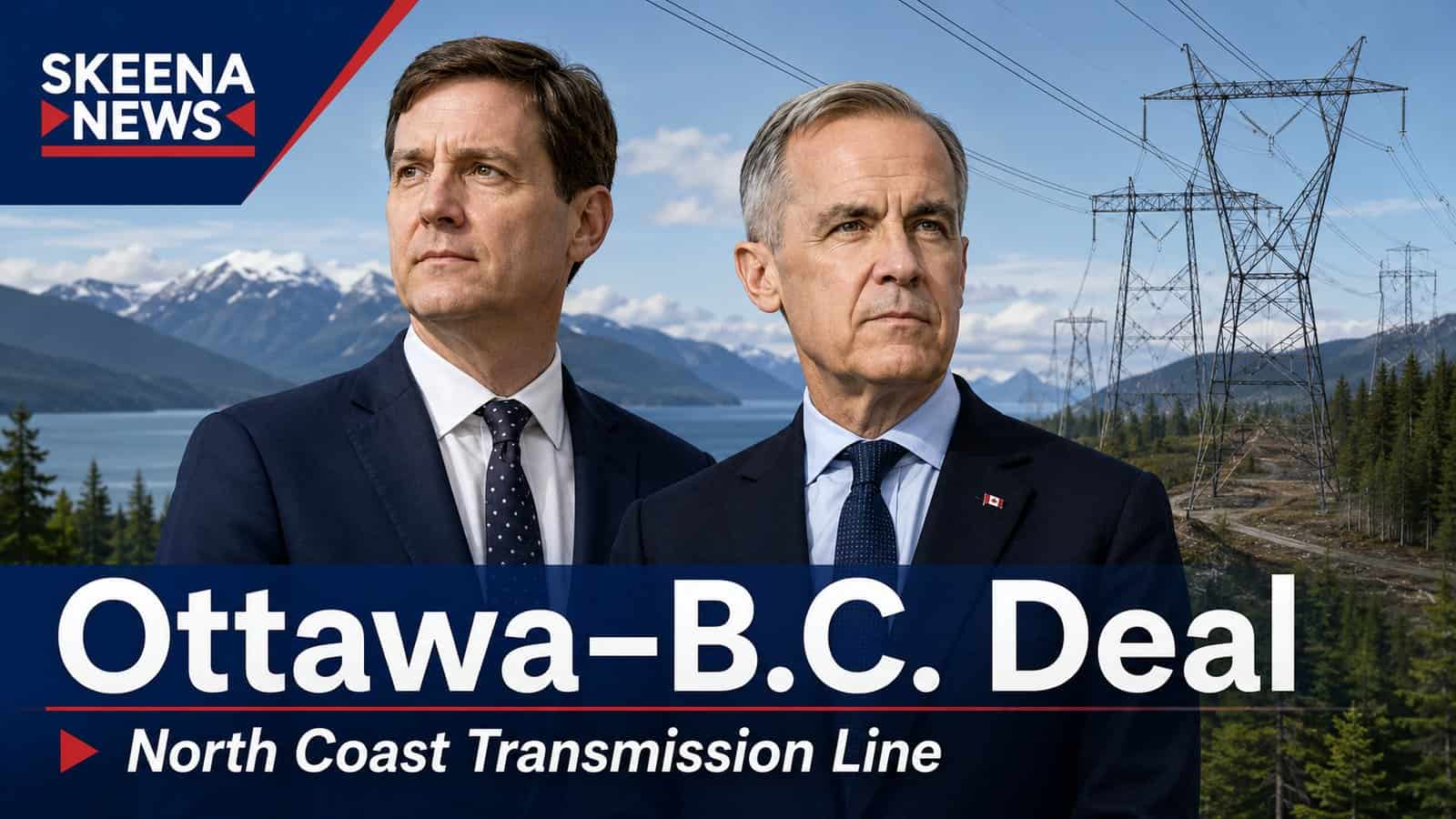
Ottawa–B.C. Deal Puts North Coast Transmission Line at Centre of Northwest B.C.’s Future
By Skeena News
A new Canada–British Columbia economic agreement signed in Vancouver on July 2 could become one of the most important infrastructure decisions for Northwest B.C. in a generation.
Prime Minister Mark Carney and B.C. Premier David Eby announced the Canada–B.C. Cooperative Prosperity Agreement, a broad federal-provincial framework aimed at accelerating major projects, strengthening clean energy infrastructure, expanding trade, and supporting resource communities. For the Skeena region, the biggest piece is clear: the North Coast Transmission Line.
The agreement includes major federal support for the North Coast Transmission Line, a proposed high-voltage electricity corridor that would expand clean power capacity from the B.C. Interior toward Terrace and the North Coast. The federal government says the partnership is intended to help build a stronger and more sustainable economy, while supporting clean electricity, critical minerals, ports, trade infrastructure, and Indigenous economic participation.
For Terrace, Kitimat, Prince Rupert, Stewart, Smithers, the Hazeltons, and surrounding First Nations communities, this is not just another political announcement from Vancouver or Ottawa. It could shape the next decade of jobs, investment, industrial development, electricity demand, environmental debate, and Indigenous ownership across the Northwest.
Why the Transmission Line Matters
The North Coast Transmission Line is designed to bring more clean, reliable electricity into the North Coast region, where demand is rising from ports, mining, hydrogen, technology, liquefied natural gas, and other industrial projects. BC Hydro says the potential demand for electricity in the region is already greater than the capacity of the existing transmission system.
The first two phases would add new 500-kilovolt transmission infrastructure from the Prince George area toward Terrace. Phase 1 proposes a new line from Williston Substation to Glenannan Substation, while Phase 2 would continue from Glenannan to Skeena Substation near Terrace.
That makes Terrace a key point in the future power map of northern British Columbia.
If completed, the line could help electrify major industrial activity that currently depends on diesel, natural gas, or limited grid access. Supporters say this could make Northwest B.C. more competitive for mines, LNG projects, port upgrades, and clean-energy investments while reducing emissions from industrial operations.
A Major Bet on the Northwest Economy
The agreement comes at a time when Northwest B.C. is facing both opportunity and pressure.
The region has deep-water ports, critical mineral deposits, LNG proposals, forestry communities, Indigenous-led projects, and growing demand for infrastructure. But it also faces long-standing challenges: limited highway and rail redundancy, housing pressure, industrial uncertainty, high construction costs, and public concern over whether major projects actually benefit local residents.
The North Coast Transmission Line is being promoted as the backbone of a new clean-energy corridor. Federal project information says several First Nations under the K’uul Power consortium have signed agreements that provide an option to acquire up to 50 percent equity in the project.
That ownership model is important. Instead of First Nations only receiving impact benefits or short-term construction jobs, the structure could allow participating Nations to become long-term equity partners in the infrastructure itself.
K’uul Power says its purpose is to support First Nations ownership and operation of renewable energy transmission and generation infrastructure in Northwest B.C.
Early Work Already Moving
The North Coast Transmission Line is not just an idea on paper. In November 2025, the Canada Infrastructure Bank announced a $139.5 million loan to BC Hydro to support early works for the project. That includes planning, engineering, fieldwork, procurement, First Nations consultation, stakeholder engagement, and enabling work to improve site access.
That means the project has already moved into the preparation stage, even as the full buildout, financing, permitting, and final timelines remain under close public scrutiny.
The B.C. Energy Regulator describes the project as BC Hydro’s proposal to build new 500 kV transmission lines and associated infrastructure from Prince George to Terrace through two phases.
What This Could Mean for Terrace, Kitimat, Prince Rupert and Stewart
For Terrace, the project could mean years of construction activity, staging, road access work, contracting opportunities, and new pressure on housing and services. Terrace could also become a central hub for the regional power corridor because of the Skeena Substation connection.
For Kitimat, more grid capacity could support industrial electrification and future LNG-related power demand. Cedar LNG, already positioned as an Indigenous-led floating LNG project, is one example of the type of industrial activity that depends heavily on reliable electricity.
For Prince Rupert and Stewart, the bigger power picture is connected to port modernization, critical mineral exports, and future trade with Asia. The Northwest has some of the shortest marine routes from North America to Asian markets, but ports also need power, land, rail reliability, and industrial capacity to expand.
For inland communities such as Smithers, Houston, Burns Lake, and the Hazeltons, the transmission corridor could bring construction traffic, contracts, employment, and debate over land use, environmental protection, and long-term community benefit.
Not Everyone Sees It the Same Way
While governments are presenting the agreement as a clean-growth breakthrough, the project will continue to face questions.
Environmental groups and some residents have raised concerns that large amounts of public clean electricity could end up supporting LNG and other heavy industrial projects instead of being reserved for homes, small businesses, public transit, local manufacturing, and community-level decarbonization.
There are also practical questions: Who pays? How much will ratepayers carry? How many jobs will be local? How will work camps be managed? Will housing prices rise? Will local contractors actually get work? How will wildlife, salmon watersheds, and culturally important areas be protected?
Those questions matter because Northwest B.C. has seen major announcements before. Communities across the Skeena region know the difference between a press conference and a completed project.
Northern Tanker Ban Remains
One politically significant part of the Canada–B.C. agreement is that it maintains the northern oil tanker ban. That reduces the likelihood of a heavy-oil pipeline to B.C.’s north coast, even as the federal and provincial governments push electricity, mining, port, LNG, and clean-energy development.
For the Skeena region, this means the future being promoted is not a traditional oil export corridor. It is a power, port, critical minerals, LNG, and clean electricity corridor.
That distinction will likely define the next major debate in Northwest B.C.
A Generational Opportunity — If Local Communities Are Not Left Behind
The North Coast Transmission Line could become one of the most consequential infrastructure projects in northern British Columbia. It has the potential to unlock billions in investment, support Indigenous equity ownership, expand clean electricity, and position the Northwest as a stronger gateway to Pacific trade.
But the success of this agreement will not be measured only in megawatts, export numbers, or political speeches.
It will be measured in whether people in Terrace, Kitimat, Prince Rupert, Stewart, Smithers, the Hazeltons, and surrounding First Nations communities see real benefits: good local jobs, affordable housing, safer roads, stronger public services, responsible environmental protection, and long-term economic stability.
For Northwest B.C., the announcement on July 2 may be the beginning of a new chapter.
The real test is whether that chapter is written with the region — not just about it.