





Nation-Building or Northern Extraction? Skeena Region Sits at the Centre of Canada’s Next Resource Rush
By Skeena News
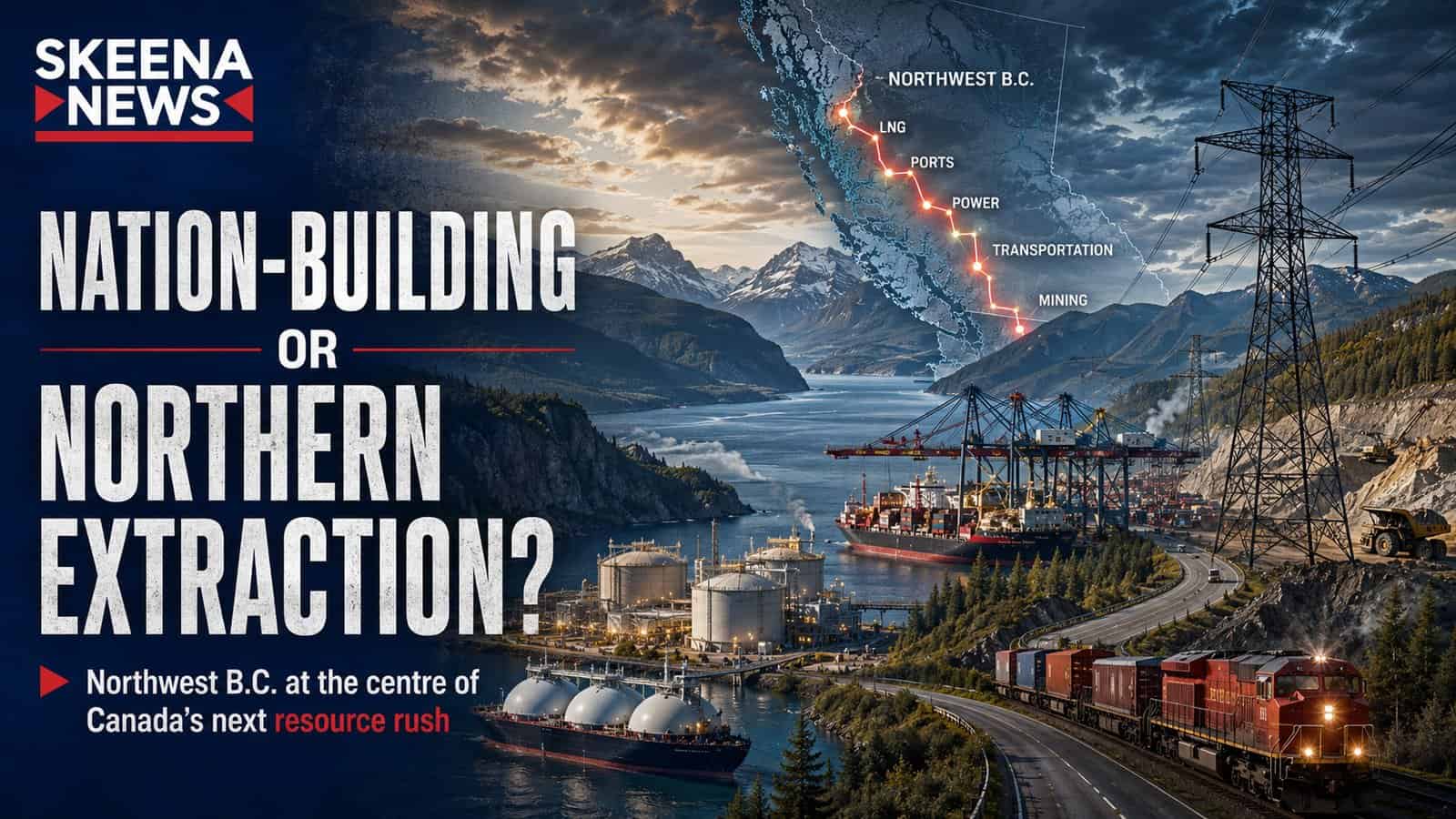
Less than a week after Ottawa and Victoria announced a new prosperity agreement, Northwest British Columbia is being positioned as one of Canada’s next major economic corridors — a place where power lines, LNG terminals, mines, ports, Indigenous partnerships and national trade ambitions all meet.
For the Skeena region, the question is simple but serious: is this finally nation-building investment for the North, or another resource rush where local communities carry the pressure?
Prime Minister Mark Carney and B.C. Premier David Eby announced the Canada–British Columbia prosperity agreement last week, saying it is meant to speed up major infrastructure, energy and resource projects. For Northwest B.C., the agreement is not just a political headline. It directly connects the North Coast Transmission Line, LNG expansion, port growth and critical-minerals development to Canada’s economic future.
The federal government says it will provide billions toward the first two phases of the North Coast Transmission Line, a major electricity project meant to deliver more power to communities, industries and future developments across northern B.C.
For the Skeena region, that means Terrace, Kitimat, Prince Rupert, Stewart, the Nass, Tahltan territory and the Highway 37 corridor are no longer just watching the national economy from the sidelines. They are being placed directly inside it.
The transmission line is being framed as the backbone for a new northern economy. It could support cleaner electricity for mining, LNG, port operations and growing communities. It could also unlock major industrial projects that have long been limited by power supply.
But power is only one part of the story.
The same agreement connects Northwest B.C. to LNG Canada Phase 2 in Kitimat, Ksi Lisims LNG near the north coast, Cedar LNG, the Red Chris Mine expansion, and trade-corridor growth through Prince Rupert and Stewart. Ottawa and Victoria are now openly tying together clean electricity, liquefied natural gas, critical minerals and export infrastructure as part of a wider national strategy.
That makes the Skeena region a strategic zone.
Kitimat is already home to LNG Canada, one of the largest private-sector investments in Canadian history. A second phase would double the facility’s production. Cedar LNG, majority-owned by the Haisla Nation, has been promoted as a model for Indigenous ownership in major energy infrastructure. Ksi Lisims LNG, led by the Nisga’a Nation and partners, is another major project being positioned as part of Canada’s LNG export future.
Farther north, the Red Chris Mine expansion in Tahltan territory is being tied to Canada’s critical-minerals ambitions. Copper is increasingly viewed as essential for electrification, clean technology and global supply chains. The expansion is being presented as part of Canada’s effort to strengthen domestic production of minerals needed for the future economy.
Then there are the ports.
Prince Rupert and Stewart are both being discussed as important gateways for Canadian goods, minerals and energy exports. Prince Rupert already plays a major role in Canada’s Asia-Pacific trade, while Stewart sits near key mining corridors in the northwest.
Put together, the message is clear: Canada wants Northwest B.C. to help move energy, minerals and goods to the world.
That is why the phrase “nation-building” is being used.
But in the Skeena region, people know that nation-building can look very different on the ground.
It can mean jobs, contracts, training, Indigenous equity, better infrastructure and long-term revenue.
It can also mean higher rents, stretched roads, worker shortages, pressure on hospitals, environmental risk, temporary camps, housing stress and communities being asked to absorb the impacts of decisions made in Vancouver, Ottawa and corporate boardrooms.
Terrace already feels the pressure of regional growth. Kitimat has seen the housing and labour impacts of LNG development. Prince Rupert faces port growth, infrastructure demand and cost-of-living concerns. Smaller communities along Highway 37 and in the Nass and Tahltan territories know that major projects can bring opportunity, but also intense questions about land, water, wildlife, consent and who benefits.
That is the real tension behind the announcement.
The Canada–B.C. agreement also keeps the federal oil tanker ban along B.C.’s north coast. That is politically significant for Prince Rupert, Haida Gwaii, coastal First Nations and communities concerned about marine spill risk.
But the tanker-ban issue does not end the energy debate. The agreement protects the north coast from one kind of project while continuing to promote LNG, mining, transmission lines and export infrastructure across the wider region.
So Northwest B.C. is being protected from one form of risk while being opened wider to others.
That contradiction is exactly why this story matters.
The Skeena region is being promised a future of clean power, LNG exports, critical minerals, Indigenous partnerships and trade expansion. But local residents may ask a harder question: will the North shape this future, or simply host it?
If billions of dollars are coming through the region, communities will want more than press conferences. They will want housing plans, health-care capacity, road upgrades, local hiring, transparent environmental reviews, meaningful Indigenous consent, and clear answers on how long-term benefits will stay in the Northwest.
The North Coast Transmission Line may become one of the most important infrastructure projects in modern northern B.C. LNG growth could bring major investment. Mining expansion could put the northwest at the centre of Canada’s critical-minerals strategy. Port growth could strengthen Canada’s trade links with Asia.
But none of that automatically guarantees local prosperity.
For Skeena communities, the key question is not whether Canada needs the North.
It clearly does.
The real question is whether Canada is prepared to invest in the people, towns and First Nations who live here — not just the projects that pass through here.
As Ottawa and Victoria celebrate a new prosperity agreement, Northwest B.C. now has to decide what kind of prosperity it will accept.
Because this time, the Skeena region is not just on the map.
It is the corridor.