




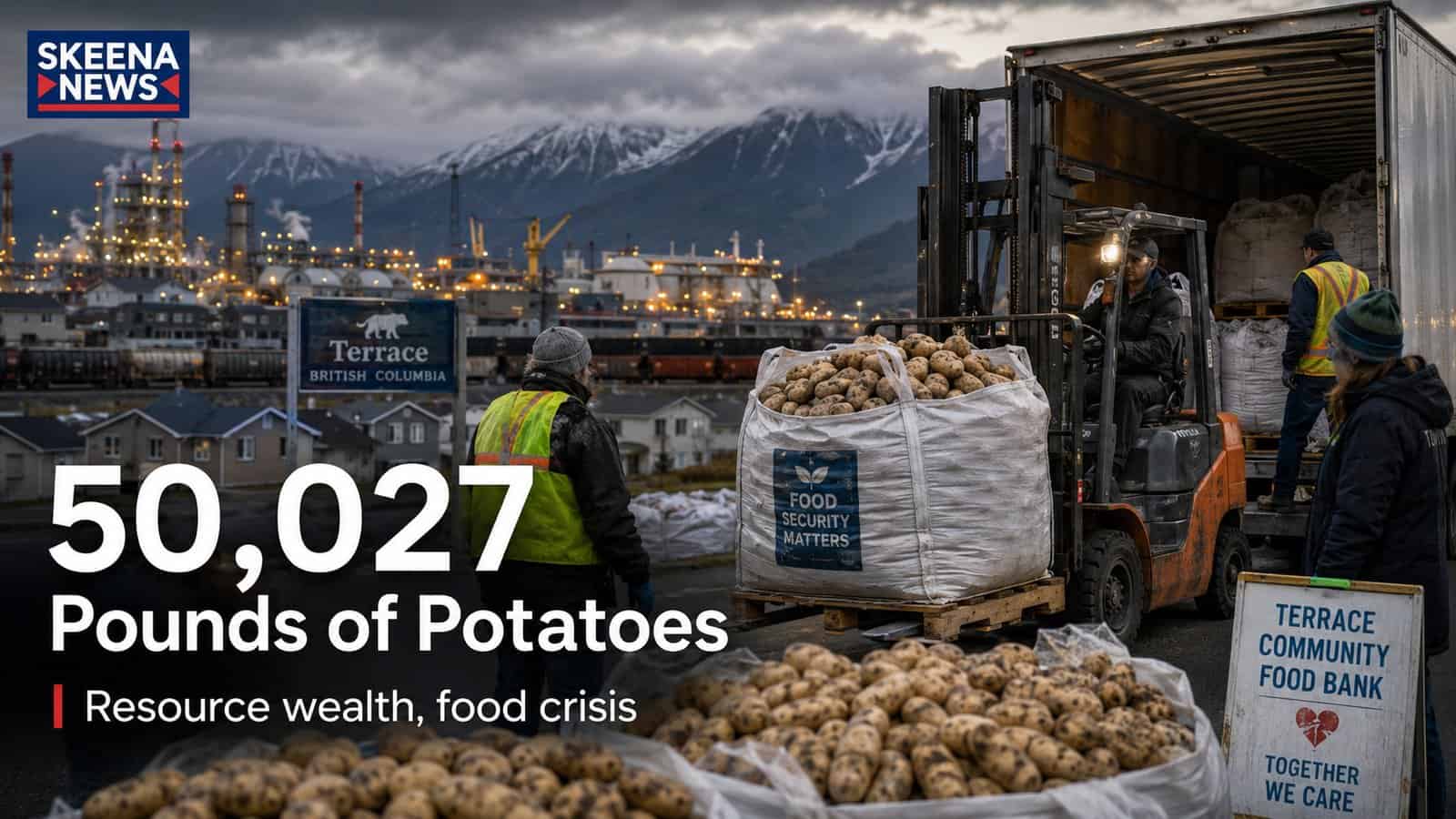
50,027 Pounds of Potatoes, Billions in Industry: Northwest B.C.’s Resource Wealth Is Not Reaching the Dinner Table
A massive food-rescue shipment arrived in Terrace as northwest British Columbia continues to attract billions of dollars in LNG, mining and port investment. The contrast raises a difficult question: why are families in one of Canada’s most resource-rich regions still struggling to afford food?
On July 16, heavy equipment rolled into the Sparks Street Bread of Life facility in Terrace to unload exactly 50,027 pounds of surplus potatoes shipped from Saskatchewan.
The massive delivery was coordinated through the national food-rescue organization Second Harvest and managed locally by the Skeena-Kalum Community School Society, led by chair Marja Burrows.
From Terrace, the potatoes were distributed across a vast northwest B.C. corridor stretching from Haida Gwaii to the Bulkley Valley and north toward remote communities where access to affordable food remains an ongoing challenge.
Northern Savings Credit Union, Emil Anderson, Volunteer Terrace, Skeena Diversity and the Galore Creek mining project were among the organizations supporting the operation.
It was an impressive display of community coordination, volunteer effort and regional logistics.
It was also a striking symbol of a much deeper contradiction.
Northwest British Columbia is currently being promoted as one of Canada’s most important industrial and economic-development regions. Billions of dollars are flowing into LNG terminals, mining projects, port expansions, power infrastructure and transportation corridors.
Yet, at the same time, thousands of residents across Terrace, Kitimat, Prince Rupert, Smithers, Hazelton and surrounding First Nations communities are facing rising housing costs, expensive groceries and growing dependence on emergency food programs.
The region is becoming wealthier on paper.
For many families, daily life is becoming less affordable.
A resource boom that does not reach every household
The industrial transformation of northwest B.C. is difficult to overstate.
LNG Canada has reshaped Kitimat. Cedar LNG is moving forward. Ksi Lisims LNG has been proposed near Prince Rupert. Mining activity continues throughout the Highway 37 corridor, while Prince Rupert’s port remains central to Canada’s trade ambitions.
These developments create employment, tax revenue and investment.
But the benefits are not distributed evenly.
Workers directly employed in major industrial projects may earn high wages. Residents working in retail, hospitality, health care, education, nonprofit services and other lower-paying sectors face the same rising prices without receiving comparable income increases.
Housing is one of the biggest pressures.
Industrial construction attracts thousands of temporary workers, subcontractors, job seekers and service providers. Even when major projects house workers in camps, the wider region still experiences pressure on rental housing, hotels, transportation and essential services.
When vacancy rates fall and rents rise, lower- and middle-income households are forced to make difficult choices.
Rent cannot easily be reduced. Utility bills still arrive. Medications must still be purchased.
Food becomes the household expense that gets cut.
This is how a region can experience record-breaking industrial investment while food-bank demand continues to rise.
The most expensive food basket in British Columbia
The cost of groceries in northwest B.C. adds another layer to the crisis.
According to food-costing data cited in the regional analysis, the monthly cost of a nutritious food basket for a reference family of four in the Northwest Health Service Delivery Area was approximately $1,571—higher than any other region listed in the comparison.
The Northwest Health Service Delivery Area includes communities such as Terrace, Prince Rupert and Smithers.
For a low-income household, food alone may consume between 39 and 48 per cent of available income.
That figure does not include rent, power, transportation, childcare, clothing, medical expenses or debt payments.
Northern food prices are affected by long transportation distances, fuel surcharges, supply-chain disruptions and limited retail competition.
A highway closure, ferry disruption or severe weather event can quickly expose how vulnerable regional food supplies remain.
The arrival of 50,027 pounds of potatoes was therefore not simply a generous donation.
It was evidence of the scale of the need.
Terrace carries the regional burden
Terrace has become the natural distribution centre for northwest B.C.
Its road, rail and air connections make the city an important logistics hub for surrounding communities. Organizations based in Terrace have developed the capacity to receive, unload, sort and redistribute large quantities of rescued food.
But the city also carries social pressures generated throughout the broader region.
People travel through Terrace while searching for work, housing, medical care and social services. The city supports populations connected to projects in Kitimat, Prince Rupert and the interior, even when Terrace does not receive the same level of direct industrial property-tax revenue.
This creates a growing mismatch.
Terrace performs the role of a regional service centre, but its local organizations and infrastructure are frequently expected to manage needs created far beyond city boundaries.
The potato shipment demonstrated Terrace’s ability to respond.
It also showed how heavily the region depends on volunteers, nonprofit groups and charitable partnerships to fill gaps that governments and economic growth have not resolved.
Kitimat: industrial revenue and household pressure
Kitimat represents one of the clearest examples of the resource paradox.
The community has received substantial industrial taxation connected to LNG Canada, and those revenues have supported municipal services and infrastructure.
At the household level, however, prosperity looks different.
High housing costs and an expensive local economy continue to affect service workers, seniors, people with disabilities and residents outside the industrial wage structure.
The Kitimat Food Bank operates during limited weekday hours and requires documentation from clients. Other organizations, including the Tamitik Status of Women Food Share program, help meet the needs of residents facing housing instability and food insecurity.
A municipality can receive millions in industrial tax revenue while individual residents remain unable to afford groceries.
Both realities can exist at the same time.
Prince Rupert: isolation increases the cost
Prince Rupert faces a different set of pressures.
Its coastal location makes the city especially vulnerable to highway interruptions, ferry disruptions and transportation costs.
Food-bank clients must often navigate registration and documentation requirements before receiving assistance. Local organizations, including the Salvation Army and the Kaien Anti-Poverty Society, continue to provide meals, hampers and emergency support.
The Prince Rupert Port Authority helped finance a major renovation of the Salvation Army’s community kitchen, improving its capacity with industrial-grade equipment, freezers and coolers.
That investment strengthens the emergency response.
But an expanded food-bank kitchen is also an acknowledgment that demand is not disappearing.
Hazelton and the struggle for food sovereignty
In the Hazelton area and nearby First Nations communities, food insecurity is closely connected to poverty, geographic isolation and the disruption of traditional food systems.
Emergency food services operate under limited schedules and often restrict households to one hamper per month.
Some communities are working toward a different model.
Sik-E-Dakh First Nation, also known as Glen Vowell, developed local meat-processing infrastructure that allows wild game to be processed closer to home.
Projects like this do more than distribute emergency food. They strengthen local control, create employment, reduce dependence on distant suppliers and help preserve Indigenous food traditions.
For remote communities, food security is not only about charity.
It is also about land, infrastructure, transportation and sovereignty.
Smithers sees new faces at the food bank
Smithers has a more diversified economy than some neighbouring communities, but it has not escaped the affordability crisis.
The Salvation Army Food Bank in Smithers reported that a significant portion of its clients in late 2025 were new to the service.
They reportedly included low-income families, recent immigrants and college graduates carrying student debt.
This is an important shift.
Food insecurity is no longer limited to the people traditionally associated with emergency assistance.
It is increasingly reaching employed residents, educated young adults and families who would once have considered themselves financially stable.
Community fundraising continues to help stock food-bank shelves, but annual donation campaigns cannot solve a permanent affordability problem.
Where is the resource money going?
Northwest B.C. local governments spent years fighting for a larger share of the revenues generated by industrial development.
That campaign led to the Northwest B.C. Resource Benefits Alliance and a $250-million provincial funding agreement covering 21 municipalities and regional districts over five years.
The agreement was a major victory.
Communities are using the money for essential infrastructure, including water systems, public buildings and other long-delayed capital projects.
Prince Rupert requires enormous investment to replace aging water infrastructure. Smithers has allocated funding toward a new public library. Other municipalities face major road, sewer, recreation and public-safety costs.
These are necessary investments.
But Resource Benefits Alliance funding was primarily designed to close the region’s infrastructure deficit.
It was not structured as direct household assistance.
A new water line does not immediately help a parent buy groceries.
A new public building does not reduce next month’s rent.
Industrial taxes and capital agreements can improve a municipality’s balance sheet without improving the disposable income of its poorest residents.
That is the gap exposed by the Terrace potato shipment.
Charity is essential—but it is not a complete economic policy
Second Harvest and the Skeena-Kalum Community School Society deserve recognition for preventing usable food from being wasted and delivering it to families across a vast region.
The volunteers, businesses and organizations supporting the distribution provided an immediate and practical benefit.
Without these partnerships, many residents would face even greater hardship.
But emergency food rescue cannot become the permanent answer to structural poverty.
Potatoes can fill cupboards for a period of time.
They cannot lower rents, raise wages, expand disability benefits or repair the region’s unequal distribution of industrial prosperity.
Cold-storage facilities, regional food hubs and local processing infrastructure could help northwest organizations preserve and distribute more food efficiently.
Such investments would reduce waste and improve regional resilience.
But the deeper problem remains household income.
Research cited in the analysis found that direct income supplementation is among the most effective ways to reduce severe food insecurity. By comparison, food subsidies and housing programs do not always provide immediate financial relief to households struggling with multiple expenses.
A question northwest leaders cannot ignore
The arrival of 50,027 pounds of potatoes should be celebrated as an extraordinary community effort.
It should also make political and industrial leaders uncomfortable.
Northwest B.C. is being asked to host projects described as nationally important. Communities are being promised growth, employment and long-term prosperity.
If that prosperity is real, it must eventually become visible beyond industrial sites, corporate announcements and municipal capital budgets.
It must become visible in stable housing.
It must become visible in affordable groceries.
It must become visible in the ability of families to live without depending on emergency food shipments.
A region can export natural gas, minerals, timber and billions of dollars in trade.
But if its own residents cannot consistently afford dinner, the economic model is not working for everyone.
The 50,027 pounds of potatoes unloaded in Terrace were a lifeline.
They were also a warning.