





Spain Crowned World Champions as FIFA’s Final Echoes Across the Skeena
Terrace families gathered for the historic final, while in the Nass Valley the World Cup’s pressure on Vancouver accommodation exposed a very different regional reality
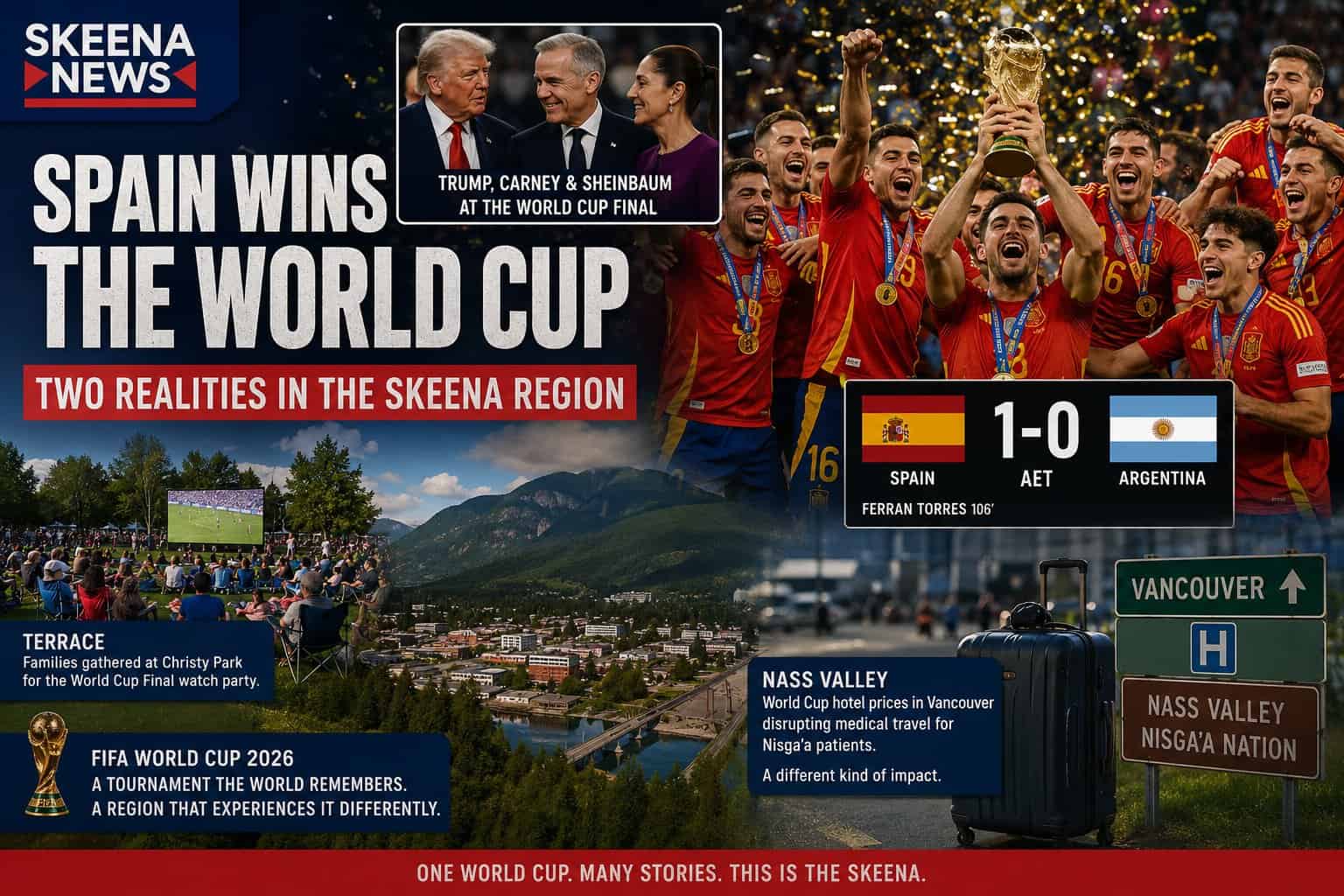
Spain captured its second men’s World Cup title Sunday with a dramatic 1–0 extra-time victory over Argentina, ending the defending champions’ attempt to retain the trophy and leaving Lionel Messi’s international future uncertain.
Ferran Torres delivered the decisive moment in the 106th minute at New York New Jersey Stadium. Pedro Porro sent a cross toward the far post, Nico Williams headed it back across goal and Torres struck the ball first-time into the roof of the net.
It was the breakthrough Spain had spent almost the entire match chasing.
Argentina goalkeeper Emiliano Martínez repeatedly denied the Spanish attack, but his side’s task became significantly harder after Enzo Fernández received a second yellow card near the end of regulation time.
Spain continued pressing against the 10-man Argentine side through extra time and finally found the goal that returned the country to the top of world football for the first time since 2010.
Spain controlled the final
The final brought together the champions of Europe and South America, but Spain controlled most of the possession and attacking play.
Lamine Yamal tested Martínez early, while Spain continued circulating the ball around Argentina’s compact defensive formation. Argentina, despite arriving at the final with one of the tournament’s strongest attacks, was unable to produce a shot during regulation time.
Martínez kept Argentina alive with several important saves, including a late stop from Yamal before the match moved into extra time.
Argentina continued fighting after Fernández’s dismissal, but Spain’s patience and depth ultimately decided the championship.
Torres had lost his starting position earlier in the tournament, but he entered the final as a substitute and scored the most important goal of Spain’s campaign.
Spain’s victory also completed one of the strongest defensive performances in World Cup history. The champions conceded only one goal across eight matches, while goalkeeper Unai Simón recorded seven clean sheets.
Messi leaves without another title
For Argentina, the defeat ended its attempt to become the first country since Brazil in 1962 to win consecutive men’s World Cups.
Messi, now 39, was kept largely isolated by Spain’s midfield and defensive structure. Argentina struggled to move the ball into dangerous positions and could not consistently connect Messi with Julián Álvarez.
Argentina coach Lionel Scaloni acknowledged afterward that Spain had been the stronger side.
Scaloni said he had not yet spoken with Messi about whether the final would be his last appearance for Argentina. That means any claim that Messi formally retired immediately after the match remains premature.
The sight of Messi leaving another World Cup final visibly emotional nevertheless gave the match the feeling of a possible ending—not only for one of football’s greatest players, but for the generation that carried Argentina through its championship era.
Carney joins North American leaders at the final
Prime Minister Mark Carney attended the final as Canada closed its historic first experience as a host of the men’s World Cup.
Carney joined U.S. President Donald Trump, Mexican President Claudia Sheinbaum and other international leaders and officials at the stadium.
Their presence brought together the leaders of the three countries that co-hosted the tournament. The setting carried diplomatic significance at a time when Canada, the United States and Mexico continue to manage major questions involving trade, borders and the future of their continental economic relationship.
Following the tournament, Carney described Canada’s participation as the beginning of a new chapter for soccer in the country.
He pointed to Canada’s first men’s World Cup victory, its first knockout-stage victory and its first appearance in the Round of 16 as achievements that would be remembered for generations.
Carney also announced that the federal government would invest $1 billion in sport access, stadiums, playing fields, parks and athlete development, along with support for a permanent national training centre for Canada Soccer.
Terrace gathers at Christy Park
In Terrace, the World Cup final became a community event rather than simply another match watched at home.
Families and soccer supporters gathered at Christy Park on Sunday for a public screening of the Spain–Argentina final.
The event ran from late morning into the afternoon, allowing residents to watch the noon Pacific kickoff together.
The Christy Park gathering was part of Terrace’s World Cup community programming and followed an earlier local event connected to Canada’s tournament campaign.
Terrace received $20,000 through British Columbia’s World Cup community-event program to support two local events.
The public screening carried particular meaning in a city where soccer has become one of the largest organized youth activities. Terrace Youth Soccer has approximately 800 registered participants, making it one of the strongest community sports organizations in the city.
For young players watching at Christy Park, the final offered more than a result. It brought the world’s largest sporting tournament into a local public space and allowed children, parents and supporters to experience it together.
Rather than requiring families to travel to Vancouver or pay major-event prices, Terrace created its own place within the tournament.
A different World Cup reality in the Nass Valley
While Terrace residents gathered to celebrate the final, the tournament produced a much more serious consequence for Nisga’a citizens travelling from the Nass Valley.
World Cup demand in Vancouver placed severe pressure on hotel availability and accommodation prices during the tournament.
That pressure affected the ability of the Nisga’a Valley Health Authority to arrange non-emergency patient travel to Vancouver.
For people living in remote northern communities, travelling to the Lower Mainland for medical appointments is often unavoidable. Specialist consultations, testing and procedures may not be available locally, requiring patients and sometimes accompanying relatives to remain in Vancouver overnight.
When accommodation prices rise beyond available medical-travel budgets, the effect is not merely an inconvenience. It can delay access to care.
The situation exposed how the economic impact of a major event can travel far beyond the host city.
Visitors filling Vancouver hotels may contribute to tourism revenue in the Lower Mainland, but those same hotel conditions can create serious barriers for northern patients who have no choice about travelling.
The World Cup did not create the longstanding weaknesses in northern medical travel. It did, however, reveal how easily the system can be disrupted when Vancouver experiences a sudden increase in demand.
One tournament, two regional experiences
The Skeena region experienced the World Cup final through two sharply different realities.
In Terrace, public funding helped create a family gathering at Christy Park, bringing children, local players and supporters together for one of the biggest matches in global sport.
In the Nass Valley, the same tournament contributed to accommodation pressure that interfered with medical-travel arrangements for Nisga’a patients.
Both stories belong in the regional account of the World Cup.
One shows the ability of sport to bring a northern community together.
The other demonstrates how decisions and price increases in a distant host city can directly affect essential services for people hundreds of kilometres away.
Spain left New Jersey carrying the World Cup.
Terrace residents left Christy Park having shared a historic sporting moment.
But for families in the Nass Valley, the tournament also raised a harder question, when Canada hosts the world, who absorbs the costs that do not appear inside the stadium?