





From Sternwheelers to Drone Shows: How Riverboat Days Grew With Terrace
What began as a three-day community celebration in 1970 has evolved into a 10-day regional festival that reflects more than five decades of change in Terrace.
For generations of Terrace residents, the arrival of August has meant parade floats on downtown streets, music in George Little Park, packed sports tournaments, community breakfasts and families gathering for Riverboat Days.
The festival has become one of the most recognizable annual traditions in Northwest British Columbia. But the Riverboat Days celebrated in 2026 is far larger, more diverse and more complex than the small civic gathering that began more than half a century ago.
First held in 1970, Riverboat Days was created to honour the sternwheeler era on the Skeena River and the role river transportation played in the early development of the region.
Before highways and railways connected Northwest communities, sternwheelers carried freight, workers, supplies, prospectors and passengers between the coast and the Upper Skeena. Vessels such as the SS Mumford, SS Caledonia, SS Northwest and SS Inlander became part of the region’s transportation history.
The first Riverboat Days reportedly lasted three days over the August long weekend. Its early program centred on a civic parade, sports competitions, outdoor gatherings and historical displays.
The celebration was organized through the efforts of local volunteers, businesses, service clubs and community leaders. Unlike today’s festival, it did not begin with a permanent society, a large multi-day schedule or a wide network of corporate and government support.
It began as a community event in a town of roughly 10,000 people.
A festival born during a changing time
Riverboat Days arrived during an important period in Terrace’s development.
The city’s population stood at 8,637 in the 1966 Census and reached 9,991 by 1971. Forestry, sawmilling, railway operations and regional trade formed the foundation of the local economy.
Terrace was also becoming more connected to the rest of British Columbia.
On August 15, 1970, Premier W.A.C. Bennett officially opened the Yellowhead Highway through Terrace. The highway strengthened Terrace’s position as the transportation and commercial centre of the Northwest.
Riverboat Days emerged as the community itself was changing—from a smaller resource town into a growing regional centre.
That transformation continued over the following decades.
By 2021, Terrace’s municipal population had reached 12,017. Although the city’s population grew gradually, its importance to the wider region expanded significantly.
Terrace became a centre for healthcare, education, retail, government services, transportation and businesses supporting forestry, mining, energy and major industrial developments throughout Northwest B.C.
Riverboat Days followed a similar path.
It grew beyond a local holiday weekend and became a regional gathering attended by residents from Kitimat, Prince Rupert, Smithers, the Nass Valley, nearby First Nations and communities throughout northern British Columbia.
From a volunteer committee to a permanent society
For its first two decades, Riverboat Days was coordinated mainly by community volunteers and participating organizations.
That changed in 1992 when the Terrace Riverboat Days Society was formally incorporated.
The society gave the festival a permanent organizational structure and assumed responsibility for coordinating the schedule, securing permits, arranging insurance, promoting the festival and working with municipal departments and community organizations.
The Riverboat Days Society does not organize every event itself.
Instead, it serves as the umbrella organization for a festival made up of dozens of independently operated activities.
Sports associations organize tournaments. Service clubs run fundraisers. Churches host gatherings. Businesses sponsor entertainment. Cultural organizations arrange performances. Community groups create events that become part of the larger Riverboat Days calendar.
That model allowed the festival to expand without placing the responsibility for every activity on one organization.
From three days to ten
For many years, Riverboat Days remained closely tied to the August long weekend.
In 2004, the festival expanded from its traditional three-day format to a seven-day program. In later years, it grew again into a 10-day celebration featuring close to 50 events at its pre-pandemic peak.
The expansion changed Riverboat Days from a parade-focused civic weekend into a festival spread across parks, streets, sports facilities, community halls, businesses and cultural spaces.
Some events became annual traditions.
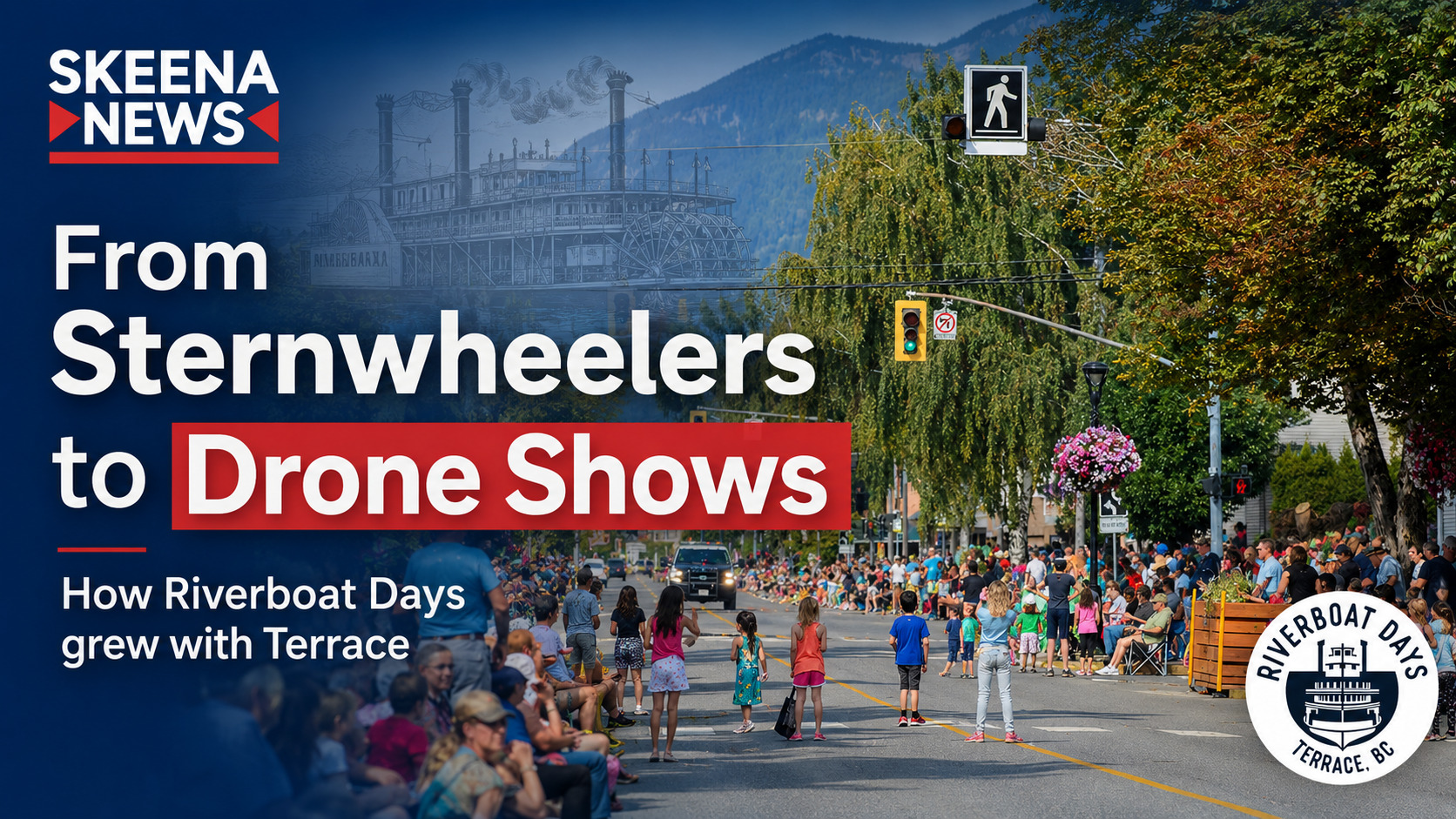
The Riverboat Days parade remained the festival’s most visible attraction, bringing together businesses, cultural associations, sports teams, public officials, community groups and generations of Terrace families.
Concerts in the Park turned George Little Park into a central gathering place for free public entertainment.
Sports became another major part of the festival. Basketball tournaments attracted teams from across British Columbia, while Beach Blast Volleyball transformed commercial parking areas into temporary sand courts.
The Rotary Duck Race became both a community spectacle and an important fundraiser. The City Council Pancake Breakfast brought residents, firefighters and elected officials together in an informal setting.
Church in the Park, car shows, children’s activities, markets, cultural performances and community barbecues added to the growing schedule.
Each event developed its own following, while collectively contributing to the identity of Riverboat Days.
The cannon that announces the celebration
One of the festival’s most distinctive traditions is the ceremonial cannon firing.
In the early 1990s, Ted Ramsey and Brian Lockhart constructed a large bronze replica mountain howitzer. The cannon, weighing approximately 600 pounds, became part of the opening ceremonies and one of the most recognizable symbols of Riverboat Days.
Its firing marks the official beginning of the celebration and connects the modern festival with the historical theme that inspired its creation.
Over time, however, Riverboat Days became about much more than sternwheelers.
The festival grew into a broader celebration of Terrace itself—its families, volunteers, athletes, artists, businesses, cultures and community organizations.
How Riverboat Days is supported
The modern festival depends on a combination of municipal assistance, sponsorships, grants, event revenues and volunteer labour.
The City of Terrace provides financial and operational support. Municipal crews assist with road closures, traffic barricades, park preparation, waste collection and other logistical requirements.
Emergency services, public works employees and volunteers all contribute to the safe operation of events.
The Regional District of Kitimat-Stikine has also participated in regional cost-sharing arrangements connected to community events and services.
Corporate sponsors support major public attractions, including concerts and nighttime displays. Tourism organizations and regional grant programs help with promotion and event delivery.
At the same time, many participating organizations finance their own activities through registrations, donations, sponsorships, vendor fees and fundraising.
The result is a festival supported not by a single budget, but by a network of public agencies, private sponsors and independent community organizations.
The exact cost of the first Riverboat Days is not available in the historical material reviewed, but its early structure was far simpler than the modern festival.
What began with volunteers, community organizations and local business support now requires extensive planning, insurance, traffic management, entertainment production, security coordination and municipal services.
A changing understanding of history
Riverboat Days was originally shaped around sternwheelers, pioneer settlement and the development of Terrace by non-Indigenous settlers.
That history remains part of the festival, but the way it is presented has evolved.
Terrace is located on the traditional territory of the Tsimshian people, particularly Kitsumkalum and Kitselas.
The history of the Skeena River did not begin with sternwheelers, railways or European settlement. Indigenous communities had lived, travelled, traded and harvested throughout the region for generations before those developments.
In recent years, Riverboat Days has included stronger First Nations participation through territorial welcomes, cultural performances, artists, community events and sponsorship.
Kitsumkalum has hosted its annual salmon barbecue and participated in festival programming.
In 2025, Kitselas master carver Stan Bevan was selected as a Riverboat Days ambassador, reflecting the festival’s movement toward a broader and more inclusive representation of the region.
The change mirrors a wider transformation in Terrace’s public identity.
Riverboat Days is no longer presented only as a celebration of pioneer history. It has become a gathering that increasingly reflects the Indigenous, multicultural and modern character of the community.
The pandemic interruption
Riverboat Days faced one of its greatest disruptions during the COVID-19 pandemic.
Large public gatherings were cancelled or restricted in 2020 and 2021, interrupting traditions that had continued for decades.
The festival returned to a full in-person schedule in 2022.
The recovery brought back the parade, concerts, sports tournaments and public gatherings, but it also exposed a continuing challenge: Riverboat Days depends heavily on volunteers.
In 2023, the organizing committee was operating with only a small number of active members. Public appeals were made for new volunteers to help protect the future of the festival.
The situation highlighted how much of Riverboat Days is built not only on funding and sponsorship, but on unpaid community work.
Every parade route, event schedule, tournament, breakfast and public gathering depends on people willing to organize, supervise and participate.
From fireworks to drones
The festival’s nighttime attractions have also changed.
For years, fireworks over Ferry Island were among the most popular Riverboat Days events.
More recently, drone-light shows have been introduced as an alternative.
The change reflects growing concern about wildfire danger, dry summer conditions, smoke and public safety.
Instead of fireworks, synchronized illuminated drones now create patterns and images in the night sky.
The technology is far removed from the modest outdoor entertainment of the early festival, but it demonstrates how Riverboat Days continues to adapt to changing conditions and public expectations.
Riverboat Days in 2026
The 56th Riverboat Days runs from July 31 to August 9, 2026, under the theme “Celebrate Terrace.”
The festival once again brings together traditional community events and newer forms of entertainment.
The parade is scheduled for August 1, although construction on the 4600 block of Lakelse Avenue has required a modified route through parts of downtown Terrace.
Opening ceremonies, the ceremonial cannon firing, Concerts in the Park, sports competitions, cultural events and community gatherings remain central to the program.
Queen tribute act Queen Flash is among the featured musical performers.
The schedule also includes newer activities such as Luna’s Pulse, a music and visual-arts event, and Catch the Current, a competitive dog-disc event.
The 2026 festival demonstrates how Riverboat Days has continued to expand beyond its original heritage theme while retaining familiar traditions.
Riverboat Days, then and now
In 1970, Riverboat Days was a three-day civic celebration in a community of approximately 10,000 residents.
In 2026, it is a 10-day regional festival involving dozens of events, multiple venues, public agencies, businesses, cultural groups, sports organizations and hundreds of volunteers.
The organization has evolved from an informal civic committee into an incorporated non-profit society.
The festival’s historical focus has broadened from sternwheelers and settler development to include Indigenous culture, multicultural participation, modern entertainment and contemporary community life.
The parade remains. The parks remain. The volunteers remain.
But the city surrounding them has changed.
Terrace is more connected, more diverse and more regionally important than it was when Riverboat Days began.
The festival has survived industrial downturns, population shifts, changing leadership, volunteer shortages, a global pandemic and growing environmental concerns.
Its endurance comes from its ability to evolve without abandoning the traditions that residents recognize.
More than five decades after its first parade, Riverboat Days remains a reflection of Terrace itself—a community shaped by history, strengthened by volunteers and continually redefining what it means to celebrate together.