






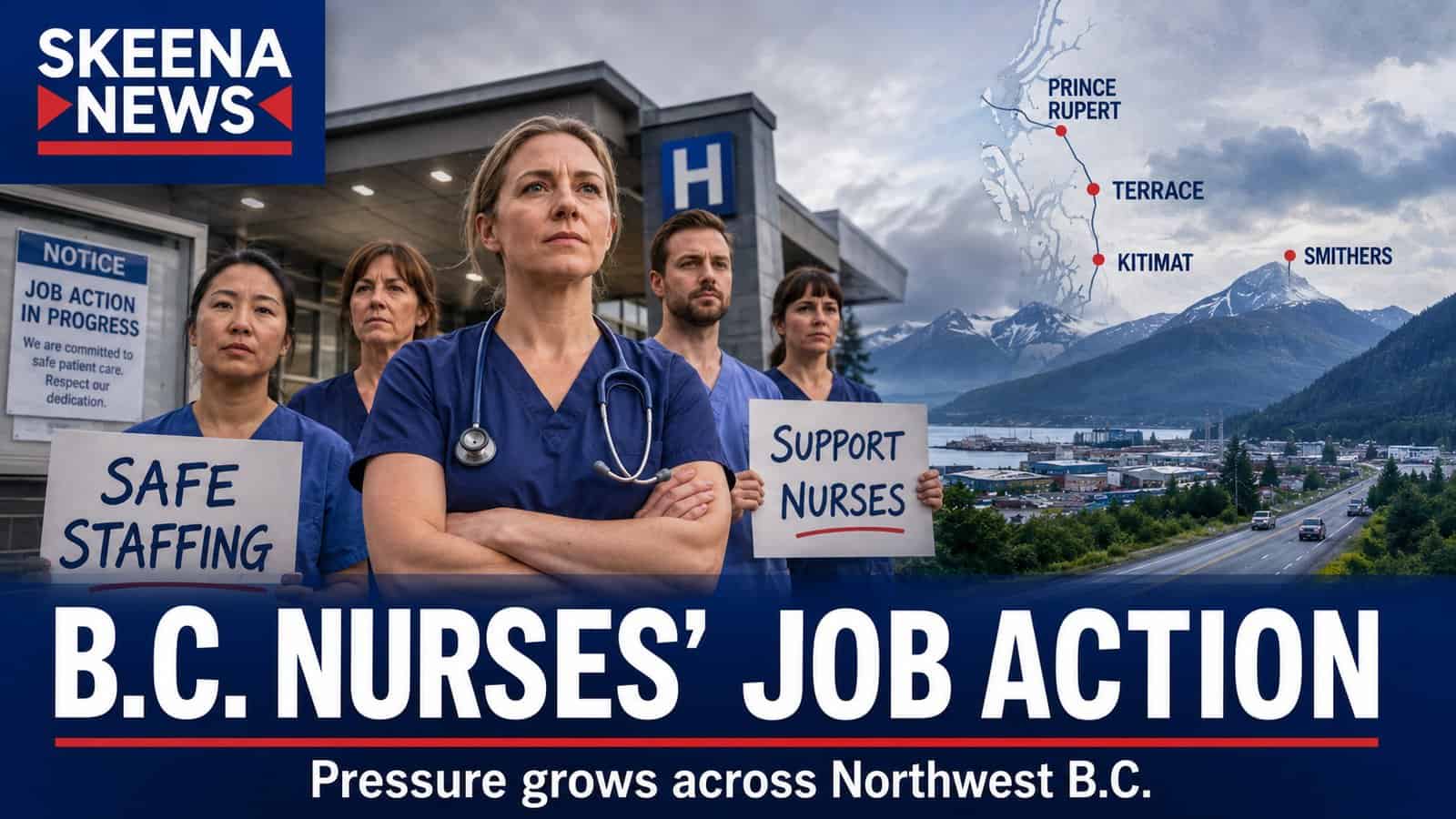
B.C. Nurses’ Job Action Exposes Fragile Health-Care Network Across Northwest B.C.
By Skeena News
A province-wide nurses’ job action is putting renewed attention on the fragile state of health-care delivery across Northwest British Columbia, where hospitals in Terrace, Kitimat, Prince Rupert and Smithers already operate under long-standing pressure from staffing shortages, overtime dependence and geographic isolation.
Nurses across British Columbia began targeted job action on Thursday, July 2, 2026, following the expiry of a 72-hour strike notice issued on June 29. The action followed a major strike mandate from members of the British Columbia Nurses’ Union and came after nurses rejected a tentative collective agreement in June.
The job action does not mean nurses are walking away from patient care. Essential service levels remain in place. But nurses are refusing non-essential overtime and non-nursing duties — work that often keeps hospitals running behind the scenes.
Those duties can include answering phones, moving patients, cleaning non-clinical areas, stocking supplies, delivering meal trays, collecting medications, and transporting items within a hospital.
In large urban hospitals, removing those duties may cause delays and backlogs. In Northwest B.C., where hospitals often have smaller teams and fewer backup staff, the impact can be much more serious.
Northwest B.C. has little room for disruption
Northern Health covers a vast region with scattered communities, long travel distances and limited staffing redundancy. When one hospital experiences a shortage, pressure can quickly move to another facility.
That is especially true in the Northwest Health Services Delivery Area, where Terrace, Kitimat, Prince Rupert and Smithers are closely connected. A disruption in one community can affect patient flow, emergency coverage, transfers, ambulance pressure and staff scheduling across the region.
The job action comes at a time when northern hospitals are already dealing with recruitment challenges, emergency department interruptions, workplace safety concerns and reliance on overtime or temporary staff.
For many residents, the issue is not abstract. In smaller communities, a temporary emergency department closure can mean a long drive to another hospital. For seniors, industrial workers, families with children and Indigenous communities, the distance can become a real health risk.
Terrace: regional hub under pressure
Terrace remains the main medical hub for much of Northwest B.C., serving residents from surrounding communities and supporting patient movement between the coast and the interior.
Mills Memorial Hospital has historically carried heavy regional pressure. As health services transition toward the new Ksyen Regional Hospital, the region is also dealing with recruitment challenges for specialized services.
One major concern is whether northern hospitals can recruit and retain enough specialized staff to fully operate expanded services, including advanced maternal and neonatal care. For families in the Northwest, local access to specialized care can mean avoiding emergency flights or long transfers to southern B.C.
The job action’s overtime limits could add pressure to an already stretched system. In a region where hospitals have often depended on staff working extra hours to cover gaps, even targeted overtime restrictions can make scheduling more difficult.
Terrace has also seen concerns around workplace safety. Nurses and health-care workers have repeatedly raised alarms about violence, burnout and the need for proper staffing and security support.
Kitimat: emergency access remains a major concern
In Kitimat, the stakes are especially high because the community is both geographically isolated and industrially important.
Kitimat General Hospital serves residents, seniors, families and workers connected to major industrial activity, including the aluminum sector and energy-related development. A fully functioning emergency department is critical in a community where industrial injuries, weather, highway distance and limited alternatives can all affect response times.
Kitimat residents have already expressed concern in recent years about emergency department interruptions and the possibility of patients being diverted to Terrace. For someone facing a serious injury, stroke, heart issue or other emergency, the extra travel time can matter.
The nurses’ job action does not directly close emergency rooms. But it highlights how vulnerable small hospitals can be when staffing levels are already thin. If overtime is restricted and nurses stop filling gaps outside their professional duties, managers and support staff must absorb more pressure.
That can create delays in patient movement, room turnover, supply management and communication — all of which can affect how quickly care is delivered.
Prince Rupert: high-volume hospital with limited capacity
Prince Rupert Regional Hospital is another key facility in the Northwest corridor. The hospital serves a port city and surrounding communities, with emergency demand that can be difficult to manage when staffing is unstable.
Prince Rupert’s location makes health-care reliability especially important. Patients cannot simply access another full-service hospital nearby. Transfers can require long road travel, ambulance coordination, air transport or movement through Terrace.
In a small hospital, the loss of non-essential overtime or informal extra duties can quickly expose how much the system depends on nurses doing more than direct nursing work.
When nurses stop performing non-nursing tasks, those responsibilities do not disappear. They move to clerks, porters, housekeeping, dietary staff, managers or other support workers. If those workers are unavailable, the delay moves back into patient care.
That is the central problem now being exposed across northern B.C.: the health-care system has often relied on nurses to cover cracks that belong to the system itself.
Smithers and the Bulkley Valley: rural pressure beyond hospital walls
Smithers and the Bulkley Valley face a different but connected challenge.
Health care in rural communities depends not only on hospital beds and emergency rooms, but also on public health, home visits, community clinics, mental health services and primary care networks.
When nurses are limited by overtime restrictions, pressure may not only appear inside hospitals. It can also affect outreach, community-based care and follow-up services.
For communities such as Smithers, Houston, Telkwa and Witset, any reduction in health-care flexibility can push more patients toward acute care. That means people who might have been supported earlier in the community may end up needing hospital attention later.
In rural health systems, small delays can snowball.
What nurses are trying to highlight
The nurses’ union says the job action is about more than wages. It is about workload, safety, staffing, burnout and the long-term sustainability of public health care.
Nurses have argued that too many hospitals rely on overtime, temporary staff and unsafe workloads instead of building stable permanent teams. The rejected tentative agreement included wage increases and commitments related to nurse-to-patient ratios, but many members said the proposal did not go far enough to address conditions on the front line.
The job action is designed to create pressure without abandoning essential patient care.
By refusing non-nursing duties, nurses are forcing health authorities to confront how often nurses are used to fill gaps in clerical work, transport, cleaning, food delivery and supply movement.
By limiting non-essential overtime, they are also highlighting how dependent the system has become on nurses working beyond regular schedules.
Support staff may also feel the impact
The job action could also increase pressure on other hospital workers.
If nurses stop doing non-nursing duties, those tasks may shift to other employees, including clerks, care aides, housekeeping staff, porters, dietary workers and managers. In larger hospitals, there may be more staff available to absorb the work. In smaller northern hospitals, support staff are often limited, especially overnight and on weekends.
That means the same hospital may still have to move patients, clean spaces, deliver meals, handle supplies and answer phones — but with fewer people available to do it.
The risk is that delays build up across the entire facility.
A patient may wait longer to be moved. A room may take longer to turn over. A medication pickup may be delayed. A phone call may not be answered as quickly. A nurse may still be focused on essential clinical care, but the surrounding system slows down.
Workplace violence remains a serious concern
Workplace safety is another major issue in the dispute.
Nurses across B.C. have raised concerns about violence, aggression and unsafe conditions in emergency departments, psychiatric units and high-stress clinical settings. Those risks can become worse when wait times increase, staffing levels drop or frustrated patients and families face longer delays.
In northern hospitals, the issue can be even sharper because not every facility has the same security coverage available in larger centres.
Smaller hospitals may have fewer guards, fewer specialized teams and fewer backup options when a situation escalates. Nurses can be left managing aggressive, intoxicated or unstable patients while also trying to care for others.
The job action could temporarily increase some of those pressures by slowing non-clinical workflow. That is part of the difficult reality of labour disruption in health care: the same action meant to protest unsafe working conditions can also expose how unsafe the system already is.
Rural recruitment incentives are not enough
The province and health authorities have tried different recruitment and retention tools for rural and remote communities, including signing bonuses, travel-nurse programs and rural retention incentives.
Those programs may help in the short term. But the deeper concern is whether they are enough to build permanent, stable teams in the North.
Temporary staff can fill gaps, but they do not replace long-term local nurses who understand the community, the hospital and the region. Heavy reliance on overtime and travel nurses can also create resentment among permanent staff who feel undervalued while carrying the system every day.
For Northwest B.C., long-term stability means more than bonuses. It means housing, safe workplaces, manageable workloads, permanent positions, training pathways, support for families, and real reasons for nurses to stay in northern communities.
A regional warning sign
The B.C. nurses’ job action is not only a labour story. In Northwest B.C., it is a warning sign about the structure of rural health care.
Terrace, Kitimat, Prince Rupert and Smithers are not isolated cases. They are part of one connected regional network. When one hospital is short-staffed, other communities feel it. When one emergency department diverts patients, another facility absorbs the pressure. When nurses burn out, entire communities become more vulnerable.
The current dispute has exposed a basic problem: northern health care has very little spare capacity.
If hospitals depend on overtime to function normally, then overtime is no longer extra — it has become part of the core system. If nurses are regularly expected to perform non-nursing duties, then the system is masking shortages in support services. If emergency departments can be destabilized by staffing gaps, then communities are living with risk long before any strike notice is issued.
What happens next matters for the Northwest
For patients, the immediate message is to continue using emergency services when needed and to follow official updates from Northern Health, hospitals and health-care providers.
For government and health authorities, the message from the North is harder to ignore: rural and remote health care cannot be stabilized with temporary fixes alone.
The Northwest needs a durable plan for permanent staffing, safer workplaces, emergency department reliability, support staff coverage and recruitment that reflects the realities of distance, weather, housing and industrial risk.
For nurses, the job action is a way to force those issues back into the public conversation.
For residents in Terrace, Kitimat, Prince Rupert, Smithers and surrounding communities, the concern is simple: when someone needs urgent care, the system must be ready.
The current labour dispute has shown just how fragile that promise has become.