





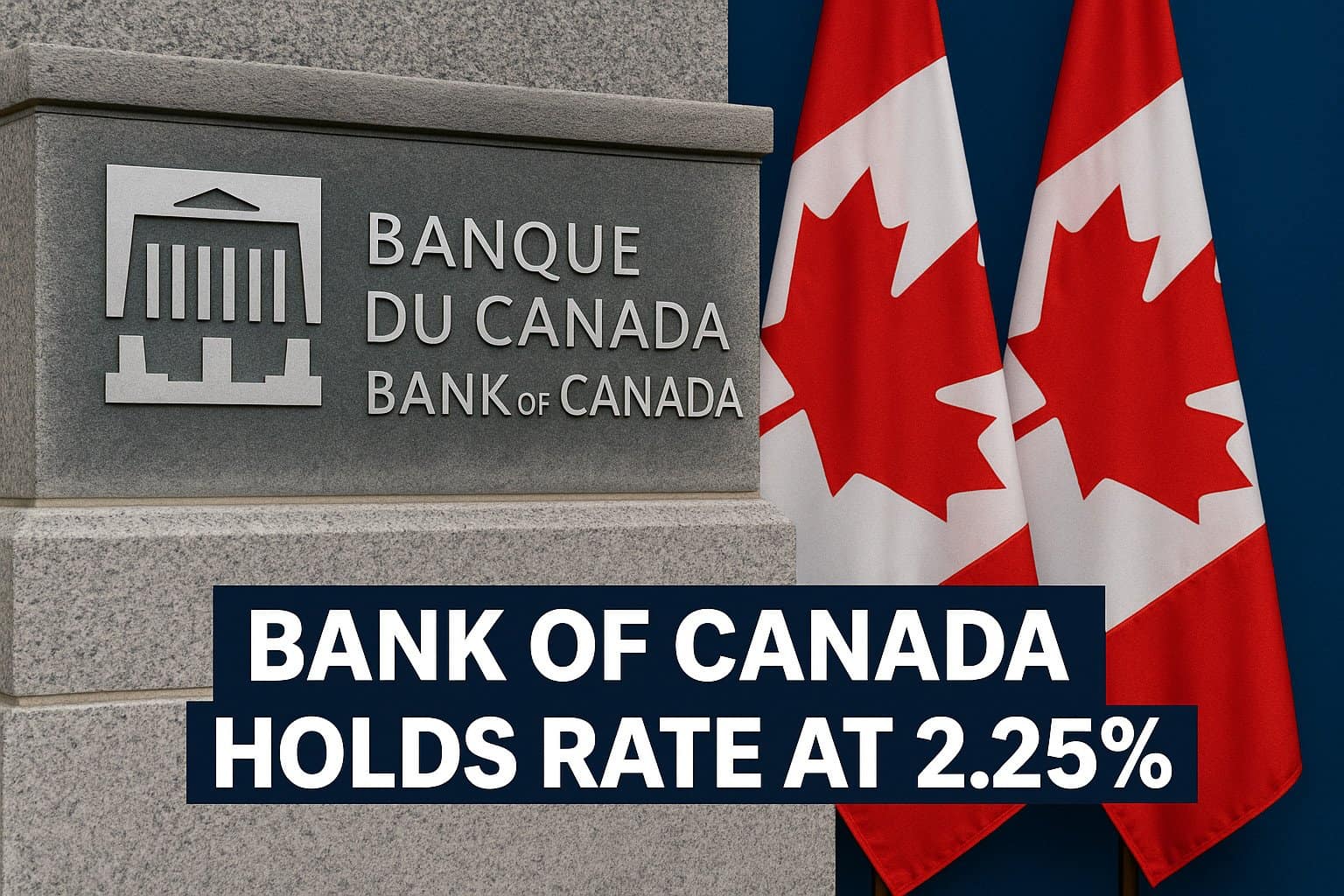
OTTAWA – The Bank of Canada (BoC) held its key policy rate steady at 2.25% on Wednesday, concluding its final monetary policy decision of 2025. This widely expected move comes as Governor Tiff Macklem stated the Canadian economy is proving to be “resilient overall” to the disruptive effects of U.S. trade measures.
Despite tariffs between 25% and 50% on critical sectors like cars, lumber, aluminum, and steel, recent data has surprised to the upside:
- GDP Growth: Third-quarter annualized GDP grew by a “surprisingly strong” 2.6%.
- Employment: The economy added a solid 181,000 new jobs between September and November, helping the unemployment rate decline to 6.5%.
“It’s been a difficult year for Canadians and Canadian businesses. But as the year is closing, it’s looking better than it looked in the spring, in the summer,” Macklem said during a press conference.
Rates Deemed ‘About Right’ for Structural Shift
Macklem said that the current policy rate of 2.25%—which is at the lower end of the neutral range—is “about the right level to keep inflation close to 2% while helping the economy through this period of structural adjustment”. He acknowledged that the trade friction means the economy works less efficiently, but emphasized that monetary policy can help the economy adjust as long as inflation is well controlled.
While inflation slowed to 2.2% in October, measures of core inflation, which strip out volatile components, have remained higher, staying in the range of 2.5% to 3%.
Senior Deputy Governor Carolyn Rogers acknowledged that while inflation has remained largely at target, Canadians have struggled with affordability, particularly high food and shelter costs. Macklem said the Bank expects ongoing economic slack to roughly offset cost pressures associated with trade reconfiguration, keeping CPI inflation close to the 2% target.
Outlook for 2026
The Bank expects the robust growth from the third quarter, largely driven by trade volatility, to ease, with GDP growth likely to be weak in the fourth quarter. However, Macklem reiterated that the recent data has “not changed our view that GDP will expand at a moderate pace in 2026 and inflation will remain close to target”.
Uncertainty remains high due to the unpredictability of U.S. trade policy, including the upcoming review of the Canada-United States-Mexico Agreement. Macklem stressed that if the outlook changes, the bank is prepared to respond.
Following the decision, the Canadian dollar weakened slightly, trading down 0.13% against the U.S. dollar. Economists expect the BoC will be “on hold for quite some time”.