




TERRACE, B.C. – The political uncertainty gripping the country has concluded for now. The Liberal minority government survived the critical confidence vote on the 2025 federal budget late Monday, November 17th, successfully fending off the push for a snap election championed by Conservative MPs, including Skeena—Bulkley Valley’s Ellis Ross.
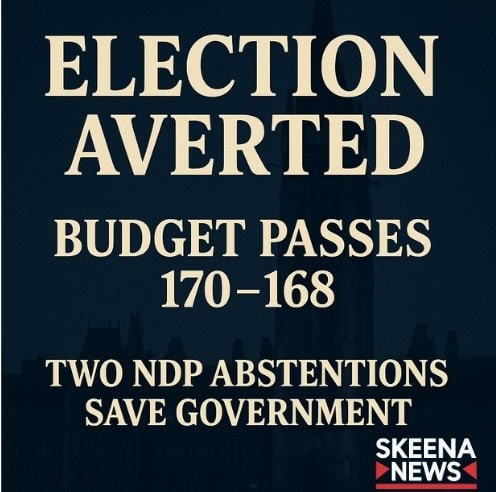
The budget passed with a razor-thin margin of 170 votes to 168, a result that averts the constitutional requirement for the dissolution of Parliament and a Christmastime election.
MP Ross’s Non-Confidence Bid Defeated
Following his decisive “Yea” vote last week on a preliminary motion to reject the budget, MP Ellis Ross followed through on his party’s commitment, formally casting a “No” vote against the final budget bill. The vote, which was deemed the ultimate test of confidence, confirmed the Conservative Party’s unified position that the government’s fiscal plan should be rejected in favor of a new mandate.
The collective effort by the 168 Conservatives, Bloc Québécois, and the majority of New Democrats to defeat the government was ultimately thwarted by a strategic surrender from within the opposition ranks.
The Strategic Vote That Saved the Government
The survival of Prime Minister Mark Carney’s government was secured not by widespread support, but by strategic abstention. The 170-168 result meant the government was saved by two crucial votes.
The New Democratic Party (NDP) executed the ultimate display of political calculation:
- The vast majority of the NDP caucus voted AGAINST the budget on policy grounds, joining the 168 non-confidence votes.
- However, two NDP MPs, Lori Idlout and Gord Johns, intentionally abstained from voting.
Interim NDP Leader Don Davies confirmed this was a deliberate, tactical choice immediately after the vote.
“The consequences of defeating this budget would not be to improve it or to help Canadians. It would be to plunge the country into an election only months after the last one,” Davies stated, confirming the party chose parliamentary stability over forcing an election they did not want.
The two NDP abstentions, coupled with abstentions from two Conservative MPs, reduced the opposition’s potential voting strength just enough to ensure the 170 “Yes” votes—cast by the Liberals and Green Party Leader Elizabeth May—secured the victory.
Instability is the New Status Quo
For the Skeena—Bulkley Valley riding, the result means that the high-stakes political environment that defined the budget crisis will continue. The survival of the Liberal government does not signal a return to stability; rather, it solidifies a highly transactional model of governance.
While MP Ross’s push for an immediate election failed, the vote confirms that Parliament remains fundamentally unstable. The government must now continue to govern with the smallest possible margin, knowing every major piece of future legislation will be negotiated under the constant threat of a non-confidence vote, a dynamic that will persist until the next federal election.