





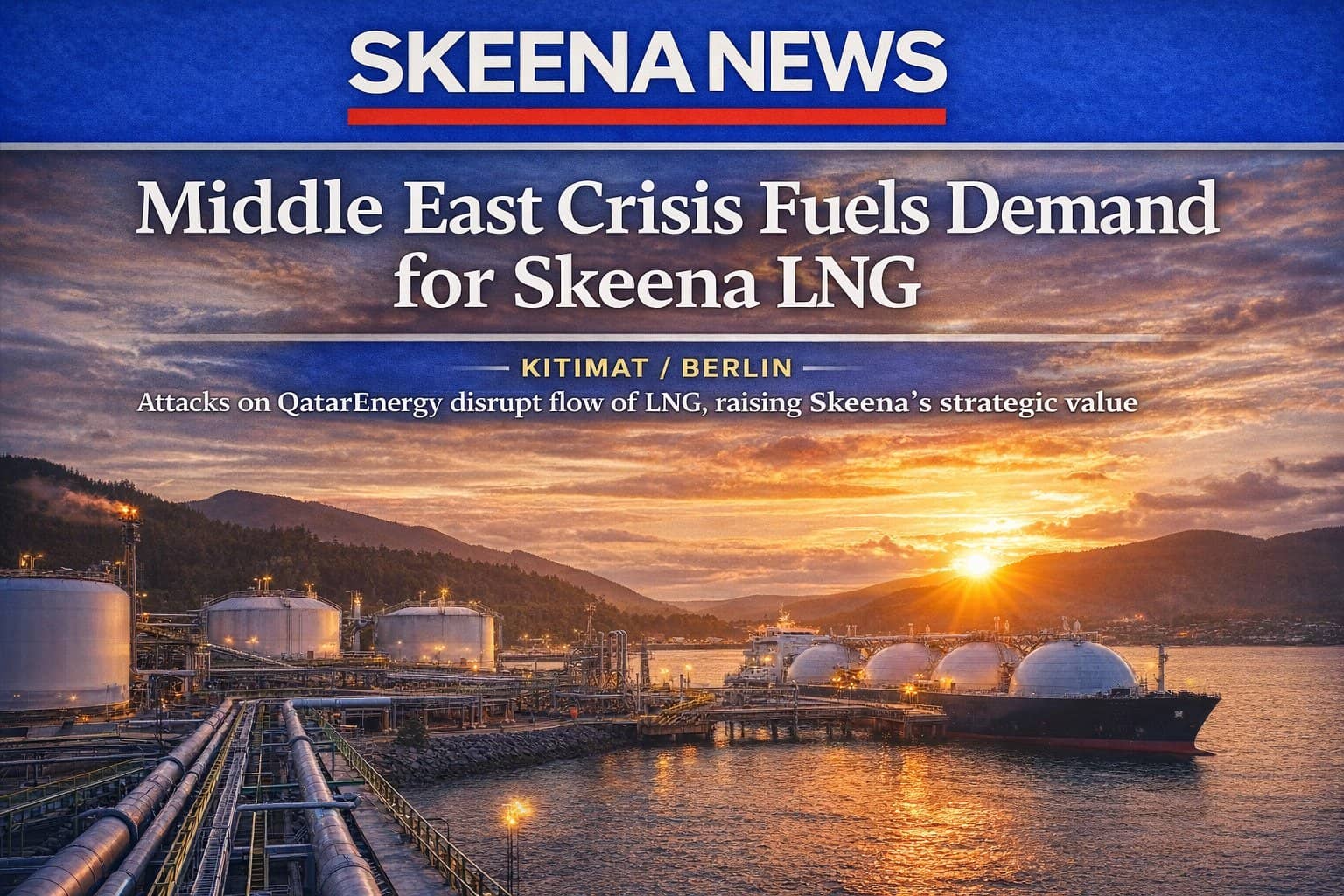
KITIMAT / BERLIN — The geopolitical landscape of the Middle East underwent a seismic shift this week, sending shockwaves through global energy markets and inadvertently positioning Northern B.C. as a critical “security dividend” for the West.
On March 3 and 4, 2026, global energy analysts reacted to a coordinated Iranian drone attack on QatarEnergy facilities in Ras Laffan and Mesaieed. Combined with a shipping crisis in the Strait of Hormuz—a chokepoint for 20% of global LNG—these events have triggered a massive surge in European gas prices and a fundamental rethink of energy sourcing.
The Qatari Disruption – A Catalyst for Canada
The attack on Ras Laffan, the world’s largest single LNG complex, forced Qatar to declare force majeure and temporarily suspend production.
While the immediate impact on LNG Canada’s operations in Kitimat is limited due to fixed-volume contracts, the regional consensus is that these events are a “huge positive and a green flag” for the approval of Phase 2 of the project. Buyers in Asia and Europe are increasingly desperate for a “straight shot” supply from a stable partner that does not rely on vulnerable maritime chokepoints like the Suez Canal or Hormuz.
The “Berlin Pitch” Poilievre’s Vision for Canadian Energy
The geopolitical crisis became the centerpiece of Conservative Leader Pierre Poilievre’s speech in Berlin on March 4, 2026. Addressing the Konrad Adenauer Foundation, Poilievre pitched Canada as the ultimate reliable alternative to “less stable suppliers”.
Key Proposals from the Berlin Speech:
- Binding Supply Agreement: A proposal for a direct natural gas pact between Canada and Germany.
- Expedited Infrastructure: A commitment to slash “red tape” to speed up the construction of pipelines and East Coast export terminals.
- Resource Stockpiling: A plan for an allied “emergency pact” to share critical minerals and energy during times of war.
Poilievre’s rhetoric aligns with a growing provincial strategy to market the Skeena region as a “haven of energy sovereignty” in a volatile world.
Technological Leadership: The Woodfibre Benchmark
While global politics dictate the demand, B.C. is attempting to set the standard for how that gas is produced. The Woodfibre LNG project near Squamish is being cited as the technological benchmark for the region.
By utilizing electric-drive compressors powered by BC Hydro’s renewable grid, the facility aims for a carbon intensity of just 0.04 tonnes of CO2e per tonne of LNG. This is nearly 14 times lower than conventional gas-fired plants and sets a precedent for the eventual electrification of LNG Canada Phase 2 and Cedar LNG.
LNG Market Profile: Global vs. Local (March 2026)
| Factor | Middle East Status | B.C. / Skeena Status |
| Supply Reliability | Volatile (Drone attacks/Blockades) | Stable (Direct Pacific route) |
| Price Trend | +70% surge in European spot prices | Long-term contract stability |
| Carbon Profile | Variable (Gas-fired liquefaction) | Targeting 0.04 CO2e/t (E-drive) |
| Growth Potential | Saturated/High risk | “Green flag” for expansion |
As the “security dividend” of Canadian energy becomes undeniable, the Skeena region finds itself at the center of a global energy reversal: moving from a localized resource hub to a vital pillar of international stability.