






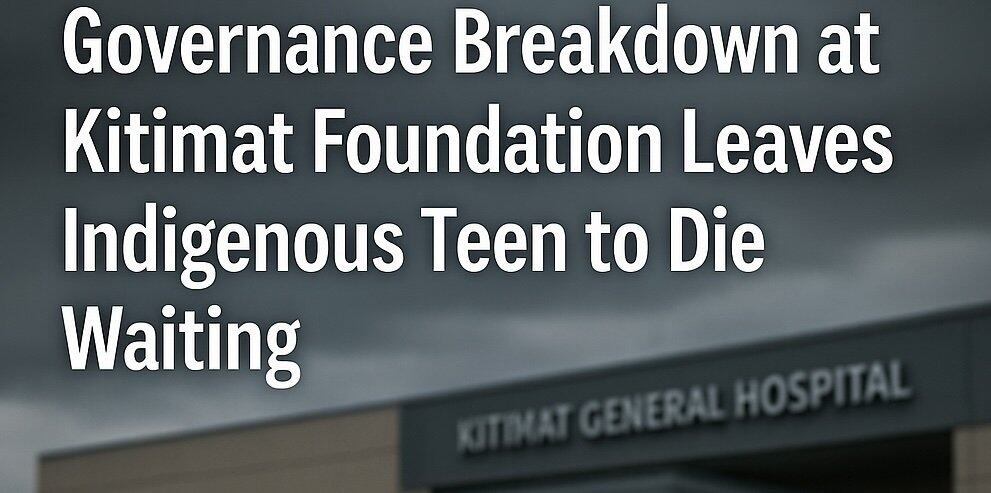
KITIMAT, B.C. — The heartbreaking death of a 17-year-old Indigenous resident of Kitimat, has exposed a deep crisis of governance and accountability in Northern B.C., raising devastating questions about whose lives are valued by the institutions responsible for protecting them.
The teen, died in the emergency room of Kitimat General Hospital in October 2025. He had waited nearly five hours for a diagnostic CT scan that could not be performed locally because Kitimat’s new $4.7 million CT scanner — fully funded months earlier — remained non-operational. His death, which Skeena MLA Claire Rattée has described as “entirely preventable,” occurred amid a months-long administrative stall on a critical, community-funded healthcare project.
“A mother lost her son because the system failed him at every stage,” said MLA Claire Rattée, the Conservative Opposition Critic for Mental Health and Addictions. “How many more people have to die before this government gets the CT scanner running in Kitimat?”
The Fatal Five-Hour Delay on Haisla Territory
On the night he died, the teen arrived at the Kitimat General Hospital at 5:10 p.m. His condition deteriorated rapidly into a life-threatening emergency. Despite this, the CT scan was not ordered until nearly five hours later.
Because the community-funded scanner remained non-operational, staff were forced to arrange a Priority 1 transfer to Terrace. When no ambulance was available in Kitimat, the delay became fatal: The teen died on the gurney moments before the delayed transport could even begin.
Governance Concerns and Concentration of Power
The circumstances surrounding the scanner delay have intensified scrutiny of Kitimat’s unusual governance structure. The Kitimat General Hospital Foundation (KGHF), which oversees health fundraising and infrastructure initiatives, is led by the same individual who simultaneously serves as Executive Director of the Kitimat Chamber of Commerce.
This dual-role arrangement — blending business-sector advocacy with oversight of life-saving medical infrastructure — is uncommon in British Columbia and has raised concerns about mandate alignment, administrative capacity, and oversight.
The nine-month delay in finalizing the CT scanner agreement with Northern Health occurred under this governance structure. While no official findings have attributed responsibility, the overlap between the two roles has prompted questions about whether governance capacity contributed to the prolonged stall.
Indigenous Exclusion in Health Governance
The teen death on Haisla Territory also highlights longstanding concerns about Indigenous exclusion in decision-making related to local healthcare infrastructure.
Publicly available information indicates that the KGHF board does not include Haisla or Indigenous representation, despite overseeing major health projects in an Indigenous-majority region. This absence has raised concerns that administrative decisions affecting local health services did not include perspectives from the community most impacted by delays.
Calls for Inquiry and Accountability
MLA Claire Rattée has called for a full, independent public inquiry into both Vincent’s death and the delayed CT scanner project. She has also urged a forensic audit of the KGHF’s governance model and project timeline, arguing that the public deserves clarity on how a fully funded scanner remained unavailable during a life-or-death emergency.
The tragedy has renewed scrutiny of rural healthcare infrastructure, emergency transport capacity, and the structural inequities that continue to affect Indigenous families in Northern B.C.




14 Comments
This is an extremely misleading article. Hospital Foundations operate at arms length from provincial health authorities. Simply put, Hospital foundations are mandated to only raise funds for equipment purchases. They have no control in regards to deployment. Any delays after funds are raised fall squarely on our government.
Thank you for giving the community a voice. This story really needs attention.
It’s sad that a tragedy had to happen before people pay attention. We need early intervention.
Important story. Many people in the region will want to read this.
The system clearly failed here. I hope proper steps are taken moving forward.
I’m glad this is being talked about. Silence won’t solve anything.
This article shows how important transparency is. Keep reporting on these issues.
This is really worrying. I hope the people responsible take this seriously and fix the system.
Thanks for the update. The community needs to know things like this so we can improve.
Very sad story. We need better leadership to prevent things like this from happening again.
I appreciate the writer for bringing this to light. Good journalism matters.
This is heartbreaking and infuriating. A fully funded CT scanner sitting unused while a young life was lost? Someone needs to be held accountable. This should never happen in a province like B.C.
Indigenous families have been saying for YEARS that we’re excluded from decision-making. Now a young person is gone because nobody listened. This tragedy is part of a bigger pattern. We need Indigenous voices on every board that affects our communities.
As someone who works in healthcare, the system failures described here are shocking. Five hours for a scan and no ambulance available? That’s not just a delay—that’s a collapse in emergency response.