




TERRACE, B.C. – The final vote on the federal budget, set for Monday, November 17, represents the most critical test of confidence since the termination of the Confidence and Supply Agreement (CASA) in September 2024 . The outcome will determine if Prime Minister Mark Carney’s minority government survives or if a snap election will be triggered, a constitutional consequence of defeating a “matter of confidence” like the budget .
The Skeena—Bulkley Valley riding is directly implicated in this national drama, as local Member of Parliament Ellis Ross, a Conservative, has formally voted to reject the government’s fiscal plan.
The Vote – MP Ross’s Non-Confidence Stance
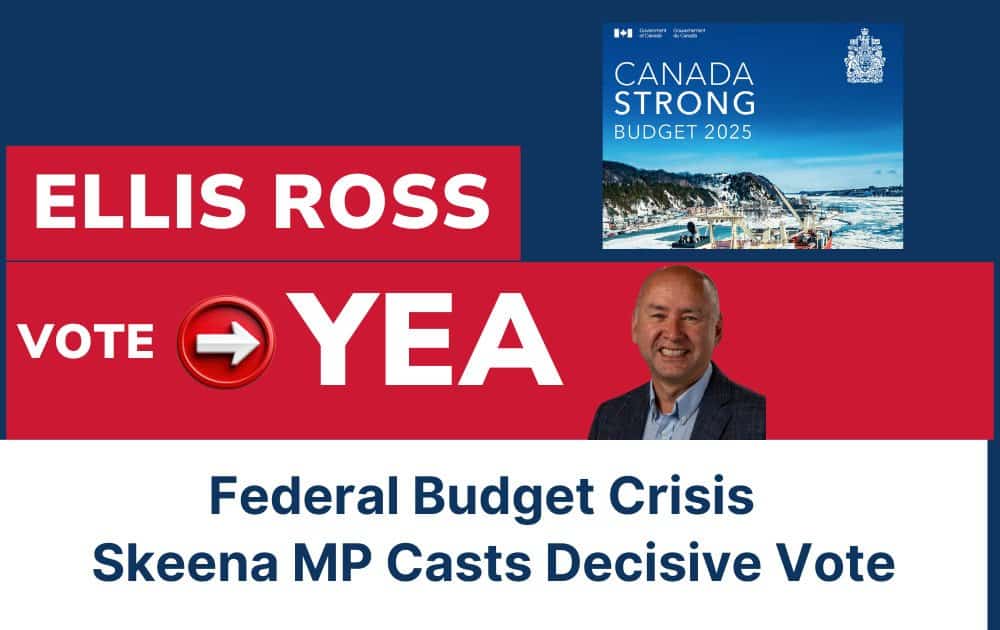
The tension escalated last Thursday when the Conservative Party used a procedural measure to challenge the budget’s survival. MP Ross cast a decisive “Yea” vote on a sub-amendment that explicitly called on the House of Commons to “reject the government’s budget”.
This vote, which is confirmed by official parliamentary records , was against a motion that the Liberal government had explicitly declared a “matter of confidence”. For the Conservative Party of Canada (CPC), a “Yea” vote was an attempt to force the dissolution of Parliament, leading to an election .
Local Economic Rationale for Rejection
The local Conservative MP’s position is consistent with his party’s fierce economic opposition to the budget. The Conservative Party is unified in its critique, arguing the government’s fiscal plan exacerbates economic problems through massive deficits, high taxation, and onerous regulation.
The party asserts that the budget fails to deliver “an affordable life” for Canadians and ignores the need for job creation, critiques that often resonate strongly in resource-based regions like Skeena—Bulkley Valley. Ross’s formal vote to reject the plan aligns with the Conservative strategy that only a change in government can fix the perceived economic malaise.
The Backroom Battle for Survival
The ultimate fate of the government now rests on the New Democratic Party (NDP), which ended its formal support agreement (CASA) earlier this year. The minority Liberal government has conceded it “don’t have the votes” to pass the budget on its own.
The NDP holds the deciding votes and is leveraging this crisis to extract last-minute concessions—such as increased funding for healthcare, seniors, and climate action. Interim NDP Leader Don Davies confirmed the caucus has “not yet made a determination on how we will vote on the main budget on November 17”.
However, the NDP faces a significant strategic dilemma:
- Policy Gain: They must secure tangible wins to justify supporting the budget.
- Electoral Risk: They must avoid triggering a snap election that could potentially lead to a majority Conservative government, which the NDP leadership has called the “greatest threat to middle class Canadians” due to promised cuts.
This tension has resulted in the NDP and the Bloc Québécois (BQ) voting with the Liberals to defeat the earlier Conservative challenge—a strategic alignment that demonstrated a preference for sustaining the current government over risking a Conservative election victory .
High Stakes and Local Readiness
The political risk is significant. While real-time prediction markets place the fluctuating odds of an election being called before the end of 2025 at a low, volatile range of 12 percent to 20 percent , a defeat on the budget would lead to immediate political uncertainty. Furthermore, public opinion polls indicate that Canadians overwhelmingly reject the idea of opposition parties forcing an election.
Despite the low probability of collapse, the high-stakes maneuver in Ottawa is already reflected in the Skeena—Bulkley Valley riding. The Liberal Party has moved to acclaim its candidate, Inderpal Dhillon, for the riding, signaling local readiness for a snap campaign should the budget fail .
The final budget vote tomorrow is a demonstration of the razor-thin margin of support the government commands. It represents a direct political stand by the local MP, Ellis Ross, to reject the government’s mandate, with the fate of the federal government hanging on the outcome of last-minute political negotiations.