





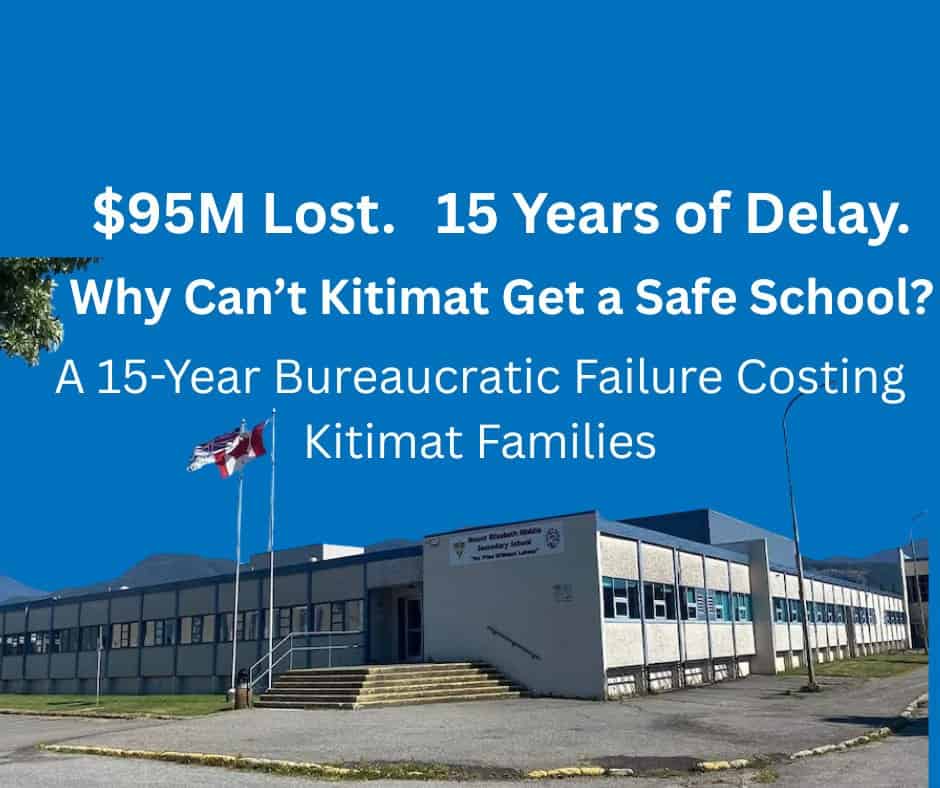
KITIMAT, B.C. – The infrastructure crisis at Mount Elizabeth Middle Secondary School (MEMSS) in Kitimat has escalated into a case study in provincial fiscal irresponsibility, with systematic delays over the past 15 years resulting in a staggering $95 million financial penalty to taxpayers.
The Coast Mountains School District 82 (CMSD82) has relentlessly advocated for renewal since 2010. The cost for a partial replacement in 2020 was an estimated $33 million. The district is now requesting $128 million for essential seismic upgrades—a direct measure of the cost inflation and scope creep caused by chronic bureaucratic denial.
From Policy Risk to Active Structural Emergency
The school’s condition transitioned from a theoretical seismic risk to an active structural emergency in September 2024 with the discovery of settlement beneath Room 104. This fundamental structural defect forced the partial closure of the academic wing, immediately validating the district’s persistent warnings.
The history of the crisis is a detailed chronicle of local foresight being systematically overruled:
- 2010–2016: MEMSS was submitted as the district’s top capital priority for six consecutive years following a confirmed seismic assessment. All submissions were denied by the Ministry of Education.
- 2020: CMSD82 requested $33 million for a partial replacement; the request was denied.
- 2023: The request hit $112 million before the Ministry finally approved a preliminary seismic assessment—years after the district had flagged the risk.
- July 2025: The current comprehensive request of $128 million for seismic upgrades was submitted and is still awaiting a ministerial reply.
Even if the $128 million is approved immediately, expert analysis suggests the necessary design and construction phases will require a minimum of four to six years, guaranteeing prolonged uncertainty and stress for the community and staff.
The Extraction Paradox – $40 Billion vs. a Safe School
The sustained neglect of MEMSS highlights a fundamental political disconnect. Kitimat is one of British Columbia’s most vital economic engines, hosting the $40 billion LNG Canada complex—the largest single private-sector investment in Canadian history—and contributing 75.64% of the municipality’s property tax revenue from Major Industry.
The failure to fund a safe school for the families who support this massive industrial wealth exposes a systemic issue of regional equity. The quantifiable economic loss of $95 million is a direct consequence of bureaucratic indecision, reinforcing the local perception that the province prioritizes industrial capital over social capital.
Furthermore, the operational strain is mounting. The Parent Advisory Council (PAC) has voiced concerns that the crisis is contributing to a feared exodus of experienced teaching staff, adding the quantifiable erosion of local educational capacity to the list of costs imposed by provincial delay.
CMSD82, led by Board Chair Margaret Warcup, continues to await the Ministry of Education and Child Care’s response, even as the risk to students and the financial penalty to the provincial treasury escalate.